Financial Restructuring in M&A Transactions and Capital Transfers in Vietnam: A Successful Case Study by IVLF Advisors LLC
Financial restructuring in mergers and acquisitions (M&A) transactions or capital transfers in Vietnam often presents a significant challenge: resolving outstanding financial obligations among former shareholders, new investors, and related business partners. In such circumstances, engaging a reputable financial restructuring and debt resolution advisor is a strategic decision that enables businesses to remove cash flow bottlenecks while ensuring compliance with Vietnam’s foreign exchange control and payment regulations.

Recently, IVLF Advisors LLC successfully designed and implemented a comprehensive debt settlement and financial restructuring solution for a Korean-invested foreign direct investment (FDI) enterprise headquartered in Hai Duong Province (hereinafter referred to as Company V). The restructuring project enabled the company to establish a clean financial position following its capital transfer transaction.
1. Transaction Background and Financial Restructuring Requirements
Company V was originally established as a wholly foreign-owned enterprise (100% foreign-invested company) by a Korean corporate investor (hereinafter referred to as Company K). Recently, Company K transferred its entire 100% equity interest to a Vietnamese individual investor (hereinafter referred to as Mr. D). However, when IVLF Advisors LLC was engaged, the purchase price for the capital transfer had not yet been fully settled through the investment capital account as required under Vietnamese regulations.
IVLF Advisors LLC Advises on Financial Restructuring and Multi-Party Debt Settlement
Beyond the incomplete capital transfer payment, Company V was also involved in an exceptionally complex network of interrelated financial transactions involving Company K and a third-party business partner (hereinafter referred to as Company B). The circumstances required a comprehensive financial restructuring strategy to address the following obligations:
- Offshore Loan: Company K (South Korea) had extended a short-term shareholder loan to Company V to support its operating activities.
- Project Security Deposit: Company V had paid Company B a substantial deposit to secure the performance of a land leveling contract for a development project.
- Partner Loan: Company V had also received an interest-free short-term loan from Company B.
- Third-Party Advance Payment: The most complicated transaction involved Company B advancing a significant amount of cash on behalf of Company V to an individual (hereinafter referred to as Ms. H) for the acquisition of land use rights intended for the project.
2. Challenges During the Financial Restructuring Process
Given the intertwined network of loans, deposits, reimbursements, and cash advances, the company faced significant risks relating to cash flow management, financial reporting, foreign exchange compliance, and regulatory requirements.
Recognizing the complexity of the matter, Company B appointed IVLF Advisors LLC to develop a comprehensive restructuring solution.
The assignment required our advisory team to redesign and coordinate the payment structure among five parties:
- Company B
- Company V
- Company K
- Mr. D
- Ms. H
The primary objective was to establish a legally compliant mechanism for offsetting, settling, and discharging all outstanding obligations while ensuring full compliance with Vietnam’s regulations governing investment, foreign exchange management, cash flow, accounting, and taxation.
3. IVLF Advisors LLC’s Solution: Streamlining Cash Flow and Enhancing Transaction Transparency
Acting as an independent financial advisory firm, our team conducted a detailed review of every historical transaction involved in the case.
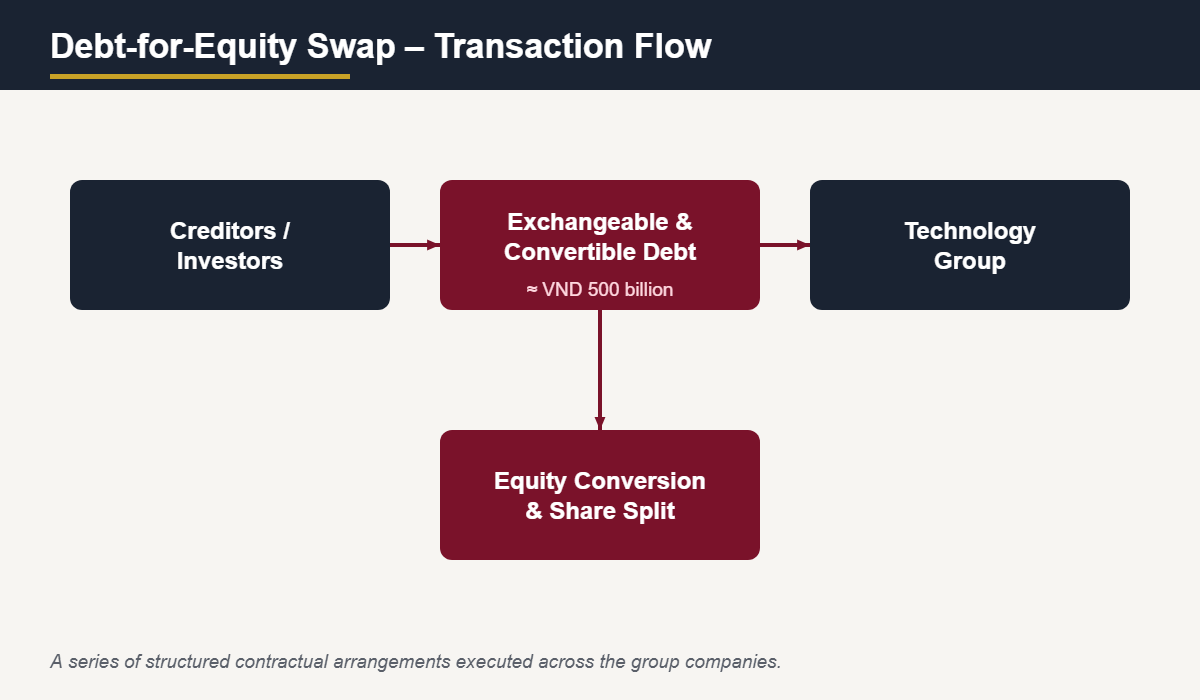
By carefully identifying the legal and commercial nature of each payment—distinguishing shareholder loans, commercial deposits, third-party reimbursements, and conditional advance payments—we successfully designed a multi-party debt offset mechanism that reconciled all outstanding financial obligations.

Our financial restructuring solution enabled the parties to settle substantial liabilities through legally recognized debt offset arrangements, significantly reducing the need for multiple physical fund transfers.
In addition, IVLF Advisors LLC provided detailed guidance on completing the documentation required for settlement through the investment capital account, thereby ensuring that the original equity transfer between Mr. D and Company K complied with applicable Vietnamese regulations.
Through our timely intervention and technically sound advisory services, IVLF Advisors LLC successfully helped the client:
- Eliminate complex outstanding financial obligations;
- Clean up its balance sheet following the ownership transfer;
- Restore transparent and compliant cash flow management;
- Ensure compliance with Vietnamese investment, foreign exchange, accounting, and tax regulations; and
- Enable management to refocus resources on project development and land preparation activities.
Is Your Business Facing Complex Debt Issues in an M&A Transaction?
Financial transparency is the cornerstone of sustainable business growth.
If your company is facing complicated debt settlement issues, post-acquisition financial restructuring challenges, or cross-border payment compliance matters, our experienced advisory team is ready to assist with practical, compliant, and commercially effective solutions.
Contact Us Today
IVLF Advisors LLC
Hotline: +84 936 726 065
Email: info@ivlf-advisors.com
Address: R1.7 Building, Eden Rose Urban Area, Alley 908 Kim Giang Street, Thanh Liet Ward, Hanoi, Vietnam.
Key Legal References
- Foreign exchange control: the Ordinance on Foreign Exchange and State Bank guidance on direct investment capital accounts (DICA) govern how purchase price and debt settlements in M&A deals must be routed.
- Law on Investment 2025 (effective 1 March 2026): M&A approval dossiers now declare the estimated transaction value, and certain acquisitions must be notified to the investment registration authority after closing.
- Law on Enterprises (as amended by Law 76/2025): beneficial-owner disclosure obligations apply to post-closing registration updates.
Need advice on a similar transaction?
Financial restructuring inside an M&A deal is where most Vietnamese transactions are truly won or lost. IVLF Advisors advises investors and enterprises on M&A and capital transfers, financing and debt restructuring and capital markets transactions in Vietnam. Contact us for a confidential discussion.
Financial Restructuring in Vietnam: Key M&A Questions
Financial restructuring in Vietnam should be considered alongside the transaction documents, ownership changes and payment mechanics rather than as a stand-alone accounting exercise. Parties benefit from mapping the obligations that will remain with the company, the obligations that must be settled before closing and the contractual protections needed if a liability cannot be fully resolved in advance.
- Identify the obligation: distinguish shareholder arrangements, third-party debt, tax exposure and operational liabilities.
- Confirm the settlement route: document who pays, when payment is due and how the transaction records will support the agreed treatment.
- Align the closing documents: ensure conditions, representations and post-closing obligations match the restructuring plan.
Documenting a Transaction-Ready Solution
A clear document trail can help an M&A team test assumptions before the transfer closes and reduce uncertainty after completion. This is particularly important where payment, capital transfer and corporate approvals need to work together. The appropriate approach depends on the facts of the transaction and should be reviewed for the parties involved.
Financial restructuring in M&A: quick answers
Why does financial restructuring decide deal outcomes?
Because price is a function of the balance sheet the buyer actually receives. Undisclosed intercompany loans, shareholder advances and stale payables all resurface at completion; a deal without prior financial restructuring imports every one of them into the purchase price dispute that follows.
What should sellers do before going to market?
Clean the loans first: document or settle intercompany balances, convert or repay shareholder advances, and reconcile the debt schedule to the accounts. Sellers who complete this financial restructuring before diligence consistently keep more of their headline price.
What protects buyers?
A locked-box or completion-accounts mechanism chosen deliberately, escrows sized to the specific exposures found, and warranties that map to the target’s real bookkeeping practice – not to a template written for another market.
Where does IVLF fit?
Our lawyers and financial analysts run the financial restructuring and the transaction documents as one workstream, which is why the settlements described in this case study closed without post-completion litigation.

This article is provided for general information only and does not constitute legal advice for any specific case. Regulations may change – please consult a qualified professional before acting. Should further analysis be required, please contact one of our lawyers below.