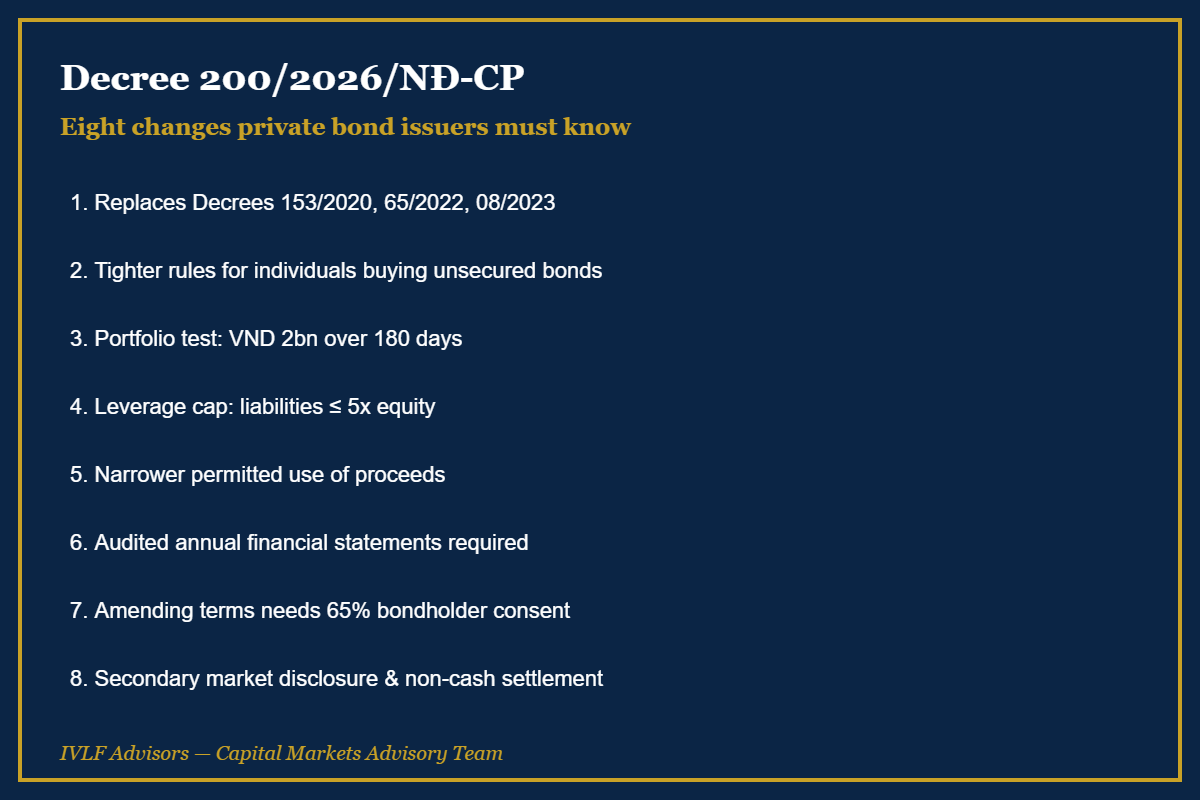
Decree 200/2026 on Private Corporate Bonds in Vietnam reshapes the private placement market, and issuers preparing a new deal need to check each of the eight changes against their existing bond programme documentation. On 5 June 2026, the Government issued Decree 200/2026/NĐ-CP, governing private placement and trading of corporate bonds in the domestic market and the offering of corporate bonds to international markets, replacing Decree 153/2020/NĐ-CP, Decree 65/2022/NĐ-CP and Decree 08/2023/NĐ-CP in one consolidated instrument.
It is the largest overhaul of the Vietnam corporate bond regulations framework in several years, and issuers should expect to revisit issuance templates and internal procedures before launching the next placement. This briefing, prepared by IVLF Advisors’ capital markets advisory team, summarises the eight changes issuers, arrangers and investors most need to understand.
1. Consolidation: one decree replaces three
Decree 200/2026 replaces Decree 153/2020, Decree 65/2022 (which amended Decree 153) and Decree 08/2023 (which had relaxed certain conditions during market stress) in full. Consolidating the framework into a single instrument reduces the risk of conflicting cross-references, but it also means issuers need to re-check every issuance template and internal procedure built around the superseded decrees before running a new placement.
2. Tighter conditions for individual professional investors buying unsecured bonds
The change with the clearest market impact: an individual professional securities investor may only purchase non-convertible bonds without warrants issued by a non-public company if the bonds carry a credit rating and are secured by collateral or backed by a credit institution’s payment guarantee. The collateral or guarantee must be sufficient to cover full repayment of bond principal and cannot consist of shares, stock, bonds or capital contributions of the issuer itself — closing off the once-common practice of securing bonds with the parent company’s own shares.
3. Recalibrated criteria for qualifying individual professional investors
The portfolio-based test for individual professional securities investor status is now more precisely defined: a listed or registered-for-trading securities portfolio worth at least VND 2 billion, measured by average daily market value over a minimum 180 consecutive days, excluding margin loan value and securities under repurchase transactions. Verification is valid for one year; an investor who has already purchased a bond does not need to re-verify status for subsequent transfers of that same bond.
4. New leverage cap: total liabilities capped at five times equity
A new issuance condition requires total liabilities (including the value of the bonds to be issued) not to exceed five times the issuer’s equity at the time of issuance, with exceptions for state-owned enterprises, issuers financing real estate projects, credit institutions and insurance companies. Highly leveraged issuers should assess their capacity to meet this threshold before preparing an issuance plan, or consider an equity injection ahead of the next placement.
5. Narrower permitted use of proceeds and heightened monitoring duties
Permitted purposes for private bond proceeds are now limited to funding an investment project under the Investment Law, restructuring the issuer’s own debt, or other purposes under specialised legislation. Proceeds must be tracked separately and applied strictly in line with the issuance plan and disclosed information; where proceeds are passed to a second party for use, the issuer must put in place monitoring measures over that party’s use of funds.
6. Audited annual financial statements required — reviewed semi-annual statements no longer accepted
Issuance documentation may no longer rely on reviewed semi-annual financial statements; it must instead be based on audited annual financial statements, and where the issuer is a parent company, the file must include both audited consolidated and audited standalone financial statements. The decree also clarifies the liability of advisory firms, issuing agents, auditors, credit rating agencies and valuation firms for the accuracy of documentation supporting the offering.
7. Amending bond terms post-issuance now requires 65% bondholder consent
Changing bond terms or the permitted use of proceeds after issuance requires internal corporate approval and the consent of at least 65% of outstanding bondholders of the same class, together with a mandatory early redemption offer to bondholders who do not consent to the change. Issuers should build this into contingency financial planning from the outset, since the early redemption obligation can create significant cash-flow pressure if dissent is high.
8. Secondary market disclosure duties and mandatory non-cash settlement
On the secondary market, a seller is obligated to provide the buyer with the issuer’s full disclosed information, and a buyer has the right to request that information before completing a purchase. Bond transactions must be settled through non-cash payment services. For bonds offered internationally, the issuance currency and principal/interest payment currency follow the rules of the offering market, and issuers must also comply with foreign exchange management law and the law on foreign loan and debt repayment management applicable to enterprises.
Counsel’s view: The two changes issuers most often underestimate are the 5x leverage cap and the 65% bondholder consent requirement for amending terms. Issuers planning multiple tranches should review their capital structure and standard bond terms now, rather than having to rework an issuance plan mid-offering.
Frequently asked questions
Which decrees does Decree 200/2026/NĐ-CP replace? It replaces Decree 153/2020/NĐ-CP, Decree 65/2022/NĐ-CP and Decree 08/2023/NĐ-CP on private corporate bond offering and trading. Can an individual investor buy unsecured private bonds? Only as a strategic investor in convertible bonds or bonds with warrants; for non-convertible, non-warrant bonds of a non-public issuer, an individual may only buy if the bonds carry a credit rating and are secured by collateral or a credit institution’s payment guarantee. What is required to change bond terms after issuance? Internal corporate approval, consent from at least 65% of outstanding bondholders of the same class, and a mandatory early redemption offer to dissenting bondholders.
IVLF Advisors’ capital markets advisory team helps issuers assess private bond issuance plans against Decree 200/2026/NĐ-CP. Request our Decree 200/2026 compliance checklist (PDF) to benchmark readiness ahead of your next placement.
Decree 200/2026 on Private Corporate Bonds in Vietnam: Common Compliance Pitfalls
Issuers preparing offerings under Decree 200/2026 on private corporate bonds in Vietnam frequently underestimate the new 65% bondholder consent threshold for post-issuance amendments, assuming the lower thresholds under prior rules still apply. Consent mechanics should be built into bond documentation from the outset rather than retrofitted later.
Another recurring pitfall is submitting reviewed semi-annual financial statements out of habit, when Decree 200/2026 now requires audited annual financial statements as the baseline eligibility document for individual professional investors purchasing unsecured bonds.
Decree 200/2026 on Private Corporate Bonds in Vietnam: An Issuer Readiness Checklist
Before launching a private bond offering under Decree 200/2026 on private corporate bonds in Vietnam, issuers should confirm:
- The audited annual financial statements are current and meet the applicable eligibility threshold.
- Total liabilities, including the proposed bonds, stay within the 5x debt-to-equity cap.
- Bond terms include a clear 65% bondholder consent mechanism for future amendments.
- Use-of-proceeds restrictions and post-issuance monitoring duties are mapped to an internal compliance owner.
- Settlement arrangements comply with the mandatory non-cash settlement requirement for secondary trading.
More Questions on Decree 200/2026 on Private Corporate Bonds in Vietnam
Does Decree 200/2026 apply retroactively to bonds already issued? Generally no, since the new conditions primarily govern new offerings and post-issuance amendments occurring after the decree’s effective date, though issuers should confirm transitional provisions for specific situations.
How does Decree 200/2026 interact with cross-border financing? Issuers combining a private domestic offering with an offshore bond issuance need to track both leverage and disclosure requirements together, since liabilities are typically assessed on a consolidated basis.
For the official decree text and related guidance, consult the State Securities Commission of Vietnam or the government legal portal at vanban.chinhphu.vn.
Decree 200/2026 on Private Corporate Bonds in Vietnam: Related Resources
For issuance planning under Decree 200/2026 on Private Corporate Bonds in Vietnam, see IVLF Advisors’ capital markets advisory services, and review the official decree text via the Government Portal on Legal Policy.
Private Corporate Bonds Issuance Checklist Under Decree 200/2026
Issuers preparing a domestic offering of private corporate bonds should work through this pre-issuance checklist alongside legal counsel to avoid the most common processing delays.
- Financial ratio pack. Confirm the debt-to-equity cap calculation and the three-year financial ratio disclosures required under Decree 200/2026.
- Investor eligibility screening. Verify that offer materials are restricted to eligible professional securities investors, with the required investor certification process.
- Use-of-proceeds documentation. Prepare a use-of-proceeds statement consistent with the issuance plan filed with the depository, since mismatches are a frequent audit finding.
- VSDC and depository registration. Complete book-entry registration before the offer closes, not after, to avoid settlement delays.
- Ongoing disclosure calendar. Map periodic disclosure obligations against the company’s existing corporate governance and disclosure calendar so bond-specific reporting does not get missed.
Issuers considering an offshore alternative should compare this domestic private corporate bonds route against offshore bond issuance, and check the applicable 5x debt-to-equity cap before finalising deal size.
Decree 200 2026 Private Bond Vietnam: Compliance Steps for Issuers
Issuers preparing a placement under the new Decree 200 2026 private bond Vietnam regime should map out the revised corporate bond issuance rules Vietnam 2026 against their existing debt program, since disclosure formats and investor eligibility criteria have both changed. Ongoing bond issuer compliance Vietnam now includes stricter post-issuance reporting cadence and collateral valuation refresh requirements.
Arrangers structuring a deal should also revisit private placement bond regulation Vietnam provisions on investor caps, since the number of eligible professional investors permitted per tranche has been tightened under the decree.

Structuring a bond issuance under Decree 200/2026? Contact IVLF Advisors for issuer compliance support.
The bottom line on private corporate bonds: Decree 200/2026 makes private corporate bonds harder to mis-sell but easier to issue cleanly. Issuers who treat private corporate bonds as a disclosure discipline, not a funding shortcut, will find private corporate bonds remain a viable capital tool, while those who cut corners on private corporate bonds now face real enforcement risk.
A final word on private corporate bonds: align your offering documents with Decree 200/2026 before marketing any private corporate bonds to investors.
This article is provided for general information only and does not constitute legal advice for any specific case. Regulations may change – please consult a qualified professional before acting. Should further analysis be required, please contact one of our lawyers below.