
Offshore Bond Issuance by Vietnamese Corporates has become a mainstream funding route for large-cap issuers, but it requires careful sequencing of SBV loan registration alongside the Reg S/144A documentation timeline. A growing number of Vietnamese corporates with large medium- and long-term funding needs are considering offshore bond issuance rather than relying solely on domestic bank credit or private domestic bonds. This is a materially more complex fundraising channel, requiring foreign securities law (typically US or English), Vietnamese foreign exchange and offshore borrowing regulations, and a deliberate choice of governing law for the issuance documentation. This briefing, prepared by IVLF Advisors’ capital markets advisory team, analyses the legal framework for Vietnam offshore bond issuance: issuance structure, SBV loan registration, the Reg S/144A distinction, governing law choices and standard covenant packages.
Issuance structure: onshore issuer, offshore SPV and a parent guarantee
Most Vietnamese corporate offshore bond issuances are not made directly by the onshore entity, but through a special purpose vehicle (SPV) incorporated offshore — typically in Singapore, Hong Kong or the British Virgin Islands — with the bond obligations backed by a guarantee or keepwell agreement from the Vietnamese parent. This structure lets offshore bondholders avoid the legal risk of suing a Vietnamese entity directly, while the arrangement still triggers Vietnam’s offshore borrowing rules if proceeds are on-lent back into Vietnam.
SBV registration for medium and long-term offshore loans
Where the Vietnamese parent or onshore entity receives an on-lent loan from the SPV issuer, that loan is treated as a self-borrowing, self-repaying offshore loan and must be registered with the State Bank of Vietnam under Circular 12/2022/TT-NHNN (as amended by Circular 08/2023/TT-NHNN) if it is medium or long term. The borrower must complete registration before drawdown, open an offshore loan account at a licensed credit institution, and file monthly online reports on drawdowns and repayments through the SBV’s online portal. Failure to register, or late registration, can result in a licensed bank refusing to process transfers relating to the loan.
Reg S and Rule 144A: different target investors and disclosure duties
The two most common exemptions from US securities registration used in offshore bond offerings: Regulation S allows an offering to non-US persons outside the United States without SEC registration, typically subject to a resale restriction (commonly 40 days) into the United States; Rule 144A permits an offering within the United States but limited to qualified institutional buyers (QIBs), with lighter disclosure than a public offering but heavier than a Reg S-only deal. Many issuances combine both (Reg S/144A) to broaden the investor base, meaning the offering memorandum must satisfy the disclosure expectations of both investor groups simultaneously.
Governing law and jurisdiction: choices and enforceability in Vietnam
Vietnamese corporate offshore bonds are almost always governed by New York or English law, with disputes referred to New York courts, English courts, or international arbitration (commonly HKIAC or SIAC). Vietnam’s 2015 Civil Code allows parties to a civil relationship with a foreign element to choose the governing law, but recognition and enforcement of a foreign arbitral award or foreign court judgment in Vietnam still requires a separate procedure under the Civil Procedure Code, and can be refused if it conflicts with fundamental principles of Vietnamese law. This is a point offshore investors need to factor into their assessment of practical recovery if the Vietnamese parent breaches its guarantee obligations.
Standard covenant packages and negotiation points for Vietnamese issuers
Standard covenant packages in offshore bonds include: debt incurrence limits (either incurrence-based or maintenance-based), a negative pledge restricting security granted to other creditors, cross-default provisions linked to other group debt, and a change-of-control put option. For Vietnamese issuers, a point that typically requires separate negotiation is the definition of “core assets” in the asset disposal covenant, since many groups have cross-shareholding structures among domestic subsidiaries that need to be carved out of the restriction to avoid impeding lawful internal reorganisations.
Cross-border security: limits under Vietnamese law
An important limitation offshore investors should note: Vietnamese law on security for the performance of obligations (Decree 21/2021/NĐ-CP) does not permit every security form common in international markets to be applied unmodified — for example, a mortgage over land use rights in favour of a foreign secured party carries specific restrictions, and enforcement of collateral on default must follow Vietnamese procedure even where the security document is governed by foreign law. As a result, most offshore bond security packages rely primarily on the parent guarantee and a pledge over the offshore SPV’s shares, rather than direct collateral located in Vietnam.
Counsel’s view: Vietnamese issuers running their first offshore bond deal typically underestimate the time needed to complete SBV offshore loan registration — this workstream should start in parallel with drafting the offering memorandum, not after terms are agreed with investors, to avoid delaying drawdown.
Frequently asked questions
Does a Vietnamese issuer need to register an offshore loan when issuing offshore bonds? Yes, if proceeds are on-lent back into Vietnam as a medium or long-term loan, that loan must be registered with the SBV under Circular 12/2022/TT-NHNN as amended by Circular 08/2023/TT-NHNN. What is the difference between Reg S and Rule 144A? Reg S targets non-US investors with lighter disclosure; Rule 144A permits a US offering to qualified institutional buyers with heavier disclosure requirements. Do offshore bonds require Vietnam-located collateral? Not typically — most structures rely on a parent guarantee and a pledge of the offshore SPV’s shares, given Vietnamese law’s limits on cross-border security. IVLF Advisors’ capital markets advisory team helps issuers structure and execute offshore bond issuances. Speak with our team about structuring an offshore issuance to assess the right approach for your transaction.
Offshore Bond Issuance by Vietnamese Corporates: Common Structuring Pitfalls
The most frequent error in offshore bond issuance by Vietnamese corporates is treating SBV loan registration as a formality rather than a condition precedent to drawdown. Registration of the offshore loan must be completed with the State Bank of Vietnam before funds can be legally repatriated, and delays here routinely push back closing dates.
A second pitfall is under-scoping the parent guarantee. Cross-border guarantees from a Vietnamese parent in favor of an offshore SPV issuer are subject to their own registration and reporting obligations, separate from the loan registration of the underlying bond itself.
Offshore Bond Issuance by Vietnamese Corporates: A Pre-Issuance Checklist
Issuers and their advisers should confirm the following before launching an offshore bond issuance by Vietnamese corporates:
- Select the SPV jurisdiction and confirm double-tax-treaty implications for interest payments back to Vietnam.
- File the SBV medium- and long-term foreign loan registration early, given typical processing timelines.
- Decide between Reg S-only and Reg S/144A structuring based on the target investor base and disclosure appetite.
- Confirm the bond’s leverage profile against Vietnam’s 5x debt-to-equity cap under the 2025 Enterprise Law Amendment.
- Cross-check covenant packages against onshore restrictions on cross-border security interests.
More Questions on Offshore Bond Issuance by Vietnamese Corporates
Does every offshore bond need SBV registration? Medium- and long-term foreign loans (typically over one year) generally require SBV registration; short-term facilities are subject to a lighter reporting regime.
Can the bond be governed by New York or English law? Yes, foreign governing law is generally permitted for the offshore instrument itself, though enforcement of security located in Vietnam still engages Vietnamese law and courts.
Issuers considering a parallel onshore private bond alongside an offshore issuance should also review our briefing on Decree 200/2026 on private corporate bonds. For the current foreign loan registration procedure and forms, consult the State Bank of Vietnam.
Offshore Bond Issuance by Vietnamese Corporates: Related Resources
For transaction support on Offshore Bond Issuance by Vietnamese Corporates, see IVLF Advisors’ capital markets advisory services, and confirm current foreign loan registration rules via the State Bank of Vietnam portal.
Offshore Bond Issuance Timeline: What to Expect Month by Month
Boards planning an offshore bond issuance often underestimate the lead time needed for SBV registration and rating agency work. A realistic timeline helps avoid last-minute market-window misses.
- Months 1-2: Mandate selection, term sheet negotiation, and preliminary SBV consultation on the proposed offshore loan/bond registration.
- Months 2-4: Legal due diligence, drafting of the offering memorandum, and (if applicable) credit rating process.
- Months 4-5: SBV registration of the medium/long-term offshore loan, FX documentation, and security perfection where cross-border collateral is used.
- Months 5-6: Roadshow, pricing, and closing, followed by ongoing FX reporting obligations for the life of the bond.
Issuers should coordinate this offshore bond issuance timeline with related domestic requirements, including the Decree 200/2026 private corporate bond rules and the 5x debt-to-equity cap that applies to Vietnamese issuers. Current SBV circulars on offshore borrowing registration are published at sbv.gov.vn.
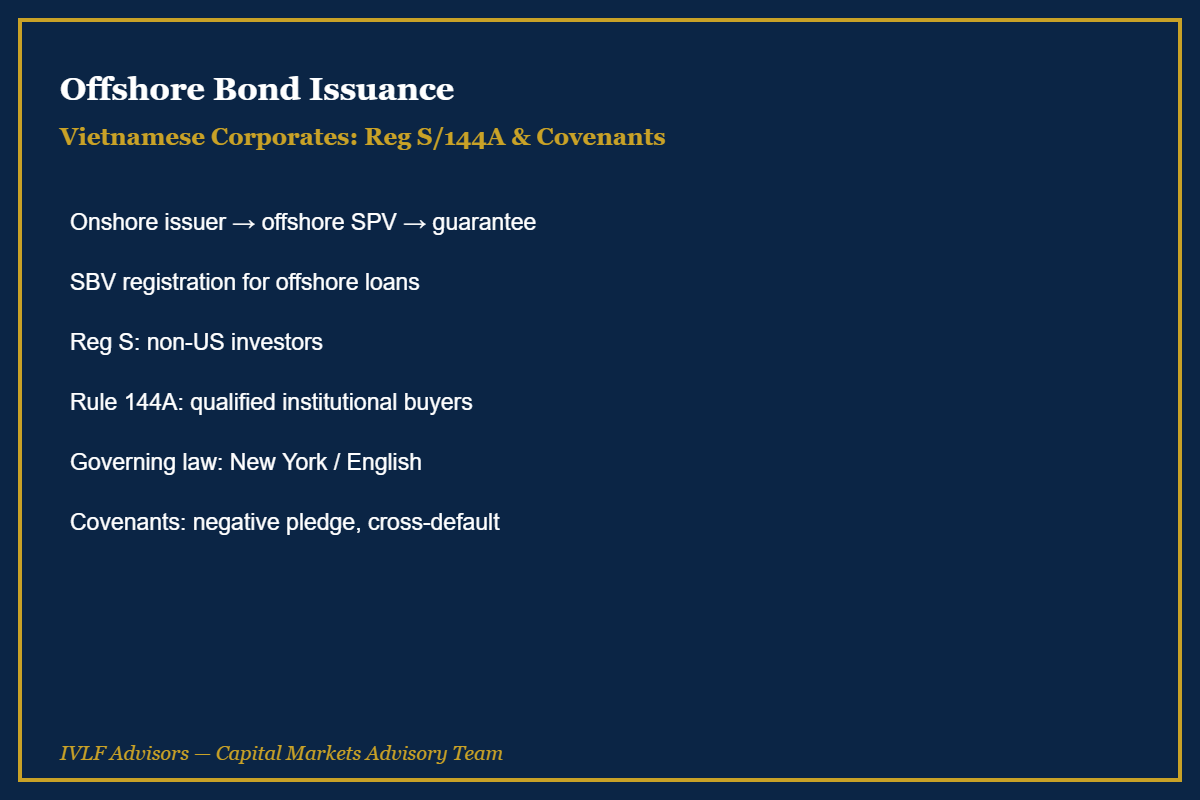
Reg S 144A Bond Issuance Vietnam: Structuring for Offshore Investors
Corporates pursuing a Reg S 144A bond issuance Vietnam structure must reconcile SEC-style disclosure expectations with local corporate approval requirements, since offshore investors will expect covenant packages comparable to other regional issuers. An offshore bond foreign currency control review is essential early in the process, as the State Bank of Vietnam closely monitors foreign currency-denominated debt raised by resident entities.
A Vietnamese corporate bond overseas investor base typically requires an international trustee and paying agent structure, while FX control offshore bond Vietnam compliance dictates how proceeds may be repatriated and used onshore.

Planning an offshore bond issuance from Vietnam? Contact IVLF Advisors to structure a compliant Reg S/144A offering.
This article is provided for general information only and does not constitute legal advice for any specific case. Regulations may change – please consult a qualified professional before acting. Should further analysis be required, please contact one of our lawyers below.