This article provides general information only and does not constitute legal advice. Please verify the current status of the regulations discussed before relying on them. Foreign-invested enterprises (FIEs) are subject to a defined FDI investment supervision Vietnam legal framework for FDI investment supervision Vietnam authorities apply, set out in Circular No. 02/2022/TT-BKHDT issued by the Ministry of Planning and Investment, effective from 1 April 2022. Understanding what this framework covers – and its limits – helps FIEs anticipate what state authorities can and cannot do when reviewing their projects.  Figure: Overview of the FDI investment supervision Vietnam framework under Circular 02/2022/TT-BKHDT.
Who the Framework Applies To
The FDI investment supervision Vietnam framework applies to state management authorities responsible for foreign investment, investment registration authorities, other authorities with a role in state investment management, FIEs, and the investment projects they operate in Vietnam.
A Core Principle: Supervision Should Not Disrupt Operations
Among its guiding principles, FDI investment supervision Vietnam rules specify that supervision and evaluation of investment activities should not prevent or disrupt an FIE’s normal business operations – a meaningful constraint on how authorities conduct FDI investment supervision Vietnam-wide.
FDI Investment Supervision Vietnam: What Gets Covered
The scope of supervision and evaluation is broad, covering: the disbursement of registered investment capital and the ratio of capital actually used to capital registered; the progress of project development; whether the project’s stated investment objectives are being met; the technology applied in projects subject to technology appraisal, including any technology transfer; compliance with investment commitments, market access conditions, and conditions attached to investment incentives; the FIE’s fulfillment of its financial obligations to the State; compliance with labor, foreign exchange control, environmental, land, construction, and fire prevention and fighting legislation, among other specialized laws; the FIE’s financial condition; and other matters relevant to how the investment project is being carried out.
How Authorities Carry Out FDI Investment Supervision in Vietnam
In practice, FDI investment supervision in Vietnam is carried out through a mix of periodic reporting, coordinated reviews among investment registration authorities and specialized state agencies, and, where warranted, on-site inspections of the project. FIEs are generally expected to submit regular investment reports and to keep records of capital disbursement, licensing conditions, and compliance measures readily available. Because multiple authorities may have a role in reviewing the same project, keeping consistent, well-organized documentation is one of the most practical steps an FIE can take to make any supervision or evaluation exercise proceed smoothly, and to demonstrate compliance if questions arise. For related reading, see IVLF Advisors’ blog for further case studies on FDI compliance in Vietnam.
Why This Framework Matters for Investors
By clearly defining the scope of state authorities’ supervisory powers, this framework helps prevent overreach during investment reviews – giving foreign investors a clearer basis to understand, and where appropriate, push back on the scope of unannounced inspections or reviews by Vietnamese authorities. It also gives legal and compliance teams a defined checklist against which to prepare in advance of any scheduled review, reducing uncertainty around what documentation or access authorities may request. Many FIEs find it helpful to run an internal readiness check against this framework at least once a year, well before any formal review is scheduled.
Conclusion
Knowing the defined scope of FDI investment supervision Vietnam authorities apply gives FIEs a practical tool: a clear sense of what authorities are entitled to review, and confidence to engage constructively – rather than reactively – when a review takes place.
Reporting Obligations Under FDI Investment Supervision Vietnam Rules
A large part of FDI investment supervision Vietnam practice operates through periodic reporting rather than on-site inspection. FIEs submit quarterly and annual reports on implemented capital, business results, and labor use through the National Investment Information System. Investment registration authorities then rely on this data when assessing whether a project is progressing in line with its registered objectives and timelines. Late or inconsistent reporting is one of the most common triggers for closer FDI investment supervision Vietnam agencies apply. A project that reports steadily and accurately rarely attracts unscheduled attention, while gaps in the data invite follow-up questions and, in some cases, administrative penalties.
Common Compliance Gaps Authorities Look For
In practice, FDI investment supervision Vietnam evaluations under Circular 02/2022/TT-BKHDT tend to focus on a recurring set of issues:
- Capital contribution schedules – charter capital contributed later than the timeline stated in the Enterprise Registration Certificate or IRC.
- Project progress – construction or operational milestones falling significantly behind the registered schedule without an approved adjustment.
- Business lines – revenue-generating activities that drift outside the scope recorded in the IRC.
- Land use – leased land left idle or used for purposes other than those committed to in the project dossier.
- Incentive conditions – tax or land incentives claimed while the underlying conditions (investment scale, disbursement, employment) are no longer met.
Under FDI investment supervision Vietnam standards, none of these issues is fatal on its own. What matters is whether the enterprise can document the cause and show corrective steps – which is precisely what a well-prepared FIE does before any review begins. 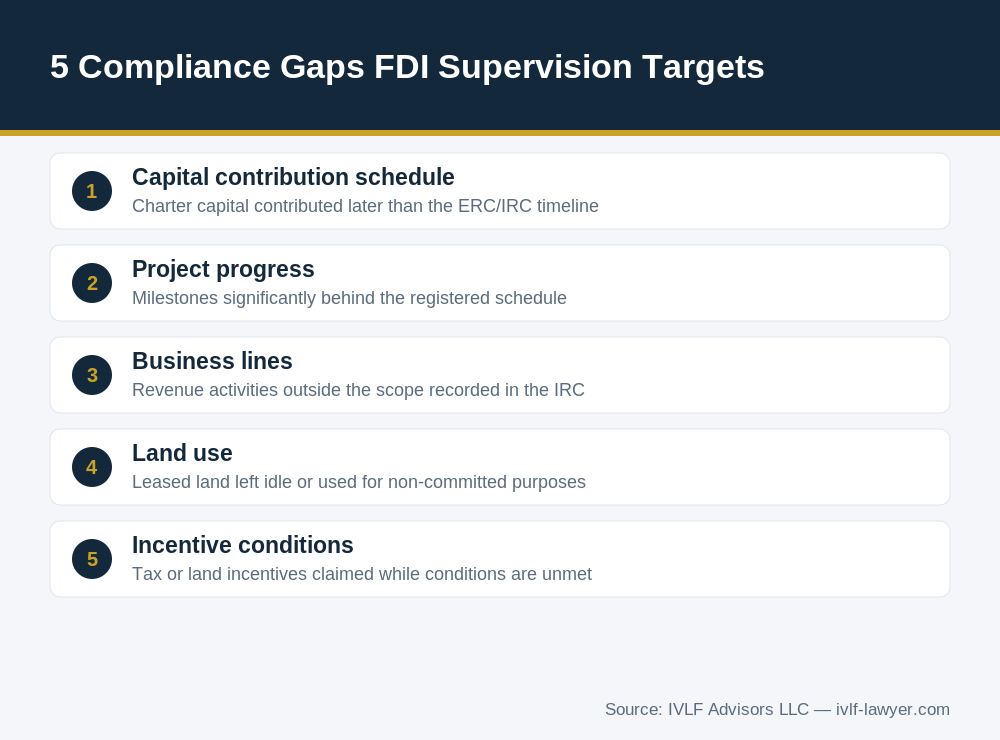
A Practical Readiness Checklist
Before any scheduled evaluation, we recommend FIEs verify five things: that statutory investment reports are filed and consistent with accounting records; that capital contributions match the registered schedule; that the IRC and ERC still reflect actual operations; that land and construction documents align with the project file; and that any incentive claims remain supportable. Running this internal check annually keeps the file ready and makes any FDI investment supervision Vietnam authorities conduct largely a formality.
Supervision vs. Inspection: Two Different Exercises
Investors often conflate FDI investment supervision Vietnam procedures with inspection (thanh tra). They are legally distinct. Supervision and evaluation under Circular 02/2022/TT-BKHDT are continuous, data-driven management activities carried out by investment authorities. Inspection is a separate, formal process under the Law on Inspection, with its own triggers, powers, and consequences. The practical difference matters: a supervision or evaluation exercise is usually resolved through documentation and dialogue, while an inspection can lead directly to binding conclusions and sanctions. Treating a routine evaluation with the same defensiveness as an inspection often creates friction where none is needed.
What Happens When Issues Are Found
Where an evaluation identifies problems, outcomes are graduated. Minor reporting lapses typically end with a request for correction. Persistent non-compliance can lead to administrative fines under Decree 122/2021/ND-CP. In serious cases – such as prolonged failure to implement a project – authorities may adjust, suspend, or ultimately terminate the investment registration certificate. Because consequences escalate with the record, early corrections are disproportionately valuable. An FIE that fixes a reporting gap in the same quarter rarely faces anything further; one that ignores repeated requests builds a file that supports harsher measures.
How to Respond to an Evaluation Request
When FDI investment supervision Vietnam authorities issue an evaluation request, the response process is straightforward if approached methodically: 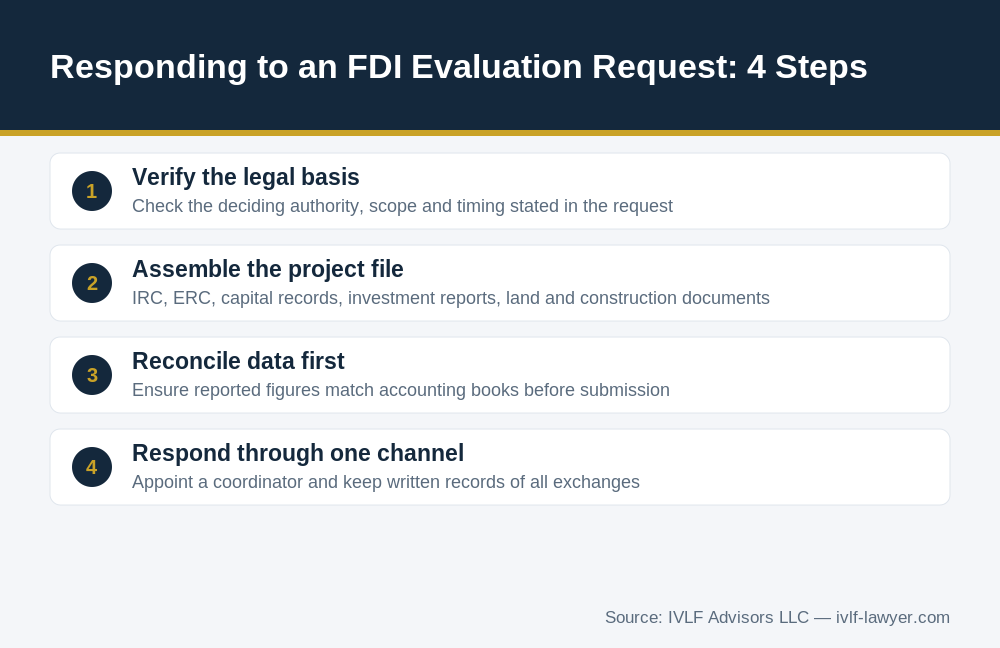 Companies that follow this sequence usually complete FDI investment supervision Vietnam evaluations without disruption. The most common own-goal is submitting inconsistent numbers – figures in the response that do not match earlier investment reports – which converts a routine review into a prolonged inquiry.
Key Legal Instruments Behind the Framework
Several instruments work together to define how FDI investment supervision Vietnam activities are conducted, and it helps to know which document governs which question:
- Law on Investment 2020 (Law No. 61/2020/QH14) – establishes the state’s general authority to supervise and evaluate investment activities, and the investor’s reporting obligations.
- Decree 29/2021/ND-CP – sets out the procedures for supervision and evaluation of investment programs and projects, including responsibilities of each authority level.
- Circular 02/2022/TT-BKHDT – the operative guidance from the Ministry of Planning and Investment detailing scope, content, and methods for supervising and evaluating FDI projects.
- Decree 122/2021/ND-CP – prescribes administrative penalties for violations in the field of planning and investment, including reporting failures.
When an FIE receives correspondence from an authority, identifying which instrument the request is grounded in is the first analytical step. A reporting reminder under the Law on Investment is routine; a document request citing Decree 29/2021 signals a structured evaluation; correspondence referencing Decree 122/2021 means a violation is already being considered and deserves immediate legal attention. For foreign investors planning new projects, these instruments are also a preview: the commitments recorded at licensing stage – capital schedule, milestones, business lines – become the exact benchmarks against which the project will later be measured.
Frequently Asked Questions
Can authorities suspend a project during supervision? Only in defined cases – for example, prolonged failure to implement the project or serious legal violations. Routine supervision itself does not interrupt operations. How often are FDI projects evaluated? Periodic evaluation typically follows the plans of the Ministry of Planning and Investment and provincial authorities; ad-hoc evaluation occurs when reports or complaints raise specific concerns. Does supervision apply after the project is fully operational? Yes. Supervision continues throughout the project lifecycle, although its intensity usually decreases once construction and disbursement commitments are fulfilled.
Facing an investment supervision review in Vietnam?
IVLF Advisors LLC advises foreign-invested enterprises on regulatory compliance and engagement with Vietnamese investment authorities. Explore our practice areas or contact us to discuss your project. Our team can help you prepare for FDI investment supervision Vietnam reviews with confidence.
Post-Licensing Supervision Reports FDI Companies Must File
Vietnam’s framework for supervising and evaluating FDI projects does not end once the Investment Registration Certificate is issued – it continues through periodic reporting obligations that many foreign investors underestimate. Licensed FDI companies must submit quarterly and annual investment monitoring reports to the local Department of Planning and Investment, covering disbursed capital, employment figures, and project implementation progress against the schedule committed in the IRC. Projects that fall significantly behind schedule without an approved extension can be flagged during periodic supervision and, in serious cases of prolonged inactivity, risk having their investment license revoked under Vietnam’s investment project termination rules. Investors managing multiple licensed entities alongside a due diligence process for an acquisition should also see our related guide on due diligence in Vietnam, since unresolved supervision findings on a target company are a common issue uncovered during legal due diligence.
Common Triggers for an Ad Hoc FDI Project Inspection
Beyond scheduled reporting, Vietnamese authorities can trigger an ad hoc inspection of an FDI project outside the normal supervision cycle. Common triggers include a significant gap between registered and actually disbursed capital, complaints from local authorities or communities regarding environmental or labor issues, a change of control or capital structure that was not properly notified, or discrepancies identified through cross-referencing customs, tax, and investment registration data. An ad hoc inspection typically results in a formal notice requiring the company to explain and remediate findings within a set deadline, and repeated non-compliance can escalate to administrative penalties or, for chronic underperformance, license revocation. For the current investment supervision and evaluation regulations, see the Ministry of Planning and Investment, and for the national investment project database used in cross-referencing, see the Foreign Investment Agency portal.
This article is provided for general information only and does not constitute legal advice for any specific case. Regulations may change – please consult a qualified professional before acting. Should further analysis be required, please contact one of our lawyers below.