Anyone involved in an M&A deal has heard the term “due diligence” – often shortened simply to “DD.” It is one of the most important phases of any acquisition, and due diligence in Vietnam carries features of its own that foreign buyers should understand. After signing a term sheet or memorandum of understanding that sets out a preliminary purchase price and other basic deal terms, a buyer will typically conduct due diligence on the target company – either with its own in-house deal team or by engaging outside advisors, most commonly law firms and audit firms.
Why Buyers Don’t Skip Due Diligence
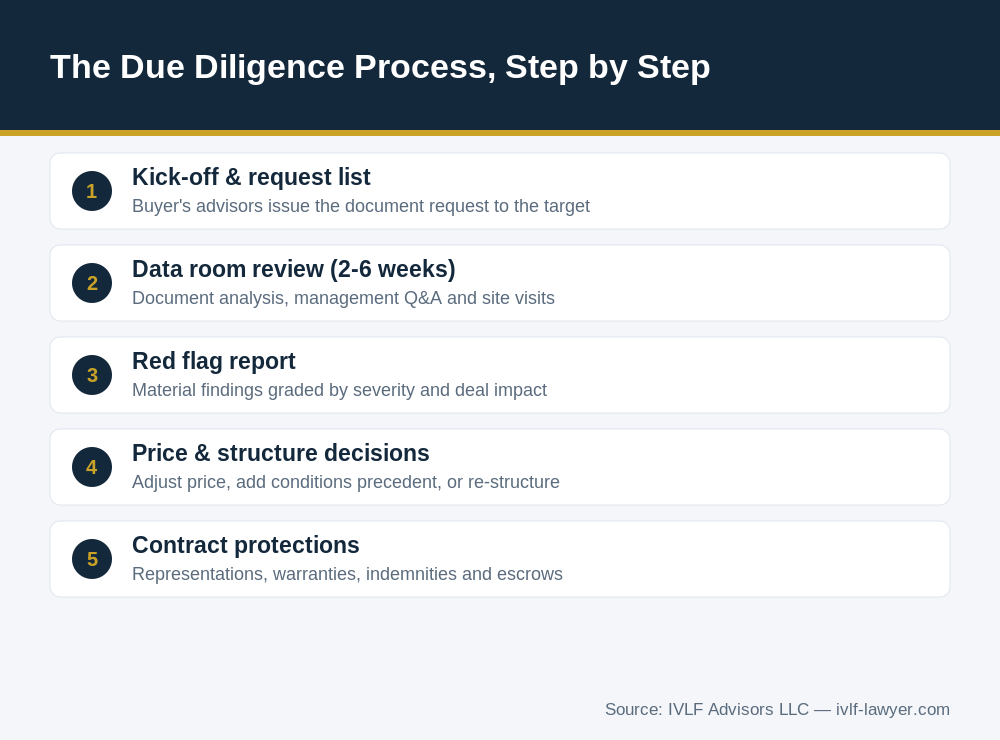 Even after price and headline terms are provisionally agreed, buyers do not skip due diligence on the target company. Latent or existing risks can and do surface in practice, and once the buyer becomes a shareholder, member, or owner of the target, it inherits those risks along with the business – legal exposure, potential disputes, existing or contingent tax and financial obligations, and other liabilities that transfer with the company from the moment the buyer takes on its rights and responsibilities.
Due Diligence as Leverage
Beyond risk identification, due diligence gives the buyer a factual basis to request a purchase price adjustment or reduction, and to renegotiate terms and conditions discussed earlier in the process. Findings from DD routinely reshape the final deal.
Protecting the Buyer in the Transaction Documents
Building on DD findings, the buyer’s legal counsel will build out a set of condition precedents, along with representations, warranties, and covenants in the transaction documents – protecting the buyer’s rights and interests before, during, and after the M&A transaction closes.
What Legal Due Diligence in Vietnam Actually Covers
The scope of legal due diligence in Vietnam is shaped by how Vietnamese companies are actually built: licensing-heavy, land-dependent, and document-driven. A standard review covers six areas: 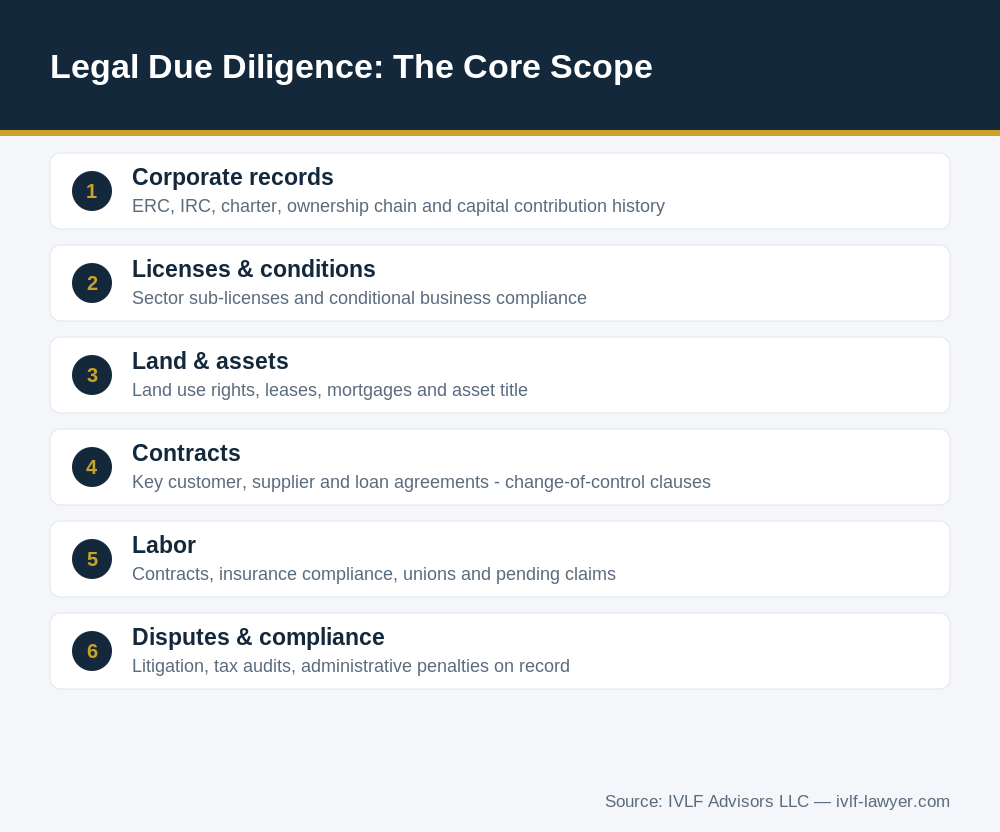 Two of these deserve special weight in Vietnamese deals. Capital contribution history matters because unpaid or late-contributed charter capital passes risk to the buyer. And land status matters because many businesses operate on leased state land whose terms – annual rental versus one-off payment – change the asset’s value and transferability.
Red Flags That Reprice Deals
Experienced advisors running due diligence in Vietnam see the same categories of findings repeatedly: 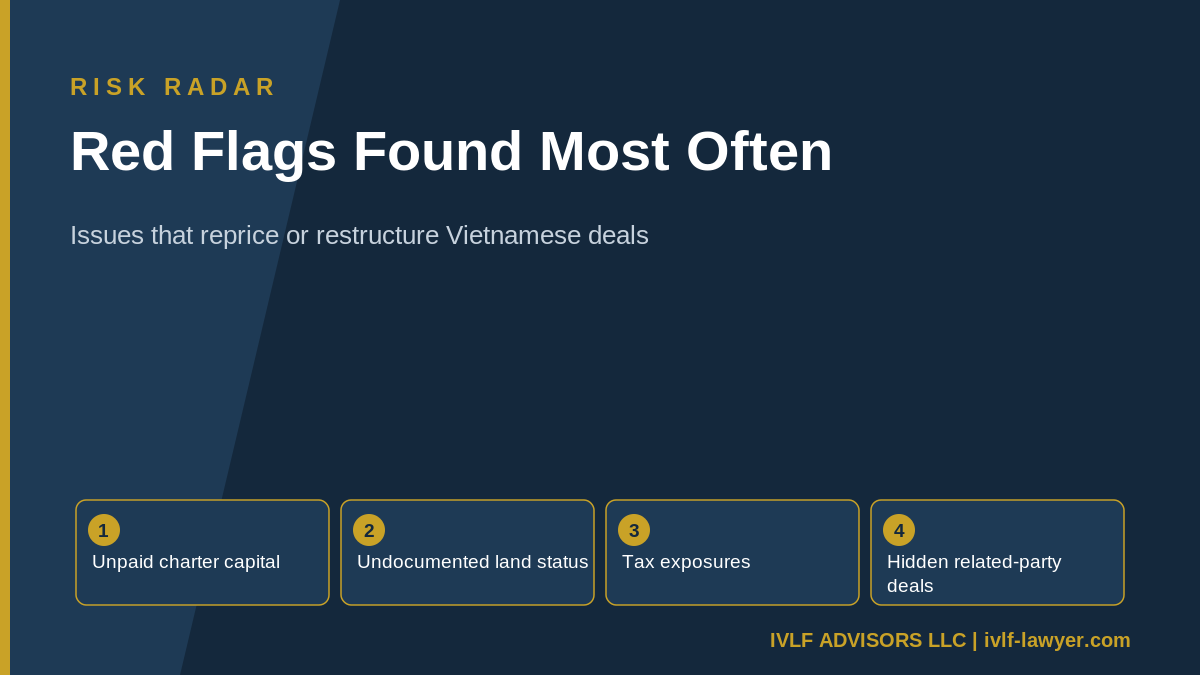 None of these is automatically a deal-killer. Each is a negotiation event: the buyer can reprice, demand rectification as a condition precedent, restructure the transaction – for example as an asset deal – or walk away. What converts a finding into a loss is discovering it after closing instead of before.
How Long Does Due Diligence in Vietnam Take?
For a typical mid-market target, legal due diligence in Vietnam runs two to six weeks from data room access, in parallel with financial and tax workstreams. Timelines stretch where the target’s records are informal – a common feature of founder-run companies – or where land documents require verification with provincial authorities. Sellers can compress this materially by preparing a vendor file in advance: corporate records, licenses, land papers, key contracts, labor files, and litigation summaries organised before buyers ask. In competitive processes, vendor due diligence in Vietnam is increasingly used to pre-empt buyer findings and hold price.
Worked Example: How Findings Reshape a Deal
A regional buyer agreed a term sheet to acquire 100% of a Vietnamese packaging manufacturer at an enterprise value of USD 12 million. Due diligence in Vietnam then surfaced three findings: a fire-safety certificate that had lapsed for one factory, land rent paid annually rather than one-off (reducing the land’s collateral value), and a related-party supply contract priced above market with a company owned by the founder’s brother. None of this killed the deal. The buyer repriced by USD 1.4 million, made fire-safety re-certification a condition precedent to closing, and required the related-party contract be terminated at completion. The seller accepted within a week – because every finding was documented, graded, and tied to a specific remedy rather than used as a vague renegotiation lever. That is what disciplined due diligence in Vietnam buys: not suspicion, but precision. The buyer knows exactly what it is purchasing, and the seller knows exactly what it is being paid for.
Who Does the Work: Building the Deal Team
A standard due diligence in Vietnam exercise runs three parallel workstreams. Lawyers cover corporate, licensing, land, contracts, labor, and disputes. Auditors cover quality of earnings, debt, and working capital. Tax specialists review historic filings – corporate income tax, VAT, transfer pricing documentation – because tax exposures in Vietnamese targets often exceed all other findings combined. For smaller acquisitions, buyers sometimes merge the tax and financial scopes. What should not be cut is the legal workstream’s land and licensing review: these are the findings that block deals entirely if discovered late, since they cannot be fixed with money alone after closing.
After Closing: The File Keeps Working
The due diligence in Vietnam report does not retire at completion. It becomes the baseline for warranty claims – proof of what the buyer knew and when. It feeds the 100-day integration plan, flagging which licenses need renewal and which contracts need consent letters. And in disputes, contemporaneous DD findings are persuasive evidence of the parties’ understanding at signing. Buyers who treat the report as a living document – assigning each finding an owner and a deadline – consistently extract more value from the exercise than those who file it away at closing.
Seller-Side Preparation: Passing Due Diligence in Vietnam
Sellers benefit from running the same checklist on themselves before going to market. A pre-sale legal audit – effectively reverse due diligence in Vietnam – identifies fixable problems while there is still time: contributing outstanding charter capital, renewing lapsed sub-licenses, papering informal related-party arrangements, and regularising labor files. Fixes made before the data room opens cost the seller little. The same issues discovered by the buyer’s advisors become price reductions, escrows, or conditions – each with a negotiation premium attached. In our experience, every dollar spent on seller-side preparation returns several times over in preserved price. Preparation also changes deal psychology. A clean, organised data room signals a professionally run company and shortens the buyer’s review; a chaotic one invites deeper digging and longer exclusivity – both of which erode seller leverage as the process drags. For founders considering a sale within the next two years, the practical advice is simple: run the due diligence in Vietnam checklist now, fix what can be fixed, and document what cannot.
Key Legal Instruments
- Law on Enterprises 2020 – corporate records, capital contribution and shareholder arrangements; text on the Government’s legal documents portal.
- Law on Investment 2020 – M&A approval for foreign buyers and conditional sectors.
- Land Law 2024 – land use rights underpinning most asset value in Vietnamese targets.
- Law on Securities 2019 – where the target is public; disclosures via the State Securities Commission.
Frequently Asked Questions
What is the difference between legal, financial and tax DD? Legal DD examines rights and obligations – ownership, licenses, land, contracts, disputes. Financial DD tests the quality of reported earnings and the balance sheet. Tax DD quantifies historic exposures. They overlap deliberately: a related-party contract found by lawyers becomes a transfer-pricing question for the tax team, and an earnings adjustment for the auditors. Should small acquisitions skip DD? Scope can scale down, but skipping entirely is false economy – smaller Vietnamese targets tend to have more informal records, not fewer issues. Is due diligence in Vietnam legally required? No – it is a commercial practice, not a statutory step. But the M&A approval process for foreign buyers assumes the buyer understands the target’s licensing position, and warranties are only as good as the seller behind them. Who pays for due diligence? Each side bears its own advisors’ costs. Break-fee arrangements occasionally shift this in larger deals. Can due diligence in Vietnam be done remotely? Largely yes – virtual data rooms are standard – but land and asset verification still benefits from on-site checks, and management interviews are more revealing in person. What does due diligence in Vietnam cost? For mid-market deals, legal DD typically runs from a few thousand to several tens of thousands of dollars depending on scope – a fraction of the exposures it routinely uncovers. Does the buyer see everything? Only what is disclosed plus what public registries reveal. This is why representations and warranties matter: they allocate the risk of what due diligence in Vietnam could not see, and why breaches discovered later are compensable rather than merely regrettable. One closing habit worth adopting: grade every finding on two axes – probability and financial impact – and record the grading in the report itself. Deals move faster when both sides argue about a number on a page rather than an adjective in an email, and the discipline keeps small issues from consuming negotiation time that the genuinely material ones deserve.
Conclusion
Due diligence is not a formality – it is the mechanism that lets a buyer see what it is actually acquiring, negotiate accordingly, and build in the contractual protections needed to manage the risks that come with the deal. Skipping or shortcutting DD shifts that risk squarely onto the buyer after closing.
Preparing for an M&A transaction in Vietnam?
IVLF Advisors LLC advises buyers and sellers on due diligence, deal structuring, and transaction documentation for M&A in Vietnam. Explore our practice areas or contact us to discuss your transaction.
Due Diligence Red Flags Unique to Vietnamese Targets
Due diligence in M&A transactions in Vietnam surfaces several recurring red flags that are less common in more mature markets. The first is undercapitalization risk – target companies frequently show charter capital on paper that was never actually contributed within the statutory deadline, which can trigger retroactive administrative penalties that transfer to the buyer post-closing. The second is informal land-use arrangements, where a target occupies premises under an unregistered lease or uses land allocated for a different purpose than its actual operations, both of which can block a change-of-control filing. The third is unrecorded related-party transactions, especially loans from the founder personally to the company that were never properly documented as either debt or capital, creating ambiguity over what the buyer is actually acquiring. Buyers who are structuring the deal around an earnout or deferred consideration should also review our related article on ESOP structures in Vietnam, since management retention packages are frequently negotiated in parallel with the due diligence findings on key-person risk.
Sequencing Legal, Tax and Labor Due Diligence for a Vietnam Deal
Because Vietnamese regulators do not maintain a single unified corporate registry that discloses all liabilities, an efficient due diligence process in Vietnam typically runs three parallel workstreams rather than a single sequential review. Legal due diligence confirms the IRC/ERC chain of title and any pending litigation; tax due diligence reconciles VAT and corporate income tax filings against the general ledger, since unpaid tax liabilities transfer with a share deal but not always with an asset deal; and labor due diligence checks whether labor contracts, social insurance contributions and any collective bargaining agreements comply with the Labor Code, since successor liability for unpaid social insurance is a common post-closing dispute in Vietnam. For the statutory tax audit and inspection framework that shapes tax due diligence timing, see the General Department of Taxation, and for labor compliance requirements, see the Ministry of Labour, Invalids and Social Affairs.
This article is provided for general information only and does not constitute legal advice for any specific case. Regulations may change – please consult a qualified professional before acting. Should further analysis be required, please contact one of our lawyers below.