Setting up an FDI company in industrial zones is the preferred entry route for manufacturing investors in Vietnam, offering ready infrastructure, a skilled workforce, and streamlined business policies. Setting up inside an industrial zone follows the same core FDI licensing path as a standalone company, but adds a land component that needs its own careful handling. Here is what that process looks like.
1. Choose Your Sector and Zone
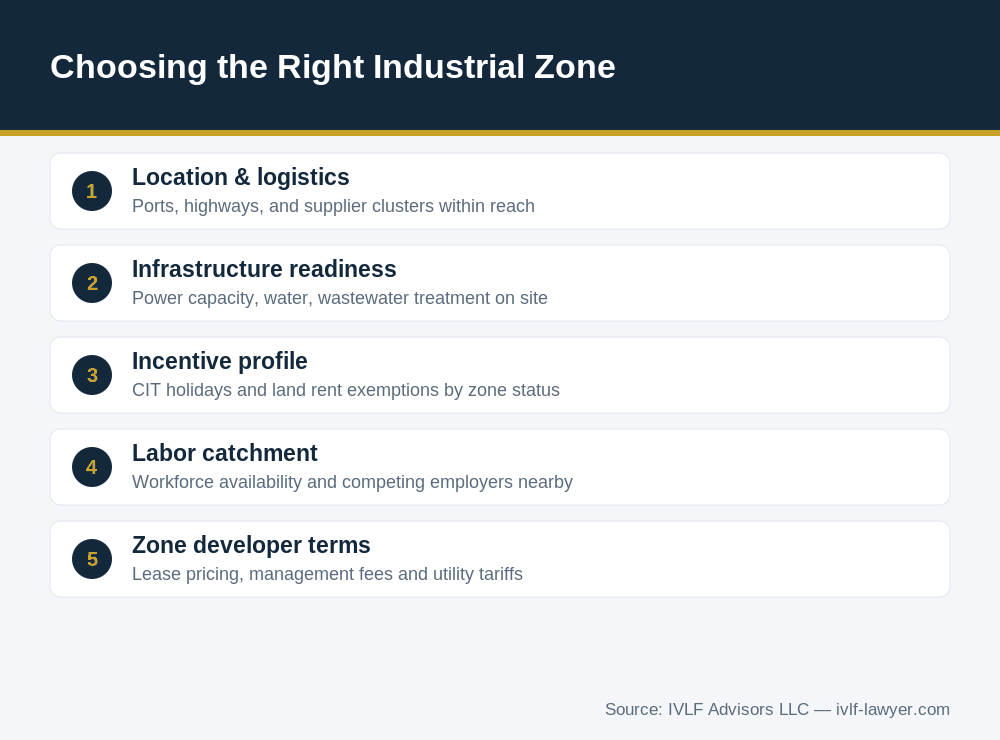 Beyond selecting an investment sector, investors setting up in an industrial zone must also choose the right zone – weighing infrastructure quality, proximity to ports and labor markets, incentive policies, and the zone’s existing tenant mix and sector focus.
2. Secure the Land Through an MOU or Deposit Agreement
An FDI company in industrial zones should negotiate the deposit agreement as carefully as the sublease itself: the refund conditions, the licensing condition precedent, and the reserved plot’s exact boundaries and utilities should all be written down. Zone sales teams move quickly with standard forms; investors should slow that moment down, because every later document builds on this one. Before the Investment Registration Certificate (IRC) application can proceed, investors typically sign a memorandum of understanding or deposit agreement with the industrial zone’s landlord/developer. This preliminary agreement sets out the land-use conditions and commits the investor to lease the land for the intended purpose. Reviewing the lease duration, rental rate, payment schedule, and any breach penalties carefully at this stage – before signing – avoids costly renegotiation later.
3. Prepare Your Business Plan and Financial Projections
With the sector, zone and land commitment identified, investors prepare a business plan (business description, market analysis, marketing strategy) and financial projections (revenue, expenses, cash flow) to support the investment application.
4. Obtain the Enterprise Registration Certificate
Under Article 19.2 of the Law on Investment No. 143/2025/QH15, the foreign investor may establish the Vietnamese economic organisation before applying for the project’s IRC. The ERC filing must reflect the proposed ownership, charter capital, registered office and business lines, while satisfying the foreign-investor market-access conditions under Article 8.
The dossier is filed with the competent provincial business registration authority under Decree No. 168/2025/ND-CP, as amended by Decree No. 296/2026/ND-CP. The ERC establishes the legal entity, but it does not by itself authorise construction, land use or implementation of an IRC-regulated industrial project.
5. Complete Corporate, Bank and Tax Setup
After the ERC, the company determines its seal arrangements, activates electronic tax and invoicing systems, organises accounting records and opens appropriate payment accounts. It should coordinate with its licensed bank on the direct investment capital account and the correct route for foreign-capital contributions.
At this stage, the company can also finalise the project dossier and negotiate the definitive industrial-zone sublease subject to the required investment, land, construction and environmental approvals. Capital remittance and binding project commitments should be structured consistently with the ERC, forthcoming IRC and foreign-exchange rules.
6. Obtain the Investment Registration Certificate and Finalise the Project Lease
The newly established company files the investment project dossier with the competent industrial-zone, economic-zone or provincial investment authority under the Law on Investment 2025 and Decree No. 96/2026/ND-CP. The dossier covers the project objectives, scale, location, capital, schedule, technology, land demand and environmental matters.
After the IRC and any required investment-policy approval are obtained, the company can finalise the definitive land sublease and proceed with construction, environmental, fire-safety and other project licences. The ERC-first rule does not permit the industrial project to begin before these approvals.
Incentives for an FDI Company in Industrial Zones
For an FDI company in industrial zones, the incentive package often tips the location decision: 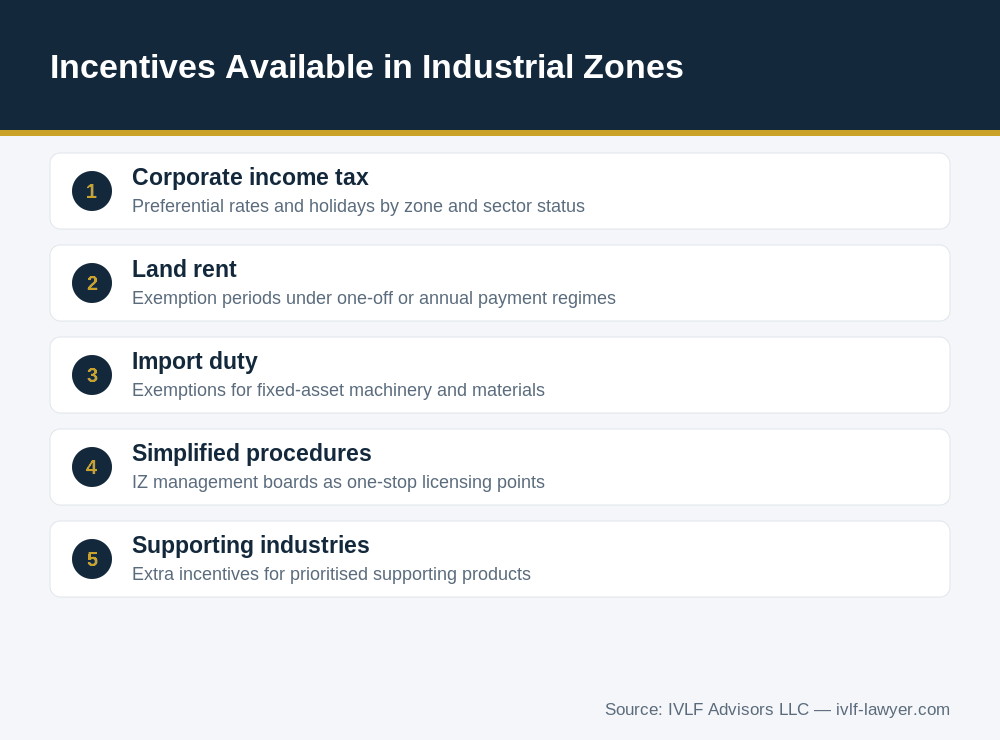 The details are zone- and sector-specific. Zones in difficult socio-economic areas carry stronger corporate income tax holidays; supporting-industry products qualify for extended preferences; and the land rent picture depends on whether the zone developer paid the state one-off or annually. An FDI company in industrial zones should have its incentive profile confirmed in writing – through the IRC’s incentive section – rather than assumed from marketing brochures.
Realistic Timeline: From Site Visit to Production
A well-run FDI company in industrial zones project moves from zone selection to production in roughly 12–20 months:  The FDI company in industrial zones licensing phase is the most predictable – IZ management boards operate as one-stop points and process IRC applications faster than provincial averages. The variance lives in construction permitting and utility connection, where the zone developer’s cooperation matters more than any statute.
Zone Types: IZ, EZ, EPZ and High-Tech Parks
Not every zone is the same animal, and the choice affects both incentives and obligations for an FDI company in industrial zones strategy. Standard industrial zones (khu công nghiệp) host general manufacturing. Economic zones (khu kinh tế) are larger territories with the deepest tax incentives. Export processing zones apply customs-controlled regimes suited to fully export-oriented producers – with real consequences for any domestic sales. High-tech parks add technology conditions in exchange for premium incentives. The practical FDI company in industrial zones test: match the zone type to the sales plan. An exporter serving global customers fits an EPZ; a producer expecting domestic distribution should avoid EPZ customs friction and pick a standard zone, even at a slightly higher tax rate.
Working With the Zone Developer
For an FDI company in industrial zones, the developer relationship outlasts every government procedure. The sublease contract deserves lawyer-level attention on four points: rent escalation formulas and management fees; utility tariffs and capacity guarantees; the developer’s obligations on infrastructure completion; and exit terms – assignment and sub-sublease rights if the project is later sold. Developers also differ in soft support: the better ones shepherd fire-safety approvals and environmental acceptance through their relationships. Asking existing tenants about their construction-phase experience is the single most predictive piece of diligence an FDI company in industrial zones applicant can do.
Financing and Capital Planning
FDI company in industrial zones projects are capital-intensive, and the registered investment capital on the IRC should anticipate the full build: land sublease payments, construction, machinery, and initial working capital. Understating capital to simplify licensing backfires – later increases require IRC amendments, and licensing authorities compare actual spending against registered figures during supervision reviews. Machinery imported as fixed assets for the project enjoys import-duty exemption, but the exemption attaches to the registered project scope – equipment lists should be prepared with customs treatment in mind. Financing through a mix of parent equity via the DICA and offshore shareholder loans is standard; loans beyond one year require State Bank registration, which is routine when planned and painful when discovered late.
Common Pitfalls
- Signing the land sublease before licensing strategy is set – deposit agreements should be conditional on IRC issuance.
- Underestimating power requirements – high-load manufacturers must verify substation capacity, not just nominal zone specifications.
- Ignoring wastewater standards – each zone’s treatment plant has intake standards that constrain process design.
- Missing the fire-safety approval path – a frequent cause of late production starts, as acceptance inspections cannot be rushed.
A Worked Example: Electronics Supplier, Bac Ninh
A Korean electronics component maker chose a Bac Ninh zone to serve nearby assembly customers. The updated FDI company in industrial zones sequence ran: zone shortlist against power and cleanroom requirements; MOU with a refundable deposit conditional on licensing; ERC issued first; corporate and banking setup; IRC issued through the zone’s management board; definitive land sublease executed; construction permit in seven weeks; and trial production in month eleven. Two FDI company in industrial zones decisions saved months. The company leased a ready-built factory for phase one while building its custom plant for phase two – revenue started in month five instead of month twelve. And it verified the zone’s wastewater intake standards against its plating process before signing, avoiding the redesign that caught two competitors in the same zone. The lesson for any FDI company in industrial zones plan: the legal path is standardised; competitive advantage hides in sequencing and site-specific verification.
Frequently Asked Questions (Continued)
Can the project expand later without new licensing? Capacity increases and additional lines generally require IRC amendments – routine, but they should be filed before the expansion operates, not after. What labor obligations attach from day one? Registration of internal labor rules once headcount thresholds are met, social insurance enrolment from the first hire, and union establishment engagement – zone labor authorities monitor manufacturers more actively than service businesses.
Key Legal Instruments
- Decree 35/2022/ND-CP – management of industrial zones and economic zones; text on the Government’s legal documents portal.
- Law on Investment 2020 – IRC procedures and investment incentives.
- Corporate income tax law and decrees – preferential rates and holidays; guidance via the Ministry of Finance.
Frequently Asked Questions
Can an FDI company in industrial zones lease a ready-built factory instead of land? Yes – ready-built factories shorten the timeline by the entire construction phase and suit lighter manufacturing; the trade-off is less customisation and recurring rent. Is 100% foreign ownership allowed? For most manufacturing activities, yes – ownership limits arise from sector rules, not from the zone. Do zones differ much between provinces? Substantially – in land price, labor availability, and administrative speed. The zone decision is a business decision with legal consequences, which is why the feasibility phase deserves real budget. A final note on people: manufacturing projects succeed or stall on the plant manager hired in month one. The licensing, land, and construction workstreams each need an owner on the ground who can meet the zone authority and the developer weekly – and every successful FDI company in industrial zones story we have advised had that person in place before the IRC was filed.
Conclusion
Setting up in an industrial zone gives manufacturing and production investors a head start on infrastructure, but it layers land-related steps – MOU/deposit, then a definitive lease – onto the standard FDI licensing process. Sequencing these correctly, with careful review of land terms before any commitment, keeps the project on schedule.
Considering an industrial zone location in Vietnam?
IVLF Advisors LLC advises foreign investors on zone selection, land lease negotiation, and the full ERC-first and IRC-second licensing process for industrial zone projects. Explore our practice areas or contact us to discuss your project.
Industrial Zone FDI Company: Utilities, Environmental and Fire Safety Approvals
An industrial zone FDI company in Vietnam benefits from a streamlined land-use process, but it still must clear utility connection and environmental approvals before construction can start. The zone management board typically pre-approves electricity, water and wastewater connection points as part of the site handover, which shortens the timeline compared to a standalone project outside a zone. However, manufacturing projects above certain thresholds still require an Environmental Impact Assessment (EIA) approved by the provincial Department of Natural Resources and Environment, and a Fire Prevention and Fighting (PCCC) design approval before the factory can be fitted out. Skipping the PCCC approval is one of the most common reasons zone-based factories fail their pre-operation inspection and cannot receive their operating certificate on schedule. Investors who are still deciding between a zone-based site and a standalone project should compare this against our broader FDI company setup roadmap for Vietnam, which covers the licensing sequence common to both models.
Lease Terms and Sub-Lease Risk in Vietnam’s Industrial Zones
Most industrial zone developers offer land or factory-shed leases for a term matching the zone’s remaining land-use right, commonly 40-50 years, with rent payable annually or as a lump sum. A critical but often overlooked point is that the zone developer’s own land-use right must remain valid for the full lease term – tenants should request a copy of the developer’s Land Use Right Certificate and confirm the expiry date before signing, since a sub-lease cannot outlast the head lease. Foreign investors should also check whether the zone developer requires a security deposit refundable only after the environmental clearance and PCCC certificates are issued, which can affect early cash flow planning. For the national list of licensed industrial zones and their regulatory status, see the Ministry of Planning and Investment industrial zone directory, and for fire safety design standards, see the official Fire Prevention and Fighting Police Department guidance.
This article is provided for general information only and does not constitute legal advice for any specific case. Regulations may change – please consult a qualified professional before acting. Should further analysis be required, please contact one of our lawyers below.