
A shareholder deadlock can affect decision-making, funding, operations and an investor?s ability to plan an orderly exit. The right response depends on the company documents, the shareholder relationship and the commercial facts.
Industrial parks in Bac Ninh remain one of Vietnam’s brightest destinations for foreign direct investment. Partnerships between domestic and international investors bring substantial resources – but also latent risks of governance disagreement and conflicting economic interests. When conflict peaks and “adversarial” shareholders threaten day-to-day business, a transparent, lawful restructuring and exit strategy becomes a matter of survival. IVLF Advisors LLC recently advised on and successfully resolved a complex divestment for an FDI company in the region (the “FDI Company“).
1. A Governance Crisis at the FDI Company
The FDI Company was a partnership between a domestic executive shareholder group (represented by “Mr A”) and a foreign investor (“Mr J”) holding 25% of charter capital. The cooperation fractured quickly due to structural weaknesses in the original arrangement:
- No involvement in management: throughout the company’s operation, Mr J took no direct part in managing or working at the FDI Company or its affiliated project (“Project T”);
- Financial disagreement: despite his 25% stake, Mr J had never received annual returns from Project T or the FDI Company;
- Escalating internal conflict: tensions between Mr A and Mr J intensified over profit distribution and the foreign investor’s demand to withdraw his capital.
With negotiations deadlocked and operations at risk of paralysis, the executive shareholder group mandated IVLF Advisors LLC to design a comprehensive and safe exit.
2. The Restructuring Brief Given to IVLF
Our team assessed that this was not an ordinary capital transfer but a restructuring exercise demanding deep command of both finance and corporate law. The management board asked IVLF to resolve three core issues:
- Design a lawful exit route enabling Mr J to divest his entire holding in full compliance with current Vietnamese law;
- Unpick the historical cash flows: the deal’s biggest bottleneck was money Mr J had transferred directly into Project T’s payment account since 2015. IVLF re-examined the legal nature of those funds, advised on their treatment, and determined the precise final settlement amount acceptable to Mr J;
- Comprehensive risk management: assessing every latent risk in negotiating and executing the withdrawal, ensuring no post-closing exposure to claims, tax reassessment or breaches of foreign exchange control regulations.
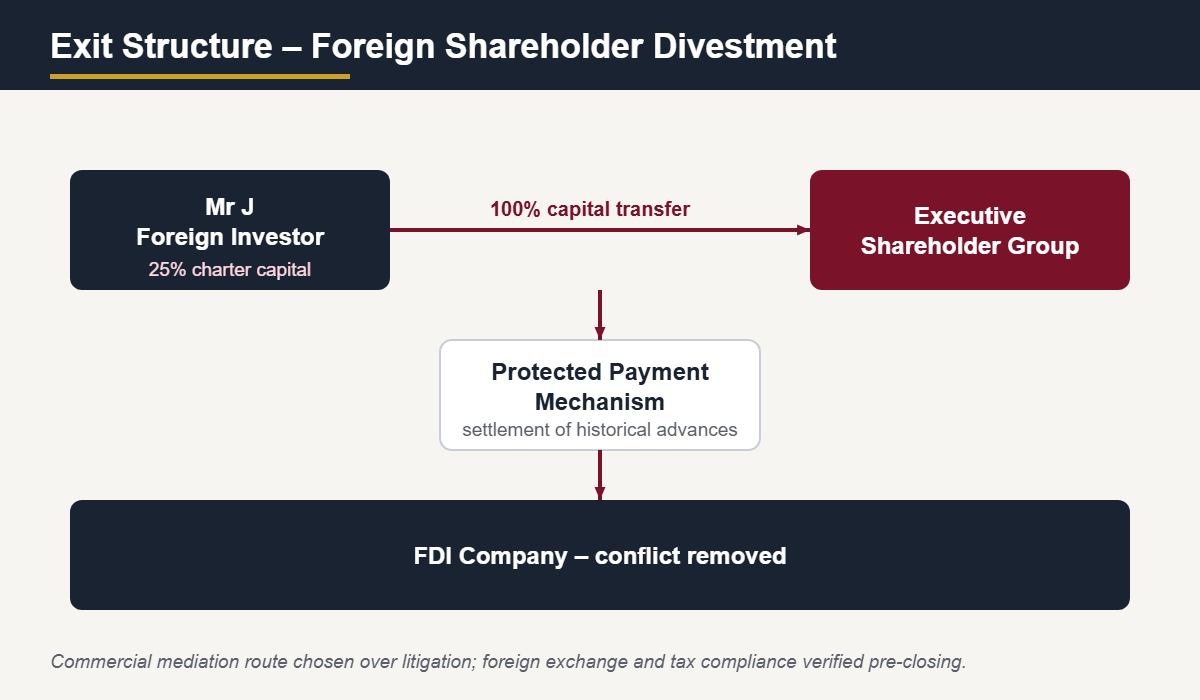
Simplified exit structure designed by IVLF Advisors for the divestment.
3. The Independent Advisor’s Solution
Applying flexible commercial thinking on a solid legal foundation, IVLF untangled the transaction step by step. Rather than letting the matter drift into years of litigation, we proposed commercial mediation options paired with a tightly protected payment mechanism.
The successful divestment removed the internal conflict entirely, allowed the remaining shareholders to restructure their ownership ratios, cleaned up the company’s financial picture and readied the business for new partnership opportunities.
Key Legal References
- Law on Enterprises 2020 (as amended by Law No. 76/2025/QH15): capital transfer procedures, member/shareholder rights and post-closing registration updates, including beneficial-owner disclosure;
- Law on Investment: M&A approval and notification requirements applicable to transactions involving foreign investors;
- Foreign exchange control: the Ordinance on Foreign Exchange and State Bank guidance on investment capital accounts governing the routing of settlement payments.
Related practice areas: Mergers & Acquisitions · Dispute Resolution · Corporate & Commercial
Facing a similar challenge?
IVLF Advisors LLC advises investors and enterprises on restructuring, M&A, employment and cross-border transactions in Vietnam. Contact us for a confidential assessment of your matter.
Shareholder deadlock: identify the actual point of disagreement
A shareholder deadlock is not simply a difficult relationship between owners. It becomes a governance issue when the company cannot take a decision that is necessary for its business, financing, management or compliance. The first step is to identify the specific decision that is blocked, the voting threshold that applies and the consequence of not deciding.
Relevant documents may include the charter, shareholders? agreement, investment agreement, board resolutions, voting records, financing documents and communications between the parties. A careful review can distinguish a legal veto from a commercial concern, a temporary negotiation point from a structural shareholder deadlock, and a disagreement about information from a disagreement about control.

Seven practical questions for an FDI investor
- Which decision is blocked? A shareholder deadlock should be linked to a defined matter such as capital, appointments, budgets, financing, business scope or a proposed transaction.
- What do the documents require? Confirm the applicable quorum, voting threshold, notice process and any escalation or consultation requirement.
- Is the information complete? The parties should have access to the financial, operational and legal information needed to assess the proposed decision.
- Are there immediate compliance risks? Some unresolved matters may affect statutory filings, signing authority, bank accounts, employees or contractual commitments.
- Can an interim arrangement work? A narrow interim authority or agreed budget may protect operations while the broader dispute is addressed.
- Is a transfer or exit contemplated? The documents may include pre-emption, tag, drag, put, call or valuation provisions that require close review.
- Who communicates externally? The company should avoid inconsistent messages to staff, customers, lenders or regulators while the shareholder deadlock is unresolved.
Preserving the company while discussions continue
A shareholder deadlock can escalate when ordinary operations are allowed to become bargaining tools. Where possible, the parties can agree a limited protocol for payroll, tax, essential contracts, customer commitments, data access and reporting. The protocol does not resolve ownership issues; it helps the business continue while the owners assess their options.
The company can also maintain a shared evidence file containing the current corporate documents, financial position, material contracts, approvals and correspondence relevant to the blocked decision. Keeping an agreed factual record reduces the risk that negotiations are dominated by competing versions of what happened.

Evaluating a negotiated exit
For a foreign investor, an exit discussion should be approached as both a commercial and legal workstream. The parties may need to consider the proposed buyer, ownership restrictions, valuation methodology, payment mechanics, conditions precedent, representations, releases, management transition and required approvals. A shareholder deadlock does not automatically determine the price or the structure of an exit; those outcomes depend on the documents and the relevant facts.
It is useful to prepare a short issue list before negotiations begin. The list can identify the transaction objective, each party?s stated concern, the documents that support or challenge a position, the decisions needed from the company and any timetable driven by financing or operations. This preparation helps an investor decide whether a negotiated solution is realistic and what safeguards should be included in any agreement.
Valuation conversations are often more productive when the parties agree the information set and methodology before debating a final number. An agreed process can address financial statements, debt, working capital, contingent liabilities, related-party matters and any adjustment that is relevant to the proposed deal. Independent input may be appropriate where the documents require it or where the parties need a common reference point.

Dispute prevention and record-keeping
Many shareholder deadlock situations can be managed more effectively when the company has clear approval paths, regular board information and written records of material decisions. Owners should know which matters require shareholder approval, which are delegated to management and how an urgent matter can be addressed without bypassing governance requirements.
Investors should also consider whether the documents include an escalation route, mediation, expert determination, arbitration or court process. The appropriate route depends on the agreement and the facts. Starting a formal process without first identifying the decision, the evidence and the desired outcome can make a shareholder deadlock harder to resolve.
Reliable reference points
For broader governance context, readers may review the OECD Principles of Corporate Governance and the Government News portal. These materials are general references and do not determine the outcome of a particular investment dispute.
This article provides general information only. A shareholder deadlock involving an FDI company should be assessed against the current charter, transaction documents, ownership structure and commercial circumstances before an investor commits to an exit, settlement or formal dispute process.
Shareholder deadlock review checklist
- Shareholder deadlock and governance: is the blocked decision and voting rule clearly identified?
- Shareholder deadlock and evidence: are the relevant records complete and accessible?
- Shareholder deadlock and operations: can essential business functions continue under a limited protocol?
- Shareholder deadlock and exit: have the legal and commercial conditions for a transfer been mapped?
Building a decision and evidence map
When a shareholder deadlock is being assessed, an evidence map can bring discipline to a situation that may otherwise be driven by incomplete information. The map can list the decision at issue, the persons or bodies entitled to make it, the relevant voting rule, the documents that support each position and the immediate operational consequence of delay. It should be maintained as a working document rather than as a substitute for legal analysis.
The first category of documents normally concerns governance: the current charter, shareholders? agreement, board rules, appointment records and any resolution that delegated authority. The second category concerns the commercial setting: budgets, financing documents, material contracts, forecasts, correspondence and records of previous approvals. The third category concerns the proposed solution: draft transfer documents, a settlement outline, valuation materials or a proposed interim protocol.
Separating these categories helps the parties see whether a shareholder deadlock concerns legal authority, commercial risk, information asymmetry or a combination of those issues. It can also reveal that some matters are capable of agreement even though the principal dispute remains unresolved. For example, the parties may agree a limited operating budget, access to monthly reporting or a procedure for approving essential payments.
Understanding the transaction perimeter
An investor exit may involve more than the transfer of shares. The transaction perimeter can include shareholder loans, guarantees, options, management appointments, intellectual-property arrangements, bank mandates, supply contracts, employment relationships and rights to use group services. A proposed purchaser will usually need to understand how these matters are connected to the company and what will happen to them on completion.
Before a term sheet or settlement is finalised, the parties should identify which assets and liabilities are inside the proposed deal, which remain with a shareholder or affiliate and which require third-party consent. A shareholder deadlock may make this exercise more difficult because the parties can disagree on the underlying facts. A documented information request and response process can reduce later arguments about disclosure.
Where an FDI company is involved, the ownership route, investment registrations, enterprise records and sector-specific conditions may also need to be considered. The applicable requirements depend on the transaction and the business activities at the relevant time. The important practical point is to identify the approvals and filings early enough to build them into the transaction timetable.
Valuation, funding and payment mechanics
Valuation is often the commercial centre of a shareholder deadlock resolution. The governing documents may prescribe a formula, a valuation date, an expert process or a negotiation route. If they do not, the parties can still agree a framework that identifies the financial information to be used, the treatment of debt and cash, the assumptions for the business plan and any adjustment for contingent liabilities or related-party transactions.
A valuation discussion is more credible when the parties agree the source data before arguing about the result. They may need to decide which accounts are available, whether management forecasts are reliable, how material disputes are treated and whether the proposed buyer will assume particular obligations. The process should also state whether an independent valuer is engaged, what questions the valuer is asked to address and how the costs are allocated.
Payment mechanics deserve equal attention. A headline price may be paid in a single amount, in instalments, through an escrow, subject to a completion adjustment or in connection with releases and other documents. The seller should understand the conditions for payment; the buyer should understand the assets, risks and authority it is acquiring. These details can determine whether a negotiated solution genuinely resolves the shareholder deadlock.
Consents, notices and implementation
Before signing, the transaction team can prepare an implementation schedule. The schedule may cover board or shareholder approvals, notices to pre-emption holders, lender or contractual consents, regulatory filings, tax steps, banking updates and changes to signing authority. Assigning an owner and target date to each item helps the parties distinguish a commercial agreement from a deal that can actually be completed.
The company should also consider the operational transition. Staff, customers, suppliers and advisers may need carefully framed communications once a decision is made. Until then, communications should be accurate and limited to what is necessary. A shareholder deadlock can cause additional harm if competing owners make public or customer-facing statements that the company cannot support.
Data and access controls are another practical issue. The company can review who has access to finance systems, contracts, customer information, email accounts and statutory records. Any change should be made through a documented process that protects business continuity and respects the authority that remains in place before completion.
Settlement terms and future risk
A settlement document should be considered in the context of the dispute it resolves and the relationship it leaves behind. It may address price, transfer mechanics, releases, confidentiality, non-disparagement, expenses, cooperation on filings, management transition and treatment of claims. The appropriate drafting depends on the facts; standard wording should not be assumed to fit every shareholder deadlock.
The parties may also need to address the future of information, intellectual property, trade names, customer relationships or services that were previously shared. A clean separation requires practical arrangements for these matters, not merely a transfer form. Where the company will continue with a new ownership structure, the incoming governance documents should make the approval process clearer than the arrangements that led to the dispute.
Using the process constructively
The existence of a shareholder deadlock does not mean that formal proceedings are inevitable. A structured review can create a common factual basis, narrow the issues and help the parties assess the cost of delay. It can also identify whether a limited interim arrangement protects value while a longer-term solution is negotiated.
For investors, the key questions are practical: what decision is required now; what evidence supports the preferred outcome; which approvals or consents are needed; what is the realistic timetable; and how will the company continue to operate during the process? Working through these questions carefully helps transform a shareholder deadlock from an open-ended dispute into a sequence of decisions that can be managed.
This article is provided for general information only and does not constitute legal advice for any specific case. Regulations may change – please consult a qualified professional before acting. Should further analysis be required, please contact one of our lawyers below.