
A representative office in Vietnam is often the lowest-commitment way for a foreign company to establish a presence in Vietnam – an extension of the parent company that can conduct market research and promotional activities, but not generate revenue directly. For companies testing the Vietnamese market before committing to a full subsidiary, it is a well-trodden first step. Here is how the process works.
Eligibility Requirements
To open a representative office in Vietnam, the foreign parent company generally must have been operating for at least one year from its date of incorporation, and the application must include: a copy of the parent company’s business registration certificate or equivalent; a power of attorney from the parent’s legal representative; a decision appointing the office’s chief representative; the chief representative’s passport or identity document; the parent company’s latest audited financial statement or written confirmation of its tax obligations; and documentation of the office’s proposed registered location.
Step 1: Submit the Application
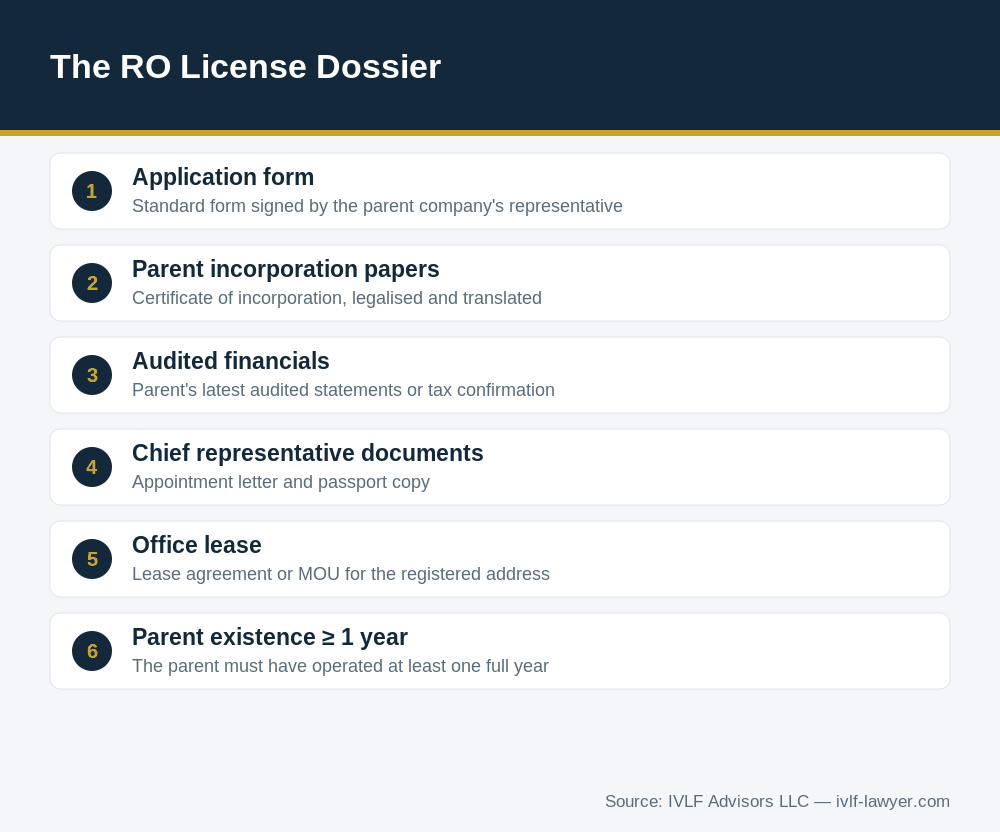
The application is filed with the provincial Department of Industry and Trade (DOIT) if the office will be located outside an industrial zone, or with the provincial Management Board of Industrial Zones (MBIZ) if inside one. Filing can be done in person, online, or by post.
Step 2: Obtain the License
The DOIT or MBIZ reviews the application and, for a complete and valid dossier, issues the representative office license within seven working days.
Step 3: Complete Post-Licensing Procedures
Once licensed, the representative office still needs to complete several post-licensing steps before it can operate day to day: obtaining a company seal, registering with the local tax office for a tax code, opening a bank account, and registering to recruit Vietnamese employees.
Ongoing Reporting
Treat the reporting calendar as part of the office’s definition rather than an afterthought. The obligations are few, fixed, and annual – which is precisely why they are easy to forget once the office settles into routine, and why assigning them to a named person at setup prevents the lapses that licensing authorities notice.
Representative offices must submit annual reports to the DOIT or MBIZ where they are registered, covering the office’s activities and financial status – an ongoing compliance obligation that continues for as long as the office operates.
What a Representative Office in Vietnam Can and Cannot Do
The trade-off for the light setup is a strict activity boundary. A representative office in Vietnam may conduct market research, act as a liaison office, and promote the parent’s business – but it cannot generate revenue.
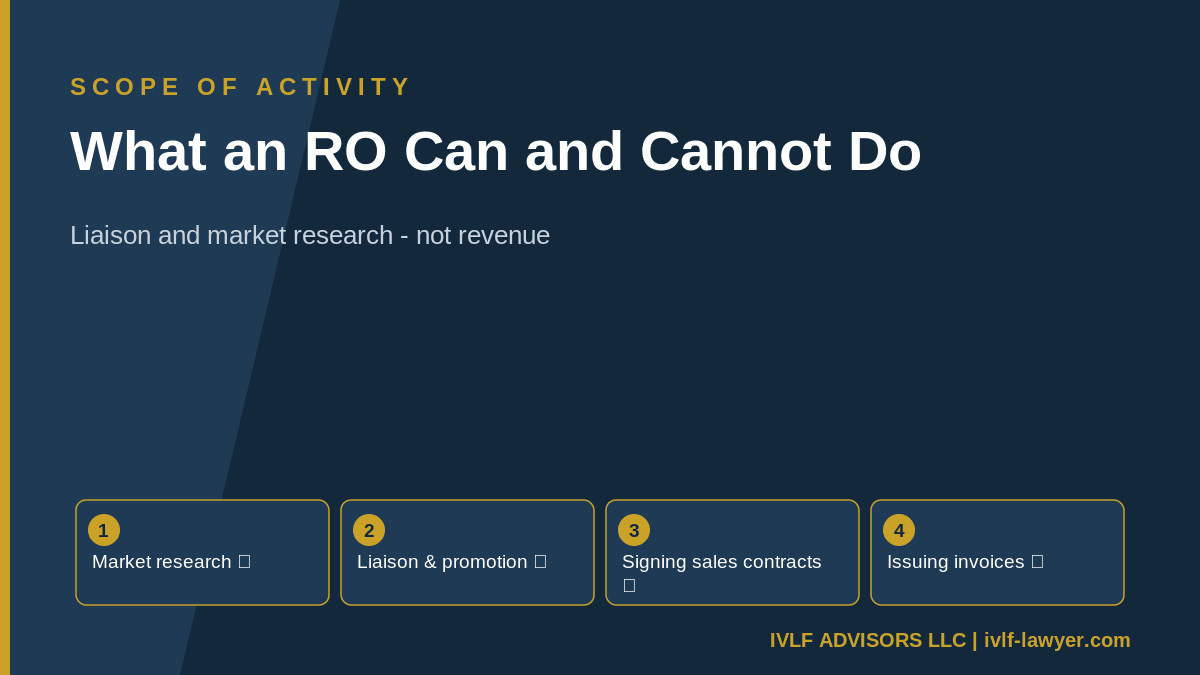
The forbidden zone matters more than the permitted one: no signing sales contracts (except office-operations contracts like the lease), no issuing invoices, no receiving sales proceeds, and no direct profit-making activity. Crossing the line risks the license and creates a permanent-establishment tax problem for the parent.
In practice, the boundary question surfaces around sales support. Staff of a representative office in Vietnam can introduce customers, relay pricing prepared by the parent, and coordinate deliveries – but the contract itself must be concluded by the parent abroad.
Ongoing Compliance for a Representative Office in Vietnam
The compliance calendar is short but unforgiving:
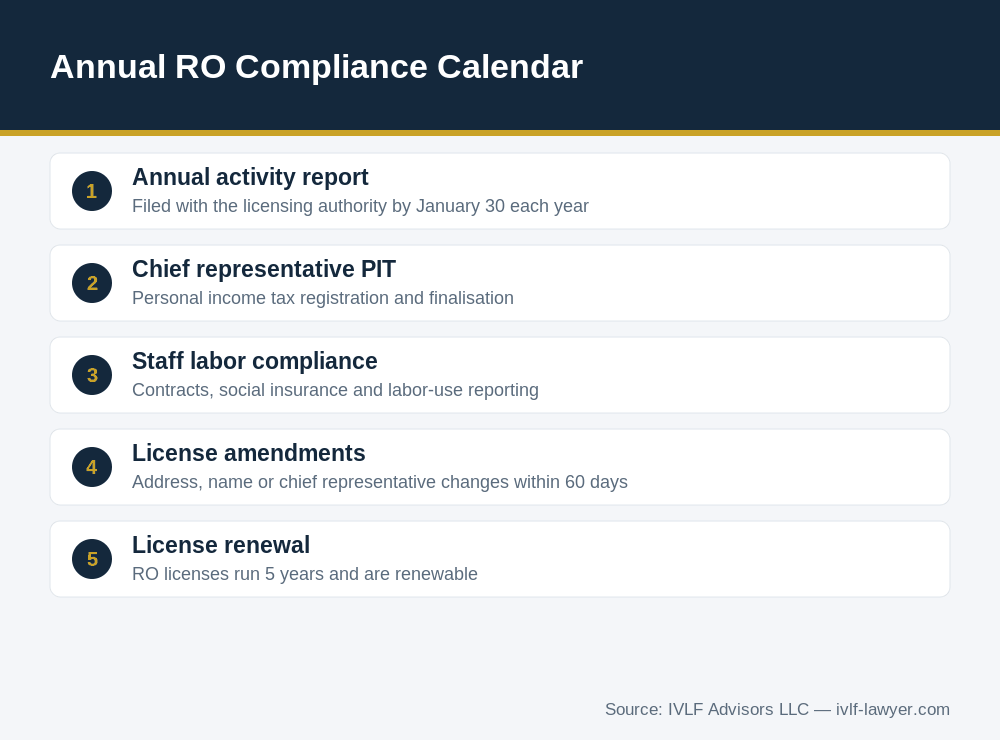
The annual activity report – due by January 30 – is the anchor. Persistent failure to file is a ground for license revocation, and licensing authorities have been noticeably more active on this in recent years.
Representative Office vs. Company: Choosing the Right Vehicle
The choice usually turns on one question: does the Vietnam presence need to earn revenue? If yes, a representative office in Vietnam is the wrong vehicle – incorporate a subsidiary instead. If the goal is testing the market, supporting distributors, or managing sourcing relationships, the RO wins on cost and speed: no charter capital requirement, a 7-working-day licensing timeline, and far lighter accounting.
Many foreign companies sequence the two: open a representative office in Vietnam first, validate the market for one or two years, then upgrade to a company – often hiring the RO’s team into the new entity and closing the office.
Budgeting: What a Representative Office in Vietnam Costs
Setup costs are modest by regional standards. Beyond professional fees, the real budget items are the office lease – serviced offices are accepted in most provinces – document legalisation and translation for the parent’s papers, and the chief representative’s work permit where a foreigner fills the role.
Running costs are dominated by payroll and rent. Because a representative office in Vietnam files no VAT or corporate income tax returns, its accounting burden – and accounting fees – run a fraction of a company’s. Most parents budget the office as a fixed monthly cost with almost no compliance variance.
Why Applications Get Refused or Delayed
Refusals are rare; requests for supplementation are common. The usual culprits: parent financial statements not audited or older than the latest fiscal year; legalisation chains that miss a step between notary, foreign ministry, and Vietnamese consulate; lease documents for premises that lack the right commercial function; and a parent that has operated for less than one year – an eligibility floor with no workaround.
A practical tip: authorities check that the parent’s business lines match the proposed office activities. A parent trading in machinery should describe machinery-related liaison work, not generic “business development”.
Closing or Converting the Office
Winding up a representative office in Vietnam is a formal procedure, not an abandonment: settle staff obligations, finalise personal income tax, close the bank account, return the seal, and file for termination with the licensing authority. The most common closing friction is tax finalisation for the chief representative – keep those records current from day one and closure takes weeks, not months.
Conversion to a company is not a legal transformation – the company is incorporated separately – but assets, staff, and the lease can transfer in practice, and many landlords and employees experience it as a seamless upgrade.
Choosing the Location and Address
The registered address does real work in this structure. It must be a premises lawfully usable for office purposes – serviced offices and co-working addresses are widely accepted, but residential apartments are not. Licensing practice also varies by city: Ho Chi Minh City and Hanoi process the largest volumes and are the most predictable, while smaller provinces may ask more questions simply because applications are rarer.
Two practical notes. First, the license ties the representative office in Vietnam to a specific province; relocating across provincial lines means a new application, not an amendment. Second, landlords accustomed to foreign tenants will provide the ownership and function documents the dossier needs – ask for them before signing, not after.
For sourcing-driven parents, proximity to suppliers often beats prestige addresses: a representative office in Vietnam near the industrial clusters of Binh Duong or Bac Ninh shortens factory visits far more than a downtown tower improves anything.
Key Legal Instruments
- Decree 07/2016/ND-CP – the core decree on representative offices and branches of foreign traders; text on the Government’s legal documents portal.
- Circular 11/2016/TT-BCT – forms and procedural guidance from the Ministry of Industry and Trade.
- Commercial Law 2005 – the statutory basis for foreign traders’ presence in Vietnam.
Frequently Asked Questions
How long does it take to open a representative office in Vietnam? The license itself takes 7 working days from a complete dossier. End to end – including document legalisation abroad, seal, tax code, and bank account – plan for four to eight weeks.
Can the chief representative be a foreigner? Yes. A foreign chief representative needs a work permit or exemption certificate, and the appointment must be reported in the license dossier.
Does a representative office in Vietnam pay taxes? The office itself has no corporate income tax – it earns nothing – but it must register a tax code, withhold and finalise personal income tax for its staff, and keep payroll records.
Can one parent open several offices? Yes, in different provinces – each with its own license and its own chief representative.
Can the office hire staff directly? Yes – a representative office in Vietnam is an employer in its own right: it signs labor contracts, registers social insurance, and reports labor use like any local employer, for both Vietnamese and foreign staff.
Is there a cap on headcount or office size? No statutory cap exists. In practice, an office whose scale looks like a trading operation invites questions about whether its activity has drifted beyond liaison – another reason to keep documentation aligned with the licensed scope.
A final planning note on banking: the office’s account is for operating expenses only – rent, payroll, utilities – funded by remittances from the parent. Banks will ask for the license and the chief representative’s papers at account opening, and a clean funding pattern from the parent makes both annual reporting and eventual closure smoother. Any inbound payment that looks like customer money is a red flag for the bank and for the licensing authority alike.
Conclusion
Opening a representative office gives foreign companies a fast, relatively low-cost way to establish a first-market presence in Vietnam and assess the business environment before deciding whether to set up a full subsidiary. Meeting the eligibility criteria and preparing a complete application dossier keeps the process to its standard seven-working-day licensing timeline.
Considering a representative office in Vietnam?
IVLF Advisors LLC advises foreign companies on representative office licensing, post-licensing compliance, and the pathway to full subsidiary establishment. Explore our practice areas or contact us to get started.
2026 Procedural Update for a Representative Office in Vietnam
Decree 07/2016/ND-CP remains the operative decree in 2026, but the administrative layer around it has changed. The application forms were consolidated under Consolidated Document 23/VBHN-BCT issued in 2026, and Circular 15/2026/TT-BCT dated 25 March 2026, effective 10 April 2026, amended the administrative procedures in areas managed by the Ministry of Industry and Trade. Foreign traders preparing a filing should check that they are using the consolidated form set rather than the 2016 originals.
The two-tier local government reform has also changed which office receives the file in several provinces. Where the office will sit inside an industrial park, export processing zone, economic zone or hi-tech park, the management board of that zone issues the licence rather than the provincial Department of Industry and Trade, and the address on the lease fixes that competence. Confirming the correct authority before signing the lease avoids a refiling.
Related representative office guides from our team
- Establish Representative Office in Vietnam: Proven 5-Step Process
- Vietnam Representative Office Licence: Renewal and Compliance
- Vietnam Rep Office vs Branch vs Subsidiary: 3 Proven Options
- Company Incorporation in Vietnam
- VIE Structure in Vietnam: Risks and Alternatives
15 Things to Prepare Before Setting Up an FDI Company in Vietnam
A four-page pre-filing checklist covering structure and market access, capital and the DICA account, licensing and legalisation, work permits, and tax. Current to July 2026, including Decree 96/2026/ND-CP, Decree 219/2025/ND-CP and Decree 236/2025/ND-CP.
This article is provided for general information only and does not constitute legal advice for any specific case. Regulations may change – please consult a qualified professional before acting. Should further analysis be required, please contact one of our lawyers below.