Private equity investment in Vietnam has become well established, drawn by sustained economic growth, favorable demographics, and government policies supportive of foreign investment. For private equity firms evaluating Vietnam-based targets, understanding both the opportunity and the practical deal process is essential.
Where Private Equity Is Focused
Capital allocation follows visible signals: consumption data, licensing openings, and the exit history of earlier vintages. Reading those signals sector by sector – rather than importing a regional thesis wholesale – is what separates funds that source proprietary deals from those bidding in the same processes as everyone else.
Private equity investors in Vietnam have traditionally concentrated on consumer goods, healthcare, and technology-enabled businesses, with a rising share of capital directed toward companies with strong ESG credentials – renewable energy, healthcare access, and education among them. This mirrors a broader global shift toward incorporating environmental, social and governance factors into investment decisions.
Key Challenges
Behind each private equity investment in Vietnam challenge sits a manageable process reality. Valuation gaps narrow when audited numbers replace management accounts; founder-control concerns resolve through governance design rather than ownership percentage; and regulatory complexity, while real, follows published procedures with predictable timelines. The funds that struggle here are typically applying a regional playbook without local adjustment – the ones that thrive have translated each challenge into a diligence item, a document, or a deal term.
Despite the attractive climate, private equity investors in Vietnam continue to navigate two recurring challenges:
- Regulatory clarity: Vietnam’s legal and regulatory framework continues to evolve, and inconsistencies or ambiguities can complicate deal structuring and post-investment governance.
- Talent availability: despite a large workforce, sector-specific skilled talent can be scarce, making it harder for investors to staff and grow portfolio companies post-close.
How a Private Equity Deal Typically Proceeds

Private equity investment into a Vietnamese company generally follows a structured process:
- Due diligence: a thorough review of the target’s financial statements, market position, management team, and other key factors to assess investment fit.
- Target identification: firms identify targets seeking expansion capital or companies facing financial pressure that need a capital injection.
- Negotiation: deal terms – valuation, structure, governance rights, and protective provisions – are negotiated between the parties.
- Regulatory compliance: the transaction is structured and completed to satisfy Vietnam’s foreign investment and M&A regulatory requirements before closing.
Deal Structures in Private Equity Investment in Vietnam
Structure follows purpose. Minority growth equity – the most common form of private equity investment in Vietnam – delivers new capital through a share subscription, paired with reserved matters and board seats that give the fund influence without control. Control buyouts remain rarer, concentrated in sectors where founders seek full exits.
Between the two sit convertible structures that bridge valuation gaps, and offshore holding company arrangements – typically Singapore – that host the investment documents while the operating company stays Vietnamese. Listed-company stakes follow securities rules with their own disclosure thresholds.
Governance: What Funds Actually Negotiate
Because most private equity investment in Vietnam is minority investment, the governance package is the real product being bought:
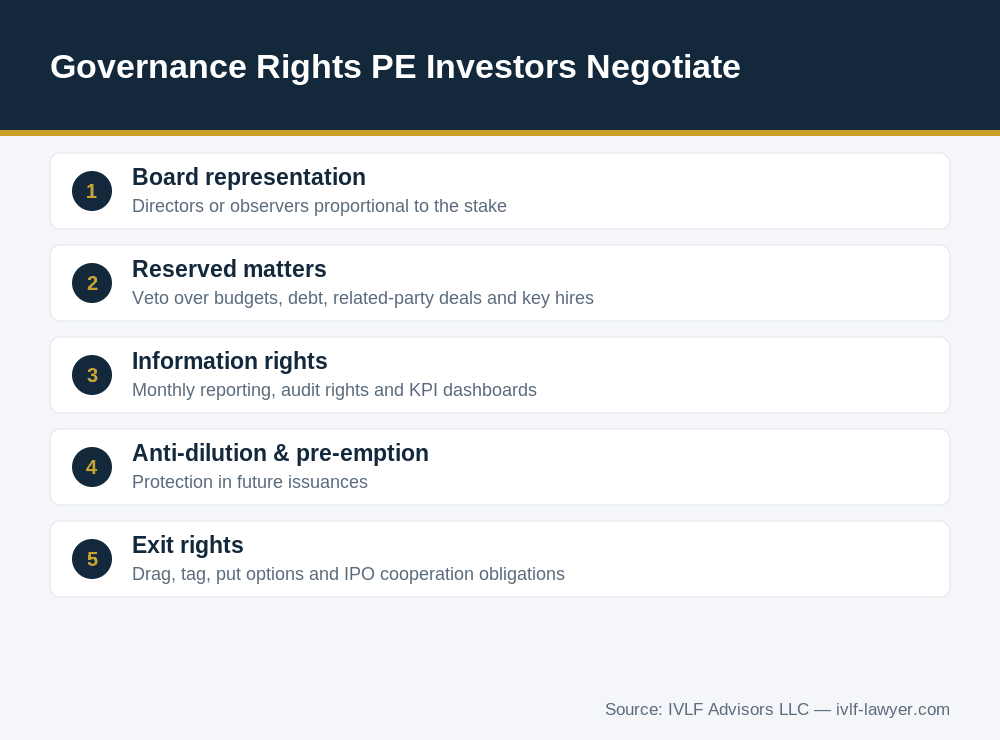
Vietnamese corporate law gives minority holders limited statutory protection, so these rights live or die by the charter and shareholders’ agreement. The practical test of a governance package is simple: can the fund block the actions that destroy value – new debt, related-party transfers, dilutive issuances – and can it force information out of the company monthly?
Exit Routes and Their Legal Mechanics
Funds underwrite exits before they invest. Four routes dominate private equity investment in Vietnam:
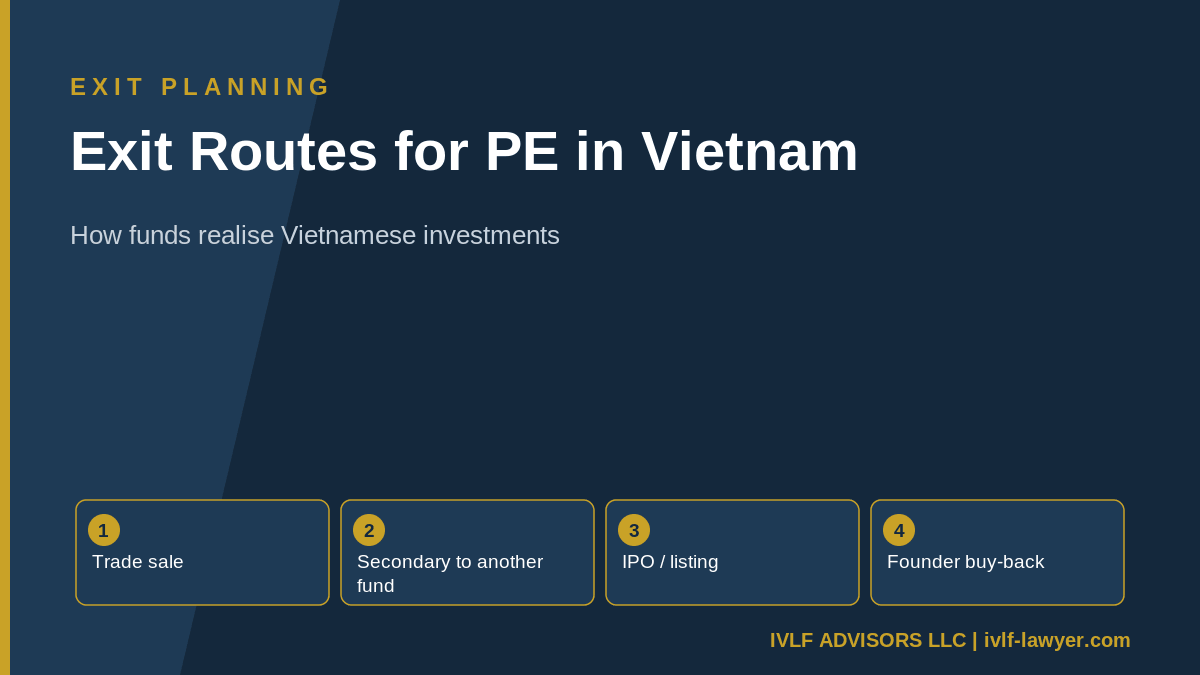
Trade sales lead private equity investment in Vietnam exits in practice – a strategic buyer acquiring the fund’s stake, with M&A approval and DICA mechanics mirroring the entry. Secondaries to other funds are growing as early vintages mature. IPOs on HOSE remain possible but timeline-sensitive, and founder buy-backs – often via put options negotiated at entry – serve as the backstop route.
The exit article of the shareholders’ agreement deserves the most negotiation time: drag thresholds, tag rights, put option pricing formulas, and IPO cooperation duties determine whether the paper exit becomes a real one.
Approvals and Timing: The Vietnamese Layer
Two procedural layers distinguish private equity investment in Vietnam from regional peers. First, M&A approval: a foreign fund acquiring equity in most sectors needs the provincial Department of Planning and Investment’s confirmation before registry changes – two to four weeks in routine cases, longer in conditional sectors. Second, funding mechanics: the investment must arrive through the target’s DICA, and the remittance must match the approved transaction to the dollar.
Neither private equity investment in Vietnam layer is a barrier; both are calendar items. Funds that wire these steps into the deal timetable close on schedule; those that discover them at signing add six weeks of avoidable delay.
Sector Watch: Where the Next Vintage Is Looking
Current private equity investment in Vietnam activity concentrates in five themes: consumer businesses riding domestic demand; healthcare and education, where fragmented private markets reward consolidation; financial services and fintech, subject to sector caps; logistics and industrial services attached to manufacturing growth; and increasingly, energy transition assets.
Each theme carries its own regulatory texture – ownership caps in banking, licensing in education, land questions in logistics – which is why sector diligence in Vietnam is inseparable from legal diligence.
A Worked Example: Minority Growth Deal, Start to Finish
A regional fund invested USD 25 million for 30% of a Vietnamese healthcare chain. The sequence: eight weeks of diligence; a Singapore-law subscription and shareholders’ agreement paired with Vietnamese-law charter amendments; M&A approval obtained in three weeks; funds through the DICA at closing; and a governance package of two board seats, fourteen reserved matters, monthly reporting, and a put option exercisable from year five.
The deal’s only friction was historic: unpaid charter capital from the target’s founding years, cured by a capital reduction filed before closing. Every element – the finding, the cure, the timeline – is typical of private equity investment in Vietnam done properly.
What Sellers and Founders Should Prepare
Founders courting private equity investment in Vietnam funds can compress deal timelines with six months of preparation. Financially: audited statements and a defensible growth model. Legally: charter capital fully contributed, licenses current, land documents complete, related-party dealings papered at market terms, and the cap table reconciled to the registry.
Equally important is governance readiness. A founder who has never reported monthly to anyone will find reserved matters claustrophobic; walking through the standard governance package with counsel before the term sheet – and deciding which matters genuinely require flexibility – converts the negotiation from emotional to commercial.
Finally, align the shareholder group early. Private equity investment in Vietnam processes stall most often not on price but on a minority family shareholder discovered late, whose signature the transfer needs and whose expectations no one managed.
Frequently Asked Questions (Continued)
Preference shares or ordinary shares? In a Vietnamese JSC, funds take dividend-preference or voting-preference shares where the charter supports them; in LLC targets, preference economics are synthesised contractually or the structure moves offshore.
What tax applies at exit? Share transfers by foreign corporate sellers generally attract capital transfer tax on the gain; the SPA should allocate filing duties and withholding mechanics explicitly to avoid closing-day surprises.
One more procedural note worth planning for: where the target operates in a conditional sector – education, healthcare, fintech, logistics with transport elements – the M&A approval review examines foreign-ownership caps and sub-license conditions in detail, and approval timelines stretch accordingly. Build the sector’s specific approval history into the timetable rather than assuming the routine case.
Key Legal Instruments
- Law on Investment 2020 – market access, conditional sectors and M&A approval; text on the Government’s legal documents portal.
- Law on Enterprises 2020 – share classes, governance and shareholder agreements.
- Circular 06/2019/TT-NHNN – DICA rules for investment flows; see the State Bank of Vietnam.
- Law on Securities 2019 – listed-company stakes and disclosure thresholds.
Frequently Asked Questions
What ticket sizes define private equity investment in Vietnam? The market clusters between USD 10–100 million per deal, with regional funds at the upper end and Vietnam-dedicated vehicles active below USD 30 million. Venture capital occupies the space beneath.
How long do funds hold? Four to six years is typical – long enough for growth plans to mature, short enough to fit fund lives. Extensions are common where IPO windows close.
Do foreign PE funds need a local license? No – the fund invests as a foreign investor through the standard approval process. What it needs locally is execution: counsel, tax structuring, and a bank comfortable with DICA mechanics.
A final observation from practice: the funds that perform best in this market treat legal process as part of the investment thesis rather than friction around it. Approval timelines, DICA mechanics, and governance enforcement are knowable, plannable variables – and pricing them correctly at entry is itself a source of returns. In private equity investment in Vietnam, execution quality is alpha.
Conclusion
Private equity investment in Vietnam-based companies continues to offer strong opportunities for investors seeking exposure to a growing emerging market. Success depends on pairing an understanding of sector trends with careful navigation of the regulatory and talent challenges that remain part of the landscape.
Evaluating a private equity investment in Vietnam?
IVLF Advisors LLC advises private equity investors and target companies on due diligence, deal structuring, and regulatory compliance for Vietnam-based transactions. Explore our practice areas or contact us to discuss your deal.
This article is provided for general information only and does not constitute legal advice for any specific case. Regulations may change – please consult a qualified professional before acting. Should further analysis be required, please contact one of our lawyers below.