
Updated 30 July 2026
Foreign-invested M&A in Vietnam takes six to eleven months from term sheet to completion, and regulatory clearance — not negotiation — consumes most of that time. The commercial terms you are used to negotiating will translate; the enforcement assumptions behind them frequently will not. That gap is where most M&A in Vietnam goes wrong.
2026 has been the most active year for Vietnamese deal law in a decade. A new Investment Law took effect on 1 March 2026. Merger control thresholds roughly doubled on 1 July 2026. Nominee shareholding — long used to work around foreign ownership caps — was expressly prohibited on 23 July 2026. Any structuring memorandum drafted before March 2026 needs to be revisited.
This guide to M&A in Vietnam covers:
- What the four 2026 reforms change for inbound acquirers
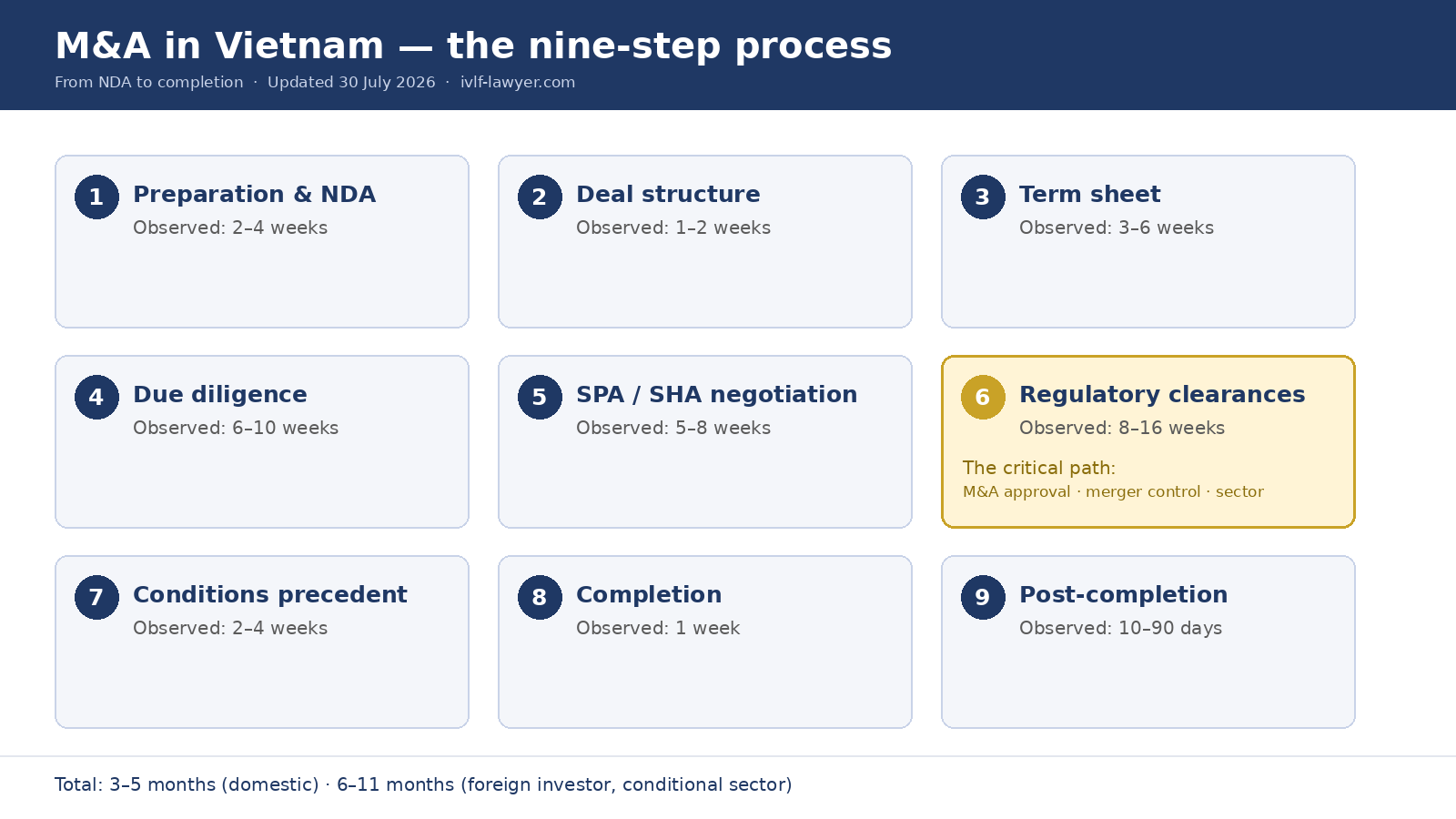
- The nine-step process, with realistic rather than statutory timelines
- The three regulatory clearances, how they interact, and how to run them in parallel
- Where Vietnamese law departs from Delaware, English and Singapore market practice — and what to do about it
Contents
- Market context: what is driving M&A in Vietnam in 2026
- The four reforms that reshaped M&A in Vietnam
- Step 1 — Preparation and the NDA
- Step 2 — Choosing the M&A deal structure
- Step 3 — Term sheet and exclusivity
- Step 4 — Due diligence for M&A in Vietnam
- Step 5 — The SPA and the shareholders’ agreement
- Step 6 — Regulatory clearances
- Step 7 — Satisfying conditions precedent
- Step 8 — Completion
- Step 9 — Post-completion
- Realistic timetable and costs for M&A in Vietnam
- How Vietnam differs from what you are used to
- Frequently asked questions about M&A in Vietnam
Market context: what is driving M&A in Vietnam in 2026
Vietnam recorded 367 M&A transactions worth approximately USD 8.7 billion in 2025, up 26% year on year. The first quarter of 2026 tells a more interesting story: deal count fell 36% while aggregate value rose 24%. Fewer, larger, more carefully selected transactions — consistent with what we see across the deals we are asked to advise on.
Three forces are shaping inbound M&A activity.
Supply chain reconfiguration. US reciprocal tariff policy has forced export-oriented manufacturers to reassess their portfolios. The result is a wave of divestments, business carve-outs and acquisitions aimed at diversifying manufacturing footprint within ASEAN. These are the most time-sensitive deals in the market, and the ones where a six-month regulatory timeline is hardest to accept.
The FTSE Russell upgrade. Vietnam moves to Secondary Emerging Market status with effect from 21 September 2026, phased into indices in four tranches through September 2027. Passive inflows will lift listed market valuations, and listed comparables set the reference point for private deal pricing. Sellers know this. Expect valuation expectations to firm through the second half of 2026.
Strategics ahead of financial sponsors. Thai, Korean and Japanese strategic buyers continue to lead by value. Private equity has been more cautious, concentrating on smaller cheques and relying more heavily on deferred and performance-linked consideration. If you are a sponsor, you are competing against buyers with lower return thresholds and greater tolerance for the regulatory timeline.
The four reforms that reshaped M&A in Vietnam
| Instrument | Effective | What changes for an inbound acquirer |
|---|---|---|
| Investment Law 2025 (Law 143/2025/QH15) | 1 Mar 2026 | Replaces the 2020 Investment Law. Narrows the range of projects requiring in-principle investment approval, removes sector licensing conditions for 38 conditional business lines, and in defined cases allows a foreign investor to incorporate before obtaining an Investment Registration Certificate. The policy direction is a shift from pre-approval to post-completion supervision. |
| Law 76/2025/QH15 amending the Enterprise Law | 1 Jul 2025 | Introduces beneficial ownership identification and filing obligations. Tightens charter capital rules and expands prohibited conduct to include false declaration of capital contributions. Caps total liabilities at five times equity for non-public joint stock companies issuing bonds by private placement. |
| Resolution 66.18/2026/NQ-CP | 1 Jul 2026 | Raises most quantitative merger control thresholds by approximately 100% — the Vietnam-market turnover or purchase-value threshold rises from VND 3,000 billion to VND 6,000 billion. Simplifies the notification file and permits online submission. |
| Decree 296/2026/NĐ-CP amending Decree 168/2025/NĐ-CP | 23 Jul 2026 | Prohibits owners, shareholders and members from holding capital as nominee for another person. Introduces electronic authentication for incorporation and for changes of legal representative. |
The last of these is the one to read twice. Nominee arrangements through Vietnamese individuals have been a standard, if uncomfortable, workaround for foreign ownership caps in conditional sectors. The exposure used to be that the underlying declaration of trust would not be recognised. It is now that the arrangement itself is prohibited. Read alongside the beneficial ownership filing regime, the regulator’s position is unambiguous: registered ownership must reflect economic ownership.
If your target’s cap table depends on a nominee, that must be resolved before the data room opens. It is not a post-completion clean-up item.
Step 1 — Preparation and the NDA
Before you sign an NDA, answer one question internally: if this target operates in a conditional sector for foreign investors, or holds land use rights in a sensitive area, is the deal still attractive once you add four months of regulatory waiting time? Foreign buyers who skip this question tend to discover the answer at month five, when the investment committee has already approved a timetable that cannot be met.
On the NDA itself, three provisions matter more than the rest and are routinely drafted carelessly: the definition of confidential information and its carve-outs; non-solicitation of key personnel; and the return or destruction of materials on termination. Draft the non-solicit narrowly in scope and duration — Vietnamese labour law protects an employee’s freedom to choose employment, and an overbroad restraint is more likely to be read down than enforced as written.
Expect a thinner data room than you are used to. Vietnamese privately held companies frequently do not maintain the corporate record with the discipline a Delaware or English buyer assumes. Minute books, share registers and board resolutions are often reconstructed rather than contemporaneous. Build this into your diligence budget and into your warranty package.
Step 2 — Choosing the M&A deal structure
M&A deal structure drives procedure, tax and the extent to which you inherit history.
Secondary share purchase from existing shareholders. The most common structure. Consideration flows to the sellers, not the company. You acquire the entity with all of its historical liabilities, including those diligence did not surface. This is why the warranty and indemnity package carries more weight in Vietnam than in jurisdictions with better public records.
Subscription for newly issued shares. Consideration flows into the company. Appropriate where the objective is growth funding rather than a change of ownership. Watch pre-emption rights and, for public companies, private placement conditions and post-issue lock-up restrictions.
Asset or project acquisition. You take the assets you want and, in principle, leave the history behind. The trade-off is procedural: transferring land use rights, sector licences and employment contracts each has its own process, and the tax cost is usually higher. For real estate, transferring all or part of a project carries its own statutory conditions.
Merger or consolidation. Used mainly for intra-group reorganisation. The surviving entity succeeds to rights and obligations by operation of law, so individual contracts need not be assigned — a material advantage where the target has a large contract book.
A note on the sub-50% structure. Many foreign investors deliberately stay below 50% to avoid the target being treated as a foreign-invested economic organisation. This is sometimes the right answer, but it is not a general solution. If the target operates in a conditional sector, the approval obligation applies regardless of percentage. And bridging the gap with a nominee is no longer available.
Step 3 — Term sheet and exclusivity
Separate the binding from the non-binding expressly. Price, price adjustment and structure are non-binding and will be reopened after diligence. Confidentiality, exclusivity, cost allocation, governing law and dispute resolution should be binding. If the term sheet is silent on which is which, the parties will litigate that question at precisely the moment goodwill has evaporated.
Sixty to ninety days of exclusivity is the workable range for a mid-market M&A deal. Less is not enough to complete diligence; more strips the seller of leverage.
Break fees do not work the way you expect. Vietnam’s Commercial Law caps contractual penalties at 8% of the value of the breached obligation. A break fee expressed as a percentage of deal value — standard practice in most markets — risks being unenforceable to the extent it exceeds that cap. The workable alternative is a costs reimbursement obligation: actual, documented transaction costs incurred, payable on defined trigger events. Frame it as compensation for expenditure, not as a penalty for withdrawal.
Step 4 — Due diligence for M&A in Vietnam
The structural difference between diligence on M&A in Vietnam and diligence in a developed market is the absence of reliable public records. There is no comprehensive searchable register of litigation, tax compliance status or administrative penalties. Your findings depend heavily on what the seller produces, and that dependence has to be priced into the warranty package rather than assumed away.
Six areas warrant priority.
Corporate standing and cap table. Whether charter capital was actually paid up and can be evidenced; the continuity of the share transfer chain since incorporation; and whether any nominee arrangement exists. The last item has moved from a diligence footnote to a gating issue.
Business lines and licences. Reconcile registered business lines against actual operations, and verify each sector licence remains valid. A common finding: the company operates more broadly than its registration permits, and adding the missing business line after a foreign investor comes in runs into market access restrictions that did not previously apply.
Land and fixed assets. Form of land tenure, remaining term, whether financial obligations to the State have been discharged, and whether the land sits in an area sensitive for national defence or security. The last point determines your approval obligation at Step 6. Note the distinction between land allocated or leased with a one-off payment and land leased with annual payments — the latter carries materially narrower rights, including a restricted ability to mortgage. Buyers financing an acquisition against the target’s real estate have been caught by this.
Employment and social insurance. Contracts, internal labour rules, and social insurance contribution status. Social insurance arrears are commonly missed in financial diligence and transfer intact to the buyer.
Tax. Last audit cycle, open disputes, and above all related-party transaction pricing. For targets transacting with an offshore parent or affiliate, this is usually the largest and least quantifiable exposure on the register.
Material contracts. Change of control provisions in customer contracts, facility agreements and leases. A change of control clause in a facility agreement can convert your transaction into an acceleration event.
Converting findings into protection. For each finding, choose deliberately among four tools: require rectification before completion as a condition precedent; retain part of the consideration in escrow; take a specific indemnity outside the general liability cap; or reduce price. The choice turns on whether the risk is quantifiable and whether it is curable. Findings that are neither should prompt a conversation about whether the deal proceeds at all.
Step 5 — The SPA and the shareholders’ agreement
International form documents are used in Vietnam and work reasonably well, provided four adaptations are made.
Vietnam-specific warranties. Beyond the standard set: full payment of charter capital with supporting evidence; absence of any nominee or undisclosed beneficial ownership arrangement; social insurance compliance; land tenure status; and related-party pricing compliance.
Limitation architecture aligned to Vietnamese limitation periods. Contractual limitation under the Civil Code and the period during which the tax authority may reassess are different. Tax warranties should survive longer than operational warranties — five years is the usual working assumption — so that the survival period covers the reassessment window.
W&I insurance: check availability early, do not assume it. A market for warranty and indemnity cover on M&A in Vietnam exists but remains thin. Pricing is above regional benchmarks and exclusions are broad, commonly covering land, historical tax and anti-corruption compliance — which is to say, the three areas where a buyer most wants cover. Test insurability at the start of diligence, not when you are negotiating the liability cap.
Governing law and dispute resolution. A share purchase agreement with a foreign element may select foreign governing law, and many do. But matters within the mandatory scope of Vietnamese law remain governed by it: the transfer mechanics, the effect of a transfer on the share register, and the registration formalities. Arbitration is generally preferable to the Vietnamese courts, because a foreign arbitral award can be recognised under the New York Convention. Factor in, however, that recognition and enforcement proceedings in Vietnam take time and outcomes are not uniform.
Build your commercial protection so that you do not have to enforce it.
If you are taking less than 100%, the shareholders’ agreement matters as much as the SPA — and one principle governs it. Anything you need to be effective against the company and third parties must be in the company charter, not only in the shareholders’ agreement. The SHA binds its signatories. The charter binds the company. A veto right that exists only in the SHA gives you a damages claim after the fact, not the ability to stop the resolution.
Step 6 — Regulatory clearances
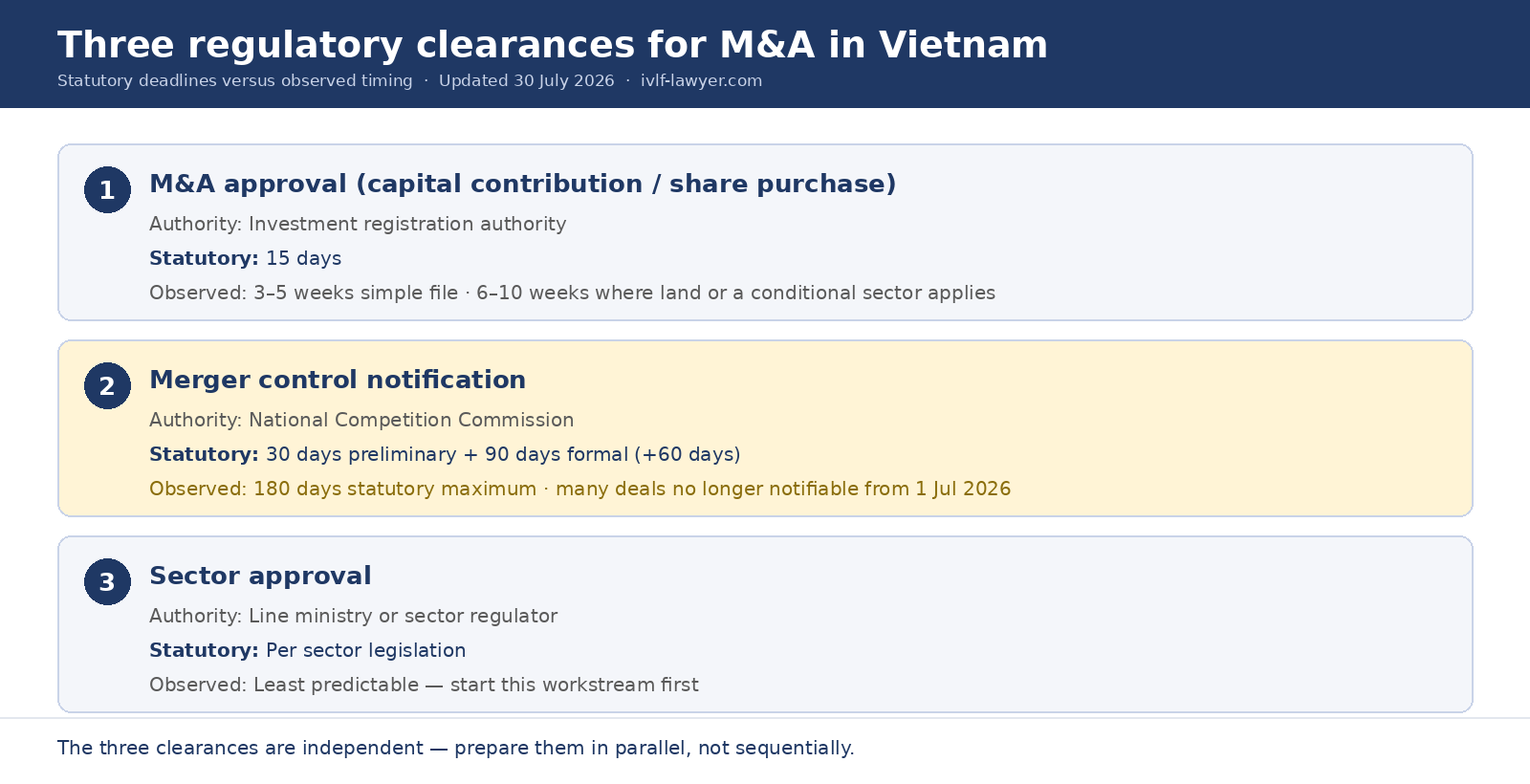
Three separate clearances may apply to M&A in Vietnam. They are independent of one another and should be prepared in parallel. Sequencing them — waiting for the first before starting the second — is the single most common cause of a missed long-stop date.
M&A approval: registration of capital contribution or share purchase
Vietnamese law does not use the term “M&A approval”. The Investment Law provides for registration of a foreign investor’s capital contribution, share purchase or purchase of capital contribution. Functionally it is an investment screening step, reviewing the target’s business lines, the resulting foreign ownership percentage, and the target’s land position.
The obligation arises in three cases:
- The target operates in a business line subject to market access conditions for foreign investors. This applies regardless of the percentage acquired.
- The transaction results in foreign investors holding more than 50% of charter capital, or increases the percentage where foreign ownership already exceeds 50%.
- The target holds land use rights on an island, or in a border or coastal commune, or in another area affecting national defence and security.
Outside those three cases, the M&A transaction proceeds under company law: the parties simply file to update shareholder or member information with the business registration authority. The difference in elapsed time between the two routes is substantial, which is why the determination belongs at Step 2, not Step 4.
One technical point with real commercial consequence. The filing now requires the parties to declare the actual transaction value rather than the previously permitted expected value. Two implications follow. First, price must be settled before filing, which constrains post-completion adjustment mechanics. Second, the value declared to the investment authority should be consistent with the value declared for tax and the value in the M&A transaction documents. Inconsistency between those three figures is a natural starting point for a tax review.
The statutory period is 15 days from receipt of a complete file. In practice: three to five weeks for a straightforward file; six to ten weeks where land or a regulated business line requires the investment authority to consult a line ministry. Use the second figure when setting your long-stop date.
Merger control notification for M&A in Vietnam
This obligation is entirely separate and applies to purely domestic transactions as well.
Under Decree 35/2020/NĐ-CP, notification to the National Competition Commission is required if any one threshold is met — total assets, Vietnam-market turnover or purchase value, transaction value, or combined market share. From 1 July 2026, Resolution 66.18/2026/NQ-CP raises most quantitative thresholds by approximately 100%, with the Vietnam-market turnover or purchase-value threshold moving from VND 3,000 billion to VND 6,000 billion. The combined market share threshold is not a financial threshold and must still be assessed separately on the relevant market.
The practical effect is that a significant band of mid-market transactions — growth and venture investments in particular, and intra-group reorganisations — no longer require notification. For those M&A deals, two to three months come out of the timetable.
Two cautions. First, the threshold increase is paired with a shift to post-completion supervision, so parties should retain their competitive assessment materials to support a later review. Second, the sanctions regime was recalibrated: Decree 102/2026/NĐ-CP, effective 20 May 2026, replaces the turnover-percentage calculation with defined penalty bands while retaining the statutory ceiling of 5% of turnover on the relevant market.
The remedies matter more than the fine — they include compulsory demerger of a completed merger, compulsory divestment of acquired capital or assets, and State control over the pricing and transaction terms of the post-merger business.
Timing: 30 days for preliminary review from receipt of a complete file. If the Commission does not issue its preliminary result within that period, the M&A transaction may proceed. If the matter goes to formal review, that stage runs 90 days from the preliminary notification, extendable by up to 60 days for complex cases. Statutory maximum: 180 days.
Gun jumping. Completing before clearance is a breach. Reflect this as a hard condition precedent, drafted without qualifying language, and keep interim covenants narrow enough that the buyer cannot be characterised as having exercised control pre-clearance.
Sector approvals
Banking, insurance, securities, telecommunications, education, healthcare and aviation each carry their own regulatory consent. This category has the least predictable timing and should be started first.
Step 7 — Satisfying conditions precedent
Because M&A in Vietnam almost always involves a signing-to-completion gap, this period has to be managed contractually rather than left to goodwill.
Split conditions precedent into two categories. Statutory conditions — the Step 6 clearances — which neither party may waive. And negotiated conditions — rectification of diligence findings, execution of ancillary agreements, third-party change of control consents — where the agreement should state expressly which party may waive.
Set the long-stop date on observed rather than statutory timing. Six months from signing is realistic where both investment approval and merger control apply, with a single automatic extension where the delay is attributable to the authorities rather than the parties.
Interim covenants. The seller undertakes to operate in the ordinary course and not to take listed actions without buyer consent. Draft the list with care: too broad, and the buyer risks being treated as having assumed control before merger clearance.
Step 8 — Completion
Completion of an M&A transaction is a set of simultaneous actions, usually at a completion meeting, run against an agreed checklist.
Typical items: execution of transfer documents; payment through the correct account under Vietnam’s foreign exchange rules; delivery of original share certificates and the updated share register; resignation and appointment letters for management; and handover of the company seal, digital signature certificate and system access.
On payment flows. Foreign buyers must route consideration through the correct account type under the foreign exchange regulations. Selecting the wrong account type is a common and costly error: it creates obstacles when the seller seeks to remit proceeds offshore, and again when the investor later wishes to repatriate profits or capital. Confirm the mechanics with the servicing bank before completion day, not on it.
On the company seal and digital signature. In Vietnam, physical control of the seal and the digital signature certificate has far greater practical significance than in most jurisdictions. If the person holding them declines to cooperate after completion, a buyer can lose months restoring the company’s ability to transact. Put both on the completion checklist, take delivery in the meeting, and have the handover witnessed.
Step 9 — Post-completion
Within 10 working days. File the change of shareholders or members, legal representative and managers with the business registration authority. Note the electronic authentication requirement for changes of legal representative, applicable from 23 July 2026. Update the beneficial ownership record.
Within 30 days. Declare and pay capital transfer tax. Where the seller is a foreign entity without a presence in Vietnam, the declaration obligation typically falls on the target company or the transferee — allocate this expressly in the SPA with a corresponding indemnity, and consider a retention against it.
Within 90 days. Adopt the new charter and internal governance regulations; complete third-party notifications under change of control provisions; and execute the integration plan. The item most often missed is the third-party notification — omission can hand a counterparty a termination right.
Realistic timetable and costs for M&A in Vietnam
Elapsed time observed in practice on M&A in Vietnam, not statutory periods.
| Step | Domestic mid-market deal | Foreign investor, conditional sector |
|---|---|---|
| Preparation and NDA | 2–3 weeks | 2–4 weeks |
| Term sheet | 2–4 weeks | 3–6 weeks |
| Due diligence | 4–6 weeks | 6–10 weeks |
| SPA and SHA negotiation | 3–5 weeks | 5–8 weeks |
| Regulatory clearances | 0–6 weeks | 8–16 weeks |
| Conditions precedent and completion | 2–3 weeks | 3–5 weeks |
| Total | 3–5 months | 6–11 months |
Advisory fees for mid-market M&A in Vietnam typically run 0.5% to 1.5% of deal value, with diligence accounting for roughly 40%. Scope and fee basis for each workstream are set out on our corporate restructuring and M&A services page. Deals involving land or multiple entities sit at the upper end.
How Vietnam differs from what you are used to
Five points where assumptions imported into M&A in Vietnam fail.
Contractual penalties are capped. The Commercial Law limits penalties to 8% of the value of the breached obligation. Break fees, liquidated damages and similar provisions calibrated to deal value need to be restructured as costs reimbursement.
The charter outranks the shareholders’ agreement in dealings with the company. In England or Delaware, a well-drafted SHA does most of the work. In Vietnam, protections that must bind the company — reserved matters, board composition, transfer restrictions — belong in the charter as well. Expect the negotiation to be harder, because charter amendments are public and require shareholder resolutions.
Specific performance is not a reliable remedy. Drag-along rights, put options and compulsory transfer mechanics that depend on a court compelling a shareholder to transfer shares should not be relied on as the primary protection. Build in self-executing mechanics — escrowed transfer instruments, irrevocable powers of attorney, staged consideration — and treat the contractual right as a fallback.
Registered ownership is what counts. The share register and the business registration record determine ownership as against the company and third parties. Beneficial ownership arrangements sitting behind them are now both a filing obligation and, in nominee form, prohibited.
Regulatory timing is the critical path. In most markets, negotiation drives the timetable and clearances run alongside. For M&A in Vietnam, the reverse holds. Structure your investment committee approvals, financing commitments and long-stop dates around the clearance timetable, and start the clearance workstream the week the term sheet is signed.
What to do next
- Determine your approval obligations before signing the term sheet. Three questions: is the target’s business line conditional for foreign investors; what is the resulting foreign ownership percentage; does the target hold land in a sensitive area.
- Recalculate merger control against the new thresholds. If your transaction was previously notifiable, check again — it may no longer be.
- Resolve any nominee arrangement in the cap table before the data room opens.
- Set the long-stop date on observed clearance timing, with an extension mechanism for authority-side delay.
- Put everything that must bind the company into the charter, not only into the shareholders’ agreement.
Frequently asked questions about M&A in Vietnam
How long does M&A in Vietnam take from term sheet to completion?
Three to five months for a domestic mid-market M&A transaction that is not notifiable for merger control. Six to eleven months where a foreign investor acquires a target in a conditional business line. Regulatory clearance, not negotiation, is the binding constraint.
Does a foreign investor always need approval to buy shares in a Vietnamese company?
No. The obligation arises in three cases only: the target operates in a business line subject to market access conditions for foreign investors; the M&A transaction results in foreign ownership exceeding 50% of charter capital; or the target holds land use rights on an island or in a border or coastal commune. Outside those cases, the parties simply file to update shareholder information with the business registration authority.
What are Vietnam’s merger control thresholds in 2026?
From 1 July 2026, Resolution 66.18/2026/NQ-CP raises most quantitative thresholds under Decree 35/2020/NĐ-CP by approximately 100%. The Vietnam-market turnover or purchase-value threshold moves from VND 3,000 billion to VND 6,000 billion. The combined market share threshold is not financial and must still be assessed on the relevant market.
Can a share purchase agreement be governed by foreign law?
Yes, where there is a foreign element, and many are. Matters within the mandatory scope of Vietnamese law still apply — transfer mechanics, the effect on the share register, and registration formalities. Arbitration is generally preferable to the Vietnamese courts because foreign awards can be recognised under the New York Convention, though enforcement takes time.
Is W&I insurance available for M&A in Vietnam?
Available but limited. Pricing is above regional benchmarks and exclusions commonly cover land, historical tax and anti-corruption compliance. Test insurability at the outset of diligence rather than assuming cover when negotiating the liability cap.
Can we still use a Vietnamese nominee to hold shares?
No. From 23 July 2026, the business registration rules prohibit owners, shareholders and members from holding capital as nominee for another person. Combined with the beneficial ownership filing regime under the Enterprise Law, existing nominee structures must be regularised before any transaction proceeds.
Sources
- Investment Law 2025 (Law 143/2025/QH15) — Official Gazette of the Government of Vietnam
- Law 76/2025/QH15 amending the Enterprise Law — National Business Registration Portal
- Resolution 66.18/2026/NQ-CP on merger control thresholds — Government legal database
- FTSE Russell reclassification timetable for Vietnam — Government News
About the author
M&A Advisory Team — IVLF Advisors
IVLF Advisors’ specialists advise on mergers and acquisitions, capital markets and foreign investment in Vietnam, acting for strategic acquirers, private equity sponsors and Vietnamese corporates on share acquisitions, group reorganisations and capital raisings.
Assessing a specific transaction?
IVLF Advisors’ M&A specialists offer a 45-minute structuring review identifying your approval obligations, an expected completion timetable, and the principal risk areas to prioritise in diligence.
Arrange a call about M&A in Vietnam
Related reading
- M&A approval under Vietnam’s 2025 Investment Law: when is it required?
- Vietnam’s new merger control thresholds from 1 July 2026
- Legal due diligence in Vietnam: 12 recurring red flags
- Negotiating the SPA: warranties, indemnities, escrow and W&I insurance
- Price adjustment: locked box, completion accounts and earn-outs
- Acquiring land-rich targets: share deal or asset deal?
- Tax on capital transfers and indirect offshore transfer risk
- Structuring private equity investments into Vietnam
- Shareholders’ agreements in Vietnam: veto rights, board seats and the charter
This article is general information current as at 30 July 2026 and does not constitute advice on any specific matter. The law referred to is subject to change. Please take professional advice before acting.
This article is provided for general information only and does not constitute legal advice for any specific case. Regulations may change – please consult a qualified professional before acting. Should further analysis be required, please contact one of our lawyers below.