
A foreign-invested M&A deal in Vietnam requires investment policy approval (“M&A Approval”) when it falls into one of three categories: the foreign investor will hold more than 50% of charter capital in a target operating in a conditional market-access sector, the target holds land use rights on an island or in a border or coastal commune, or the target is implementing an investment project already subject to investment policy approval. The 2025 Investment Law (No. 143/2025/QH15), effective 1 March 2026, narrows the approval perimeter compared with the 2020 Investment Law, but tightens the obligation to declare the actual transaction value under Decree 168/2025/ND-CP.
This is the clearance that almost every foreign-invested share or capital contribution deal in Vietnam needs to check at term sheet stage, because the outcome drives the long-stop date and conditions precedent in the share purchase agreement (SPA). Since 1 March 2026, the list of deals requiring approval has changed: transactions that previously needed a formal filing may now qualify for the simpler ownership-change registration, while some deals that look routine trigger a new filing obligation because of indirect-ownership traps.
This guide answers the five questions the IVLF Advisors deal team hears most often from foreign buyers and Vietnamese sellers: which deals require M&A Approval, how the 50% threshold is calculated when ownership runs through multiple offshore layers, what the filing and realistic timeline look like, what happens if a party skips the filing, and how to sequence M&A Approval with merger control notification so the two processes do not stack sequentially.
How this differs from what you are used to
Investors coming from jurisdictions with a single foreign-investment screening regime — Australia’s FIRB, the US CFIUS, or the UK’s National Security and Investment Act — will recognise the underlying logic of M&A Approval: a government checkpoint that sits alongside, not instead of, competition clearance. The practical difference is that Vietnam’s approval perimeter is defined by three narrow, checkable criteria rather than a broad national-security discretion, which makes the outcome more predictable once the ownership structure and land holdings are mapped — but the filing sits with a provincial-level authority rather than a single national body, so local practice and processing speed vary by province.
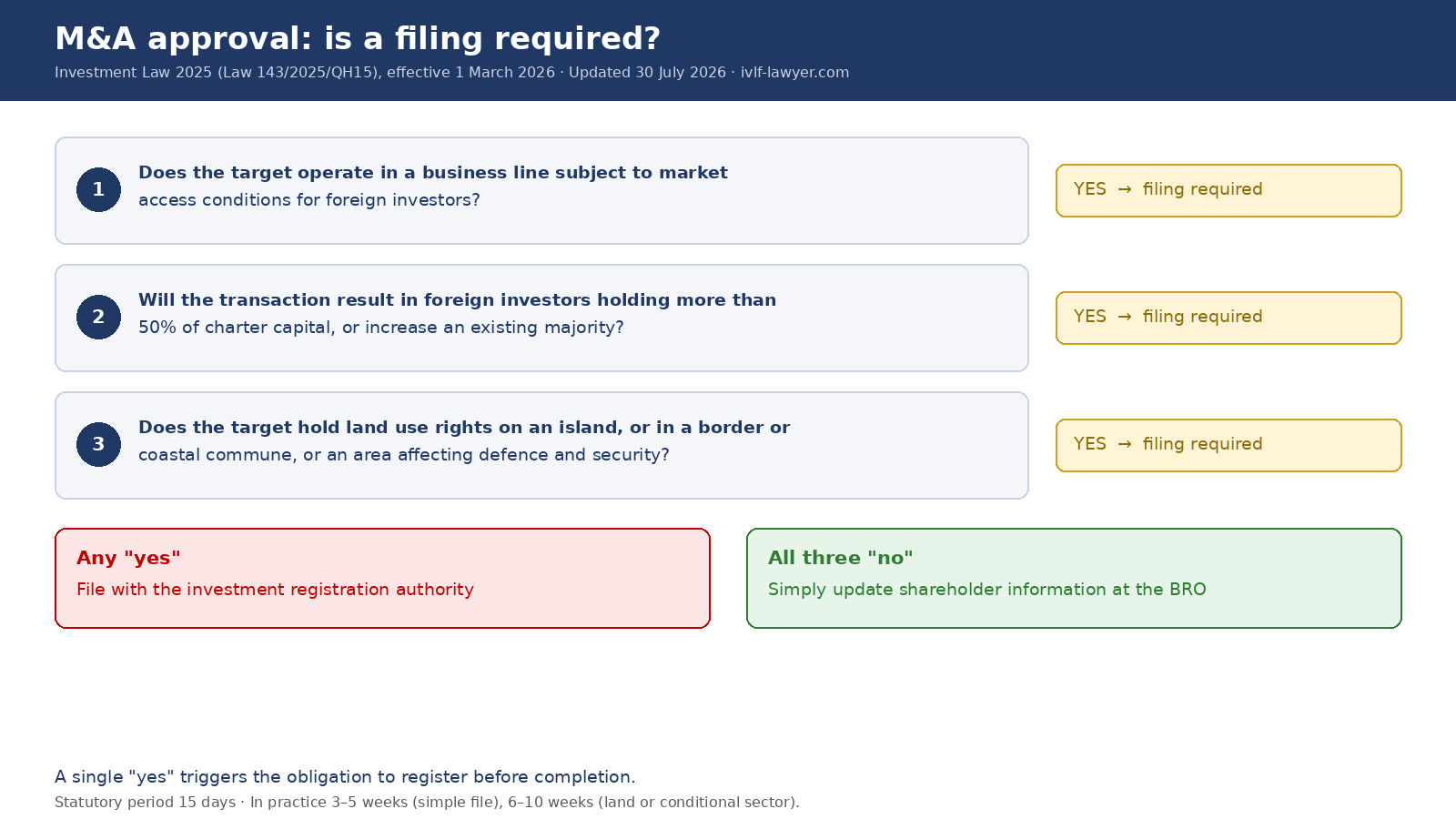
The three mandatory triggers for M&A Approval
The 2025 Investment Law requires a foreign investor to obtain approval before contributing capital or purchasing shares or capital contributions if the deal falls into one of three categories. This is the single biggest structural change from the 2020 Investment Law: the perimeter is now built around exclusion of most transactions in unconditional sectors, rather than a blanket ownership threshold applied across every sector.
The first trigger applies where the target operates in a conditional market-access sector for foreign investors and the deal results in the foreign investor holding more than 50% of charter capital, or a majority of voting rights, post-completion. The list of conditional sectors is issued under implementing guidance and must be checked against the target’s actual registered business lines, not just its operating activities.
The second trigger applies where the target holds land use rights on an island, or in a border or coastal commune, ward or town, or another area affecting national defence and security. This criterion is independent of ownership percentage: if the target holds land in one of these areas, the filing obligation arises whether the foreign investor is buying 5% or 95% of the company.
The third trigger applies where the target is implementing an investment project that is already subject to investment policy approval, and the deal changes the investor implementing that project. This trigger is the one deal teams most often miss, because it requires checking the legal status of each project the target is running, not just its shareholding.
Practical point: if none of the three triggers apply, no approval is required — the foreign investor completes the simpler ownership-change registration at the business registration authority instead, which typically takes 3–5 working days rather than the weeks associated with M&A Approval.
Calculating the 50% threshold and the indirect-ownership trap
The 50% threshold is measured on post-completion charter capital or voting rights, not the percentage transferred in a single transaction. This is the most common source of confusion: a foreign investor acquiring only an additional 15% stake can still trigger M&A Approval if aggregate foreign ownership exceeds 50% afterward, even where the increase comes from several unrelated foreign investors acting independently.
The indirect-ownership trap arises when a foreign investor does not buy shares in the Vietnamese target directly, but instead acquires shares in an offshore parent or holding company that owns the target. In principle, the regulator looks through to ultimate beneficial ownership where the target operates in a conditional sector or holds land in a sensitive area. A purely offshore transaction structure does not by itself remove the M&A Approval obligation if the economic substance of the deal is a change of control over the Vietnamese entity.
For groups with multi-tier holding structures, the advisory team should map the full ownership chain before concluding on the filing obligation — checking the percentage at a single tier in isolation is not sufficient to reach a reliable conclusion.
Land on islands, borders and the coast
The land-location trigger is the source of the most surprises in deal practice, because it does not depend on ownership percentage or business sector at all. An ordinary manufacturer outside any conditional sector can still require M&A Approval simply because its factory or warehouse sits in a coastal commune on the restricted list.
During legal due diligence, cross-checking the address of every parcel the target uses — including land leased from a third party for a representative office or branch — against the list of border, coastal and island administrative units is a step that cannot be skipped. This list is confirmed by local authorities and can differ between provinces; the advisory team should obtain a written confirmation from the provincial Department of Finance or Department of Planning and Investment rather than inferring status from the administrative unit’s name alone.
Filing requirements and the actual transaction value declaration
The M&A Approval filing under the 2025 Investment Law generally comprises a written application, documentation evidencing the foreign investor’s legal status (consular legalisation and notarised translation for foreign-issued documents), the contract or agreement in principle governing the capital contribution or share purchase, and a land use report for the target where the filing is triggered by land location.
The most significant change is the obligation to declare the actual transaction value under Decree 168/2025/ND-CP. Previously, many deals declared only the par value or book value of the equity being transferred, to minimise related fees. The new requirement obliges the transferee to declare the actual price agreed between the parties — including deferred or earn-out components where these can be determined at filing time. Misstating the transaction value creates capital transfer tax exposure and risks the filing being treated as inaccurate, which can affect the validity of the M&A Approval later obtained.
In practice, the IVLF Advisors deal team recommends preparing a reconciliation table across the value declared in the M&A Approval filing, the value used for capital transfer tax purposes, and the price mechanism in the SPA — these three figures need to align, or they become the first thing a tax or licensing authority questions.
M&A Approval timelines and how to compress them
The statutory processing period is 15 working days from receipt of a complete and valid filing. In practice, filings unrelated to land and with complete, well-prepared investor documentation from the outset are typically processed in 3–5 weeks, because the receiving authority needs time to consult relevant departments when the target’s sector sits close to the conditional list. Filings involving land in border, coastal or island areas often take 8–12 weeks because they require input from local defence and security authorities.
Three practical steps compress the timeline: obtaining written confirmation of the target’s sector classification before the formal filing is submitted, legalising and translating all foreign investor documentation in parallel with SPA negotiation rather than waiting until after signing, and engaging directly with the receiving authority in the province where the target is headquartered to confirm the required document list up front, which avoids repeated rounds of resubmission.
What happens if a party skips the filing — is the deal void?
Completing a capital contribution or share purchase without the required M&A Approval creates legal risk at two levels. Administratively, the business registration authority can refuse to update the target’s shareholder or member records on the enterprise registration certificate until the approval is obtained, leaving the foreign investor unable to fully exercise shareholder rights despite having paid the purchase price.
On contract validity, Vietnamese law does not automatically void a transfer agreement solely for lack of M&A Approval, but real risk sits in the possibility that a seller or a third party sues to have the contract declared invalid for violating a statutory prohibition — particularly where the deal touches a defence- or security-sensitive sector. This is not a risk a foreign buyer should accept just to save a few weeks of deal timeline.
From a drafting standpoint, the IVLF Advisors deal team consistently recommends making M&A Approval (where applicable) a condition precedent to completion, not a post-completion undertaking — even though this lengthens the signing-to-completion gap, it allocates the risk more safely for both sides.
Coordinating with merger control notification and enterprise registration
For deals above the merger control notification thresholds under the 2018 Competition Law, M&A Approval and merger control notification are two independent filings handled by two different authorities, but they should be sequenced deliberately. Many deal teams choose to file both in parallel once the SPA is signed on a conditional basis, rather than sequentially, to avoid stacking two separate waiting periods. Readers can find a detailed breakdown of the thresholds effective from 1 July 2026 in IVLF Advisors’ related analysis of Vietnam’s merger control regime.
Once M&A Approval is granted, the next step is the ownership-change registration at the business registration authority to update the enterprise registration certificate — typically another 3–5 working days with a complete file. Many deals lose time not because of the M&A Approval process itself, but because the follow-on registration is rejected for inconsistencies between the approval document and the registration filing — an entirely avoidable error if the two filings are cross-checked before submission.
Practical recommendations
- Check all three triggers — sector, land location, project status — at term sheet stage, not after formal due diligence begins.
- Map the full ownership chain to catch indirect-ownership triggers before concluding a deal falls outside the M&A Approval requirement.
- Obtain written confirmation from the local authority on whether the target’s land falls within a restricted border, coastal or island area, rather than inferring it.
- Keep the three transaction-value figures — the M&A Approval filing, the capital transfer tax base, and the SPA price mechanism — consistent with each other.
- Make M&A Approval (where applicable) a condition precedent to completion, and sequence it with merger control notification where both apply.
Frequently asked questions
Does M&A Approval apply to a deal between two foreign investors?
Yes. The requirement applies to any transaction resulting in foreign ownership exceeding 50% of a target in a conditional sector, regardless of whether the seller is a domestic or foreign investor, as long as the post-completion result satisfies one of the three triggers described above.
If a foreign investor already holds more than 50%, does a further purchase require M&A Approval again?
In principle, no, because the “over 50% post-completion” trigger was already satisfied by the earlier transaction and there is no new threshold being crossed. However, if the deal changes the controlling shareholder or member, or touches a project already subject to investment policy approval, the filing can still arise under the third trigger — this needs to be checked deal by deal.
Does the 15-working-day period include time spent on document resubmission?
No. The 15-working-day period only runs from the date the authority confirms the filing is complete and valid. Each time the authority requests supplementary documents or clarification, the clock resets from the date of resubmission — which is why actual processing time regularly exceeds the statutory period.
Can a company handle the M&A Approval filing without external advisers?
There is no legal requirement to use an advisory firm. In practice, for deals with a land component or a sector close to the conditional list, having an advisory team review the filing before submission avoids repeated rejections — the most common reason actual processing time runs two to three times longer than the statutory period.
Do deals completed before 1 March 2026 need to be re-approved under the new law?
No. The 2025 Investment Law does not apply retroactively to deals validly completed under the 2020 Investment Law before the effective date. Deals still in process at the transition point should check the specific transitional provisions to determine which law applies.
About the IVLF Advisors deal team
This guide was prepared by the IVLF Advisors transaction advisory team, drawing on direct experience structuring and closing foreign-invested M&A deals in Vietnam across successive changes to the investment law framework. See our track record and team profiles on the About Us page.
Need a quick read on your deal? Book a 30-minute call with the IVLF Advisors deal team to confirm whether your transaction triggers M&A Approval before you enter formal negotiations.
This article is for general informational purposes only, current as of 4 August 2026, and does not constitute advice on any specific transaction. Companies should consult the IVLF Advisors deal team directly before making transaction decisions based on the current facts of their deal.
This article is provided for general information only and does not constitute legal advice for any specific case. Regulations may change – please consult a qualified professional before acting. Should further analysis be required, please contact one of our lawyers below.