
This article provides general information only and does not constitute legal advice. Regulations governing foreign labor in Vietnam are subject to change – please verify current requirements before acting.
Recruiting talent is challenging enough for any business; signing labor contracts with foreign employees in Vietnam adds a further layer of regulatory sequencing that, if missed, can create legal exposure for both the employer and the employee.
The Governing Framework
Foreign employees working in Vietnam are governed by Decree 152/2020/NĐ-CP on foreign workers in Vietnam (and on the recruitment and management of Vietnamese employees working for foreign organizations and individuals in Vietnam). Under this framework, before a foreign employee can sign a labor contract with a Vietnam-based employer, the employer must first obtain approval of its foreign labor usage demand from the provincial People’s Committee or provincial Department of Labor, War Invalids and Social Affairs where the business is headquartered. Only after that approval, and after the employee obtains a work permit with a term matching the intended labor contract, can the labor contract itself be signed.
Why Sequencing Matters on Renewal
The same sequencing discipline applies when a foreign employee’s work permit is renewed or extended: the labor contract renewal must be executed before the employee’s expected continuation-of-work date. Signing the renewed contract after that date risks legal consequences for both the employer and the foreign employee – the employee may be working without a validly matched contract and work permit during the gap, exposing both sides to compliance risk.
The Correct Sequence for Labor Contracts with Foreign Employees in Vietnam
The rule that drives all labor contracts with foreign employees in Vietnam: the work permit comes first, the contract second. A labor contract signed before the permit is issued has no lawful basis, and authorities treat labor contracts with foreign employees in Vietnam signed that way as illegal labor use – with fines on the employer scaling by the number of workers involved.
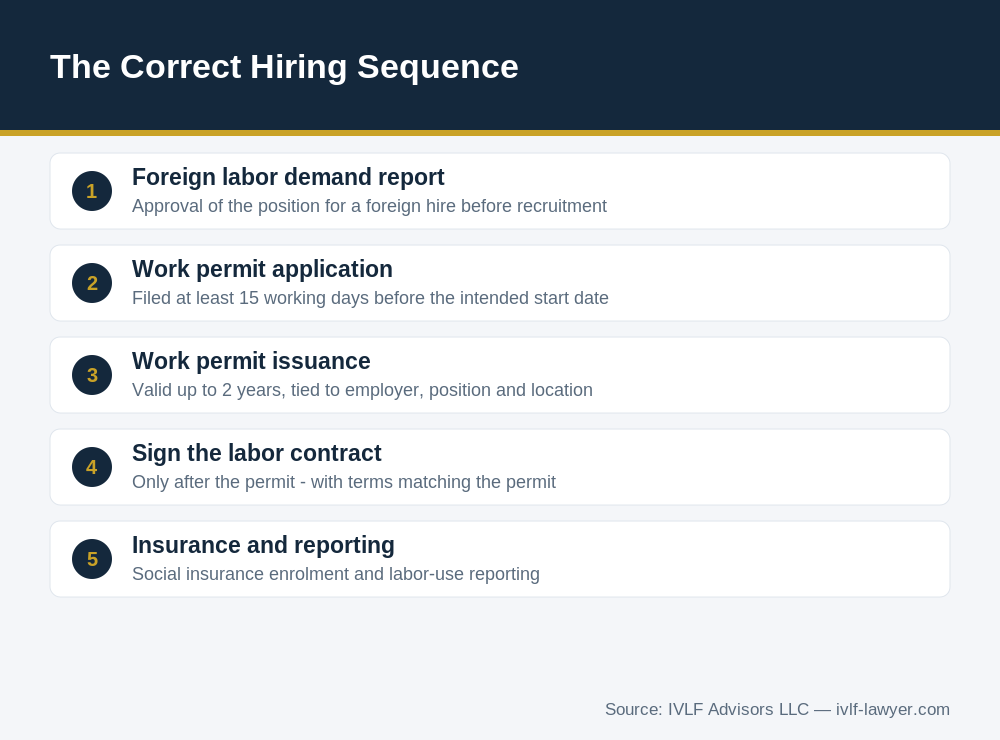
The full sequence runs: approval of the foreign labor demand report; work permit application filed at least 15 working days before the start date; permit issuance; execution of the labor contract on terms matching the permit; then insurance enrolment and labor-use reporting.
Each step feeds the next – the demand report defines the position the permit will authorise, and the permit defines the position, employer, and duration the contract may record. Labor contracts with foreign employees in Vietnam that drift from the permit’s wording invite refusal at renewal.
The Work Permit File
The permit dossier is document-heavy, and foreign documents must be consularly legalised and translated:

The health certificate and criminal record check both carry validity windows – six months in most cases – so ordering documents too early is as costly as ordering them too late. Experienced HR teams assemble the pack in reverse from the intended filing date.
Work Permit Exemptions
Not every foreign worker needs a permit. Intra-company transferees within WTO-committed service sectors, capital-contributing members and owners above value thresholds, and certain short-term specialists fall under exemption categories – but exemption is not automatic. A work permit exemption certificate must still be obtained, and labor contracts with foreign employees in Vietnam signed under an exemption must still align with the certificate’s scope and duration.
Common Mistakes and Their Consequences
Five errors account for most enforcement problems around labor contracts with foreign employees in Vietnam:
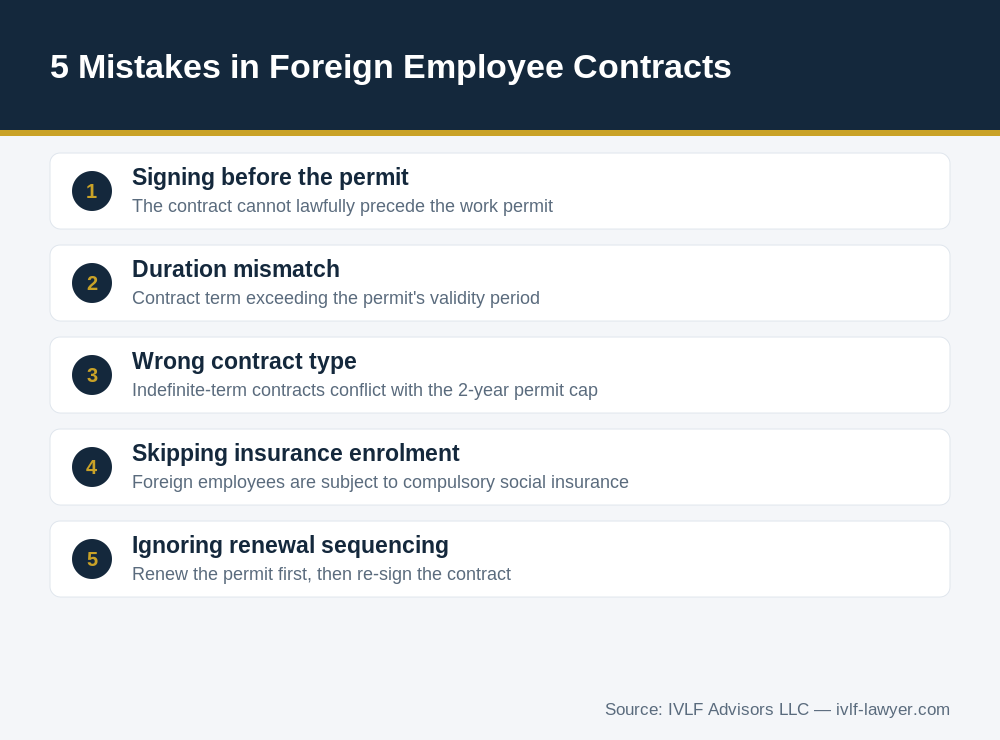
The duration mismatch deserves emphasis. Because a work permit runs at most two years, the matching contract must be a definite-term contract not exceeding the permit’s validity. Employers accustomed to offering indefinite-term contracts to senior hires must resist that habit for foreign staff – the Labor Code carves foreign employees out of the usual two-strike rule that converts definite contracts into indefinite ones.
Key Legal Instruments
- Labor Code 2019 (Law No. 45/2019/QH14) – contract types and the foreign-employee carve-outs; consolidated text on the Government’s legal documents portal.
- Decree 152/2020/ND-CP (as amended by Decree 70/2023/ND-CP) – work permits, exemptions, and the demand-report procedure; guidance via the Ministry of Labor portal.
- Social insurance regulations – compulsory coverage of foreign employees under definite contracts of one year or more.
Frequently Asked Questions
Do labor contracts with foreign employees in Vietnam differ for representative offices? The sequencing is identical, but the chief representative’s appointment paperwork replaces part of the demand-report analysis, and the office – not the parent – is the employer of record.
Are probation periods allowed in labor contracts with foreign employees in Vietnam? Yes, within the Labor Code’s ordinary caps – up to 180 days for managerial roles – and the probation term should sit inside the permit’s validity like every other term.
Can one work permit cover two group companies? No – the permit binds a specific employer, position, and workplace. Secondments within a group require either a new permit or a properly structured intra-company transfer under the exemption rules.
Can the employee start work while the permit is pending? No. Working before issuance is unlawful for both parties, and the 15-working-day statutory processing window should be built into every onboarding plan.
Do labor contracts with foreign employees in Vietnam need to be bilingual? The contract must exist in Vietnamese; a bilingual version is standard practice so the employee understands the terms, with the Vietnamese text prevailing unless agreed otherwise.
What happens to labor contracts with foreign employees in Vietnam at renewal? A work permit can be renewed once; after that, a fresh permit application is required. In each case the permit is renewed first and the contract re-signed second – the same sequencing discipline that governs the original hire.
What the Contract Itself Must Contain
Beyond sequencing, labor contracts with foreign employees in Vietnam must follow the Labor Code’s standard mandatory terms: job description and workplace, contract duration, salary and payment method, working hours and rest breaks, insurance contributions, and training and confidentiality arrangements where relevant.
Three clauses deserve foreign-specific drafting. The duration clause must track the permit. The termination clause should anticipate permit revocation – if the permit lapses or is revoked, the legal basis for employment disappears with it. And the governing language clause should fix which text prevails in a bilingual contract.
Salary in foreign currency is permitted in labor contracts with foreign employees in Vietnam – one of the few contexts where VND denomination is not compulsory – but payment must still route through lawful banking channels.
Social Insurance and Personal Income Tax
Since 2022, foreign employees under labor contracts with foreign employees in Vietnam lasting one year or more are subject to the full compulsory social insurance regime – retirement, sickness, maternity, occupational risk – alongside health insurance. Contribution rates mirror those for Vietnamese staff, and the employer’s registration must follow promptly after the contract takes effect.
On tax, residence status drives everything: a foreign employee resident in Vietnam for 183 days or more in a tax year is taxed on worldwide employment income at progressive rates, while non-residents pay a flat rate on Vietnam-sourced income. Getting the residency classification right in the first payroll month avoids year-end reconciliation pain.
Termination and Permit Revocation
Terminating labor contracts with foreign employees in Vietnam engages two regimes at once: the Labor Code’s termination grounds and notice periods, plus the administrative status of the permit. On termination, the employer must report the change, and the permit ceases to be valid for that employment.
The reverse also matters: where a permit is revoked – for example, after an inspection finding – the contract loses its foundation, and continuing the employment exposes the employer to fresh penalties. Severance, unused leave, and final payroll follow the ordinary rules, with repatriation terms governed by whatever the contract provides.
A 30-Day Onboarding Plan That Works
Employers managing labor contracts with foreign employees in Vietnam converge on the same playbook. Day 1–5: confirm the position is covered by an approved demand report, or file one. Day 5–10: collect the employee’s documents – health certificate, criminal record, legalised qualifications. Day 10–12: file the work permit application. Day 27 or earlier: permit issued; sign the labor contract the same week, enrol insurance, and report the hire.
Building the plan backwards from the intended start date keeps expectations honest with candidates and prevents the single most common failure: a start date announced before the permit timeline allows it.
For renewals, run the same plan starting 45 days before permit expiry – renewal applications can be filed from that point, and late filings leave the employee unable to work lawfully during any gap.
One final note on labor contracts with foreign employees in Vietnam: keep the permit, the signed contract, the insurance enrolment confirmation, and the labor-use reports in a single employee file. Inspections of labor contracts with foreign employees in Vietnam are document-first exercises – an employer who can produce a complete, internally consistent file within a day typically closes the inspection there, while missing papers convert a routine visit into a formal request for explanation.
Practical Takeaway
Employers hiring or renewing contracts for foreign staff in Vietnam should build in lead time for provincial approval and work permit processing, and calendar the labor contract signing (or renewal) date to fall on or before the employee’s continuation-of-work date – not after it.
Hiring or renewing a foreign employee’s contract in Vietnam?
IVLF Advisors LLC advises employers on work permit approvals and labor contract compliance for foreign staff in Vietnam. Explore our practice areas or contact us to discuss your hiring plans.
This article is provided for general information only and does not constitute legal advice for any specific case. Regulations may change – please consult a qualified professional before acting. Should further analysis be required, please contact one of our lawyers below.