IPO and Listing in Vietnam 2026 planning starts well before the filing package is submitted, since companies need up to 12 months to satisfy the charter capital, ROE and profitability conditions under Decree 245/2025. Vietnamese companies weighing an initial public offering and a listing on the Ho Chi Minh Stock Exchange (HOSE) in 2026 now operate under a meaningfully different legal framework than a few years ago: the 2019 Securities Law as amended by Law No. 09/2024/QH15, and — more significantly — Decree 245/2025/NĐ-CP amending Decree 155/2020/NĐ-CP, effective 11 September 2025, has materially shortened the time needed to bring shares to trading once listing is approved. Even so, the underlying IPO listing requirements Vietnam imposes still demand a rigorous preparation process, typically spanning 12 months or more from internal legal restructuring through to first trade. This briefing, prepared by IVLF Advisors’ capital markets and listings advisory team drawing on hands-on experience advising IPO mandates, walks through the quantitative eligibility conditions, the required filing package, the pre-IPO legal restructuring workstream, and a 12-month roadmap with concrete milestones.
IPO listing requirements Vietnam sets for public offerings, listing and UPCoM registration
Preparing for an IPO and listing in Vietnam takes careful sequencing across regulators. Companies pursuing an IPO and listing in Vietnam should confirm eligibility and financials early, because a well-planned IPO and listing in Vietnam avoids costly delays.
Companies frequently conflate three separate legal concepts. A public offering is the act of raising capital from the investing public, which must be registered with the State Securities Commission (SSC) and must satisfy quantitative and qualitative conditions under the Securities Law. A listing is the act of admitting already-issued securities to centralised trading on a stock exchange (HOSE or the Hanoi Stock Exchange), which carries its own conditions on company scale, shareholder structure and prior trading history. UPCoM registration is a lower-threshold trading venue that typically serves as a mandatory stepping stone before an official exchange listing, except where a company has already conducted a public offering or is a state-owned enterprise undergoing equitisation. Under current rules, a company seeking a HOSE listing must generally have traded on UPCoM for at least two years, unless the listing applicant has previously conducted a public offering — which is precisely why many companies choose a combined IPO-and-listing pathway to shorten the timeline, rather than listing independently after an extended period on UPCoM.
Quantitative IPO listing requirements Vietnam imposes: charter capital, ROE, accumulated losses and offering allocation
Documentation is the backbone of any IPO and listing in Vietnam. Getting the prospectus and audited accounts right keeps an IPO and listing in Vietnam on schedule, and experienced advisers make an IPO and listing in Vietnam far more predictable.
The conditions for an initial public offering of shares by a joint-stock company under the Securities Law include the following core quantitative thresholds: Paid-in charter capital of at least VND 30 billion at the time of offering registration, based on book value. The two consecutive financial years immediately preceding the offering registration year must be profitable, with no accumulated losses as of the registration year. For the HOSE listing condition specifically, the company must also achieve a return on equity (ROE) of at least 5% in the year immediately preceding the listing registration year, and must have no payables overdue by more than one year as of the listing registration date. The company must also have an issuance plan and a use-of-proceeds plan approved by its shareholders’ meeting. Under Law No. 09/2024/QH15, a joint-stock company registering an initial public offering must now additionally submit a report on paid-in charter capital as of the registration date, audited by an independent audit firm — an added requirement intended to improve IPO filing quality and curb the practice of overstated charter capital.
Filing package and processing timeline under Decree 245/2025/NĐ-CP
Timing expectations matter for an IPO and listing in Vietnam. Most issuers plan a 12-month runway for an IPO and listing in Vietnam, so mapping each milestone of the IPO and listing in Vietnam up front is essential.
Decree 245/2025/NĐ-CP delivers the most tangible benefit for IPO-bound companies: it adds Article 111a on simultaneous share listing registration alongside an initial public offering. Under the new mechanism, the stock exchange reviews the listing registration file concurrently with the SSC’s review of the offering file, rather than sequentially as before — materially shortening the total time from filing to first trade. Most notably, the time to bring shares to trading after the stock exchange approves listing has been shortened from 90 days to a maximum of 30 days. Specifically, within 5 business days of the listing approval decision, the listing applicant must register the first trading date; that date must fall at least 6 business days after the stock exchange receives the request, but no more than 30 days after the approval decision. Market commentators expect these changes to shorten the overall listing-to-trading process by 3 to 6 months compared with the prior regime.
Pre-IPO legal restructuring: ownership, land, related-party contracts and labour
Before an offering file is ever submitted, most of the 12-month roadmap is in fact consumed by internal legal restructuring — and this is also the phase most prone to slippage if not started early. Four areas warrant particularly rigorous legal diligence: ownership structure (clarifying the chain of ownership, resolving nominee or proxy shareholdings, and reconciling contributed capital ratios with the company’s accounting records); land use rights and attached assets (confirming valid land use right certificates, free of dispute, and consistent with the registered land use purpose); related-party contracts (reviewing and normalising contracts with major shareholders and related persons to avoid tripping insider-transaction rules once the company becomes a public company); and labour and social insurance records (ensuring full compliance with employee-related obligations before the company comes under public market scrutiny). Deferring diligence on these areas until shortly before filing is the single most common reason a Vietnamese company’s IPO timeline extends well beyond the originally planned 12 months.
Board and adviser liability for the prospectus
Investor communication also shapes a successful IPO and listing in Vietnam. Clear disclosures build confidence throughout the IPO and listing in Vietnam, and consistent reporting supports the IPO and listing in Vietnam long after the debut.
The prospectus is the pivotal legal document in an IPO filing, and responsibility for the accuracy and completeness of disclosed information rests with both the issuer’s board of directors and the issuing adviser. Board members and the legal representative must attest to the truthfulness and accuracy of the filing; the issuing adviser (typically a securities firm) is obligated to conduct independent due diligence on company-provided information before putting its name behind the underwriting or advisory mandate.
Counsel’s view: The largest legal risk our team observes in IPO filings is not the quantitative eligibility conditions — those are straightforward to verify — but companies underestimating the personal liability board members carry for prospectus content. A misstated business outlook, or a legal risk that was not fully disclosed, can create civil and in some cases criminal exposure for the individual signatory, not just the legal entity.
The 12-month roadmap for meeting IPO listing requirements Vietnam sets, by milestone
Post-listing compliance is part of any IPO and listing in Vietnam plan. Ongoing obligations follow every IPO and listing in Vietnam, so budgeting for them early keeps the IPO and listing in Vietnam sustainable.
Based on hands-on advisory experience, IVLF’s team recommends the following general roadmap for a company preparing a combined IPO and HOSE listing: Months 1-3 cover internal legal restructuring (ownership, land, related-party contracts, labour) alongside standardising accounting systems and completing an independent audit of the two most recent financial years. Months 4-6 involve selecting and contracting the issuing adviser, auditor and valuation firm, and drafting the issuance plan for shareholder approval. Months 7-9 focus on finalising the prospectus, submitting the offering registration file to the SSC, and submitting the listing registration file to the stock exchange under the simultaneous-registration mechanism of Article 111a of Decree 155/2020/NĐ-CP (as amended). Months 10-12 cover SSC and exchange review, responding to any requests for supplementary information, the public offering itself, and completing the process of bringing shares to trading within a maximum of 30 days of listing approval.
Frequently asked questions
What is the minimum charter capital required for an IPO in Vietnam? At least VND 30 billion, based on book value at the time of offering registration. Must a company trade on UPCoM before listing on HOSE? Generally, a company must have traded on UPCoM for at least two years, unless it has already conducted a public offering or is a state-owned enterprise undergoing equitisation — which is why many companies opt for a combined IPO-and-listing pathway. How long does it take to start trading after listing approval? A maximum of 30 days from the stock exchange’s listing approval decision, under Decree 245/2025/NĐ-CP — down from the previous 90-day standard. See also our analysis of the Vietnam FTSE emerging market upgrade, a development that may accelerate a new wave of IPOs on the back of foreign capital inflows. IVLF Advisors’ capital markets and listings advisory team supports companies from pre-IPO legal restructuring through to first trade. Download our 68-point pre-IPO legal readiness checklist to assess how prepared your company is.
IPO and Listing in Vietnam 2026: Common Pitfalls for Issuers
Companies pursuing an IPO and listing in Vietnam 2026 often underestimate how long pre-IPO legal restructuring takes, particularly land-use right conversions and cleaning up related-party contracts. These items regularly become the critical path, not the prospectus drafting itself. A second common pitfall is finalizing corporate governance arrangements too late. Since disclosure and board-independence requirements apply from the moment a company becomes public, issuers should align their governance structure with our disclosure and corporate governance guidance well before the listing filing, not after.
IPO and Listing in Vietnam 2026: A Pre-Filing Checklist
Before submitting an IPO and listing application in Vietnam in 2026, issuers and their advisers should confirm:
- Charter capital, ROE and accumulated-loss thresholds are met based on current audited financial statements.
- Land-use rights, related-party contracts and labour matters have been cleaned up well ahead of filing.
- The Board meets independence and committee-structure requirements expected of a public company.
- Prospectus liability allocation among the board, sponsor and advisers is documented and understood.
- Internal disclosure procedures are ready to operate from the day of listing, not built retroactively.
More Questions on IPO and Listing in Vietnam 2026
How long does an IPO and listing in Vietnam typically take from decision to listing day? Most issuers should plan on a 12-month roadmap, though pre-IPO restructuring issues can extend this if land-use or ownership matters are complex. Does Vietnam’s FTSE Russell upgrade change IPO listing requirements? The upgrade itself does not change the core eligibility rules, but the accompanying reform package has tightened related disclosure and governance expectations — see our FTSE upgrade legal checklist for the wider picture. For current listing rules and forms, consult the Ho Chi Minh Stock Exchange or the State Securities Commission of Vietnam.
IPO and Listing in Vietnam 2026: Related Resources
For end-to-end support on IPO and Listing in Vietnam 2026, see IVLF Advisors’ capital markets advisory services, and review current listing rules via the Ho Chi Minh Stock Exchange portal.
IPO and Listing in Vietnam: Common Pitfalls Companies Face
Companies preparing for an IPO and listing in Vietnam repeatedly encounter the same avoidable obstacles during the review process. Addressing these early shortens the 12-month roadmap materially.
- Weak corporate governance track record. Regulators and underwriters scrutinise board independence and disclosure history for at least two to three years pre-IPO; retrofitting governance in the final quarter rarely convinces reviewers. See our corporate governance guide for the practical checklist.
- Unresolved foreign ownership questions. Confirm the applicable foreign ownership limit for the company’s sector before finalising the offer structure, since FOL disputes are a common cause of delayed listing approval.
- Capital structure surprises. Outstanding private placements or bonds close to listing can complicate the cap table; issuers with existing bond programmes should review the interaction with private placement rules under Decree 245/2025 well before the roadshow.
- Incomplete financial statement history. Ensure audited financial statements cover the full period required by the listing rules, with no gaps in auditor continuity.
Frequently Asked Questions on IPO and Listing in Vietnam
How early should governance reforms start before an IPO and listing in Vietnam? Most practitioners recommend starting board and disclosure reforms at least 18-24 months before the target listing date. Where can I check current listing rules? The State Securities Commission of Vietnam publishes current listing and disclosure regulations at ssc.gov.vn. 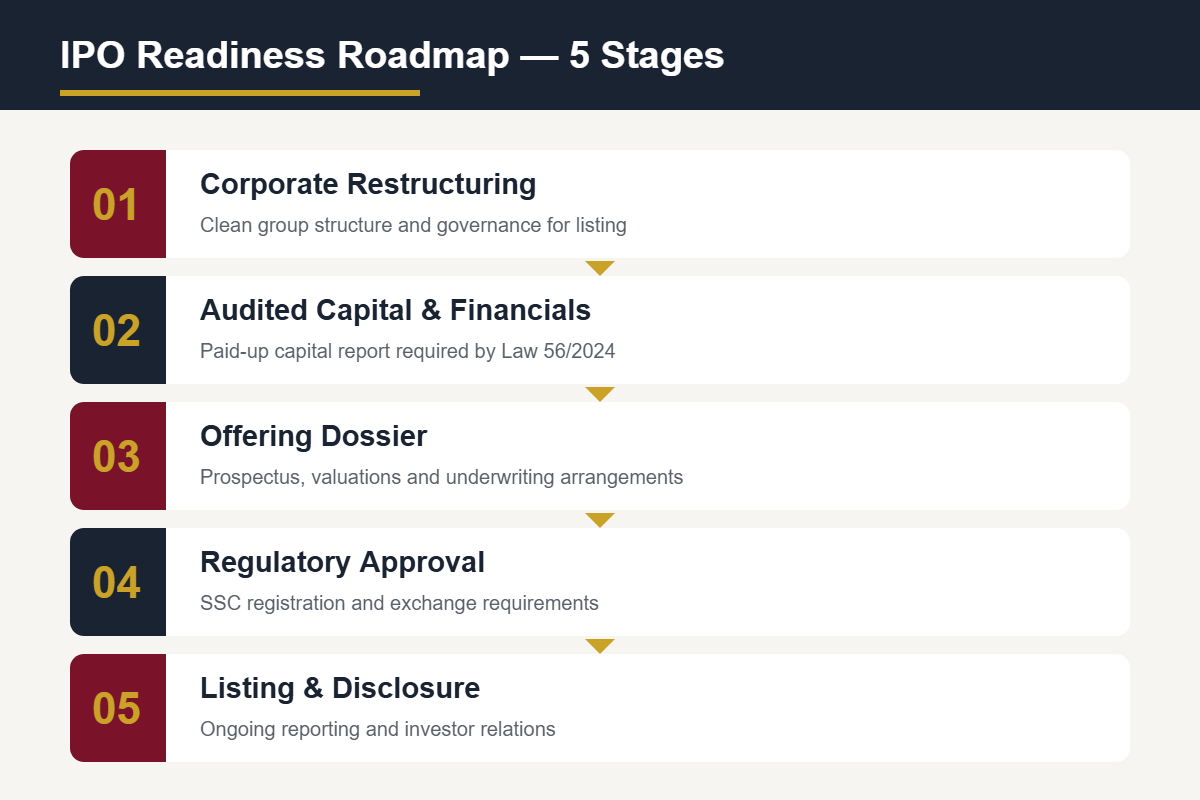
Building Your IPO Roadmap Vietnam 2026: Timeline and Eligibility Checks
Companies mapping an IPO roadmap Vietnam 2026 should start with a gap analysis against the listing requirements HOSE foreign investor participation rules, since foreign shareholding structure can affect both eligibility and post-listing FOL compliance. Confirming IPO eligibility criteria Vietnam early, including minimum profitability track record and shareholder count, avoids costly restructuring later in the process. Most issuers underestimate the Vietnam stock exchange listing timeline, which typically runs nine to twelve months once audited financials, legal restructuring, and prospectus drafting are factored in alongside regulator review cycles.  Planning an IPO or listing in Vietnam? Contact IVLF Advisors to build your listing roadmap and compliance plan.
This article is provided for general information only and does not constitute legal advice for any specific case. Regulations may change – please consult a qualified professional before acting. Should further analysis be required, please contact one of our lawyers below.