Golf course investment Vietnam opportunities have grown into a notable segment of Vietnam’s leisure and real estate market, drawing investors across the country to seek approval for golf course investment Vietnam projects. Before breaking ground, investors need to satisfy four categories of conditions: land use conditions, construction conditions for the golf course and its supporting facilities, conditions applicable to the investor itself, and golf course business operating conditions. 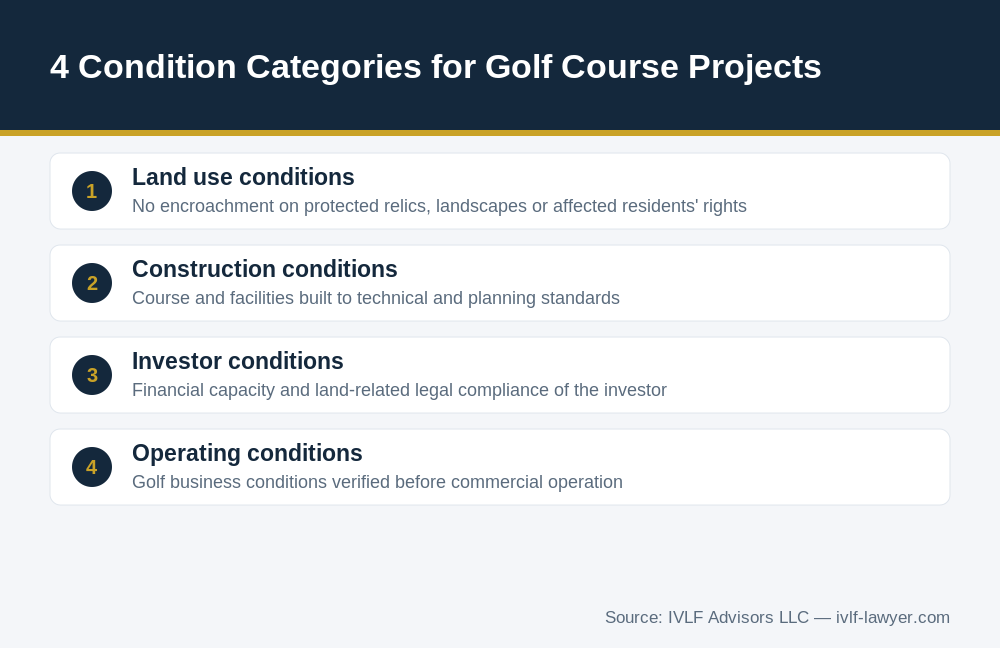
Land Use Conditions
Land earmarked for a golf course investment Vietnam project must not encroach on historical or cultural relics, or scenic landscapes that have been officially recognized and protected by the competent state authority, and the project must safeguard the lawful rights, interests, and social welfare of any persons whose land is recovered to make way for the course. The land itself must also be consistent with local land-use planning and land-use plans, be used for its intended purpose in an economical and efficient manner, and satisfy the conditions and procedures set out in the governing decree along with investment, planning, land, construction, and environmental law.
Investor and Construction Conditions
Beyond land, investors must also meet defined conditions relating to their own capacity to carry out the project, and the golf course and its supporting facilities must be constructed in compliance with applicable technical and planning standards before the course can be put into commercial operation.
Capital, Scale and Planning Requirements for Golf Course Investment Vietnam Projects
Golf is a conditional business line in Vietnam, which means a golf course investment Vietnam project is screened more closely than an ordinary real estate development. Beyond the four condition categories above, investors should expect scrutiny on three practical fronts. First, financial capacity. The investor must demonstrate equity and funding arrangements proportionate to the registered investment capital – typically through audited financial statements, bank confirmations, or parent-company guarantees. Second, planning alignment. The site must already sit within provincial land-use planning approved for sports and leisure purposes. Where it does not, a planning adjustment must be secured first, which can add six months or more to the timeline. Third, environmental assessment. Golf projects involve significant land transformation and water use, so an environmental impact assessment approved under the Law on Environmental Protection 2020 is a precondition for construction.
The Licensing Process
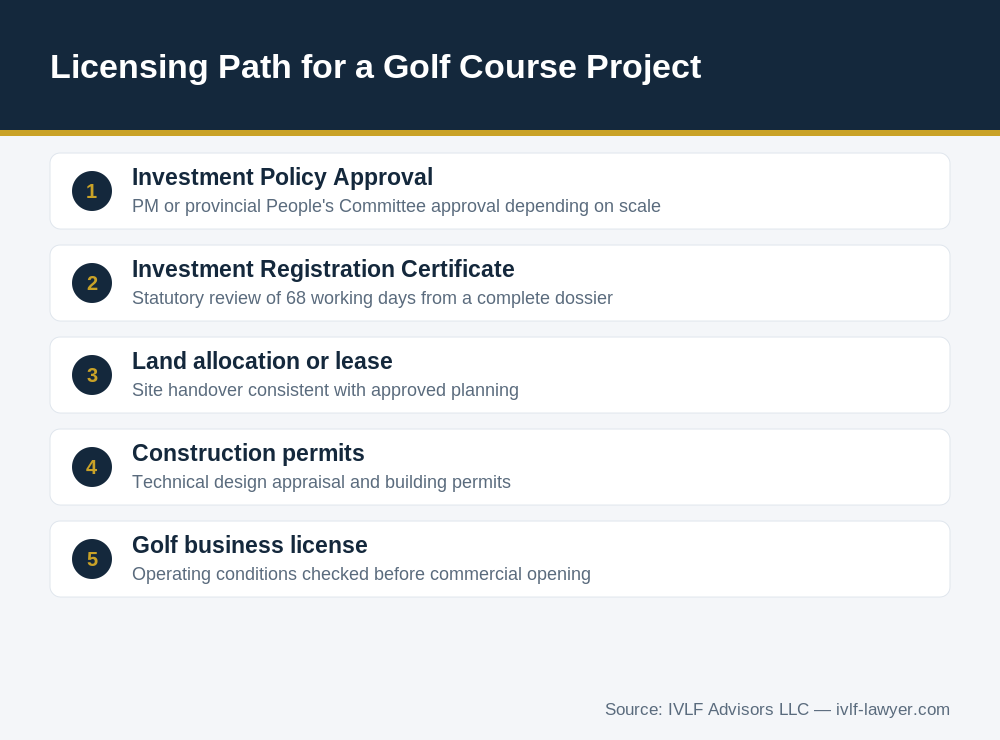 On the basis of these conditions, a golf course investment Vietnam applicant applies for either an Investment Policy Approval or an Investment Registration Certificate, as applicable. Depending on the scale of the project, the licensing authority may be the Prime Minister, the National Assembly, or the provincial People’s Committee. The statutory timeline for this licensing decision is 68 working days from the date the licensing authority receives a complete application dossier – though in practice, the process can take longer depending on the complexity of the appraisal.
After Licensing
Once a golf course investment Vietnam project is licensed, the investor still needs to complete a further set of procedures – land allocation or lease, construction permitting, and the golf course business license among them – before the course can legally open for business.
Common Pitfalls in Golf Course Investment Vietnam Deals
Recurring problems we see in golf course investment Vietnam transactions are rarely about the golf business itself – they are about sequencing and land status:
- Acquiring before checking planning status – paying deposits on land that is not yet zoned for sports and leisure use.
- Underestimating the 68-day clock – the statutory licensing timeline only starts when the dossier is complete; incomplete files reset the process.
- Ignoring resettlement obligations – where households occupy part of the site, compensation and resettlement plans must be resolved before land handover.
- Mixing residential components too early – villas or condotels attached to a course follow separate legal regimes and cannot simply ride on the golf approval.
Frequently Asked Questions
Can a foreign investor own 100% of a golf course investment Vietnam project? Yes. There is no foreign ownership cap for golf courses, although the project remains subject to conditional-sector screening and land-related requirements. How long does the full process take? From site identification to commercial operation, well-run projects typically need two to four years, with licensing and land procedures consuming the largest share. Can an existing course be acquired instead? Yes – acquiring an operating course through a share or asset deal is often faster than greenfield development, but requires careful due diligence on land lease terms and incentive conditions.
Key Legal Instruments Governing Golf Course Investment Vietnam Projects
Four instruments do most of the work in this sector, and investors should know which governs which question:
- Law on Investment 2020 – lists golf course business as a conditional sector and sets the investment policy approval framework. The full text is available on the Government’s legal normative documents portal.
- Decree 52/2020/ND-CP – the dedicated decree on golf course business, covering land conditions, construction standards, and operating requirements.
- Land Law 2024 – governs allocation, lease, and land finance for the project site.
- Law on Environmental Protection 2020 – requires an approved environmental impact assessment before construction.
Greenfield Development vs. Acquiring an Existing Course
There are two practical routes into golf course investment Vietnam opportunities, and they differ sharply in timeline and risk. Greenfield development gives the investor full control over design and location but carries the entire licensing, land, and construction burden – typically two to four years before opening. Every condition described in this article must be satisfied from scratch. Acquisition of an operating course compresses the timeline dramatically: the land lease, construction, and business license already exist, and the transaction becomes a matter of share transfer or asset purchase plus investor-change procedures. The trade-off is inherited risk – historic land-price obligations, incentive conditions that may lapse on transfer, and legacy construction compliance all need careful due diligence before signing. In our experience advising golf course investment Vietnam transactions, the acquisition route is increasingly preferred by financial investors, while strategic developers with hospitality ecosystems still favour greenfield projects adjacent to their resorts.
How Provincial Practice Differs
Although the legal framework is national, execution is provincial. Coastal provinces with established tourism master plans – such as Quang Ninh, Khanh Hoa, and Binh Thuan – tend to process golf course investment Vietnam dossiers faster because sports-and-leisure land is already zoned. Provinces without existing golf planning require a planning supplement first, which lengthens the pre-licensing phase considerably. Early engagement with the provincial Department of Planning and Investment is therefore not a courtesy – it is the single most effective way to test feasibility before committing capital to a site.
Realistic Timeline: From Site to First Tee
Investors budgeting a golf course investment Vietnam project should plan around five phases. The ranges below reflect well-managed projects; contested land or planning supplements can extend them substantially. 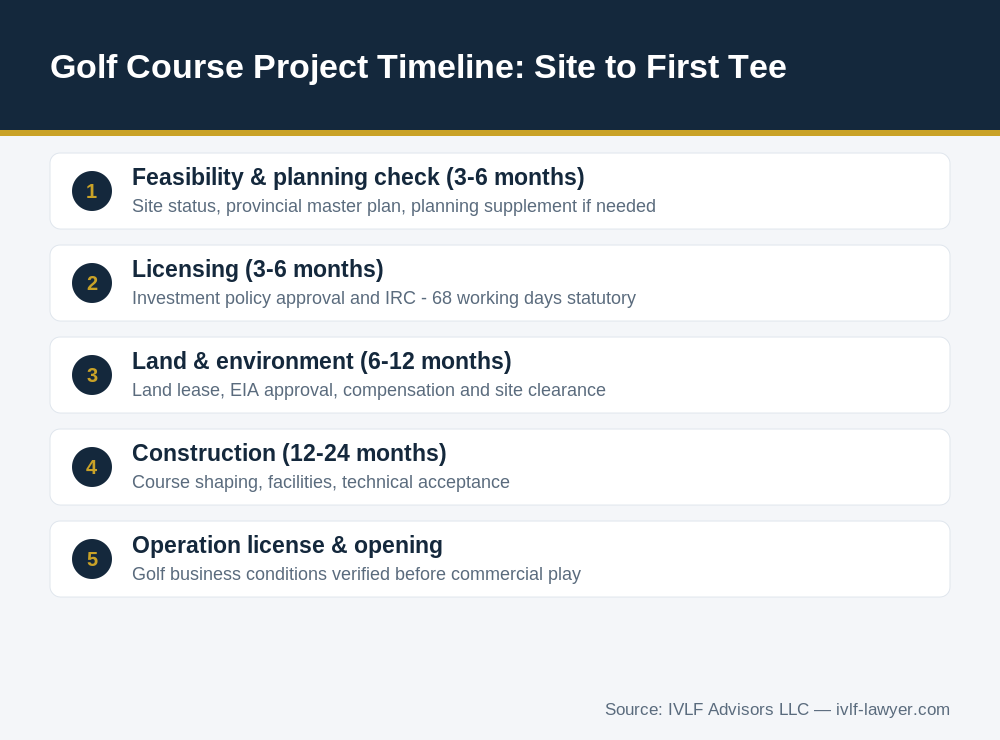 Two phases deserve particular attention. The land-and-environment phase is where most delay risk concentrates, because compensation negotiations with existing land users sit outside the investor’s full control. And the final operating-license step, while usually smooth, cannot begin until construction acceptance is complete – so defects discovered late in construction delay revenue directly. A practical rule of thumb from golf course investment Vietnam practice: if the total plan shows less than 30 months from site control to opening, the schedule almost certainly understates land procedures.
Due Diligence Checklist for Golf Course Acquisitions
Where the golf course investment Vietnam strategy is acquisition rather than greenfield, legal due diligence should prioritise six areas:
- Land lease terms – remaining term, annual versus one-off rental payment, and any outstanding land-price recalculations.
- Investment certificate conditions – whether registered milestones and capital contributions were actually met, since breaches pass to the buyer.
- Incentives – tax and land incentives tied to conditions that a change of ownership may disturb.
- Construction compliance – completion acceptance records for the course and clubhouse, and any unpermitted structures.
- Environmental obligations – EIA compliance, water extraction permits, and chemical use records.
- Labor and membership liabilities – employee obligations and, critically, prepaid membership programs whose obligations survive the transfer.
Membership liabilities are the most commonly missed item in golf course investment Vietnam due diligence. Long-term memberships sold years earlier are effectively debt owed in services; a buyer who overlooks them inherits thousands of playing rights priced into an old business model. A disciplined golf course investment Vietnam buyer treats the target’s legal file with the same rigour as its financials – because in this sector, the licenses and the land are the business. Is a casino or residential component possible alongside the course? Sometimes – but each follows its own legal regime with separate approvals, and bundling them into one dossier usually slows every component down rather than speeding anything up.
Conclusion
Golf course investment in Vietnam sits at the intersection of land, investment, construction and environmental law, with licensing timelines and authority that scale with the size of the project. Investors who map out these conditions early are better positioned to move from approval to opening without delay.
Considering a golf course or leisure investment project in Vietnam?
IVLF Advisors LLC advises investors on licensing, land, and regulatory compliance for golf course and leisure investment projects in Vietnam. Explore our practice areas or contact us to discuss your project.
Land Use Rights and Environmental Conditions for Golf Course Projects in Vietnam
Investing in golf course projects in Vietnam requires clearing several conditions beyond standard FDI licensing. The project must comply with the government’s national golf course development master plan, which caps the total permitted area nationwide and restricts new courses from encroaching on rice-growing land, protective forest, or land earmarked for national defense. Investors must also obtain a separate Environmental Impact Assessment specific to golf course operations, addressing pesticide and fertilizer runoff management, since golf courses are treated as an environmentally sensitive land use under Vietnamese regulations. Land for the course is typically obtained through a state land lease (not land allocation), with lease terms tied to the investment project’s operational period, commonly up to 50 years, renewable subject to performance. Investors structuring the corporate vehicle for a golf project should also review our related guide on in-kind capital contributions in Vietnam, since golf developments frequently involve contributed vehicles, equipment or land-use rights as part of the founding capital.
Financial Conditions and Minimum Investment Capital for Golf Projects
Beyond land and environmental conditions, golf course investment projects in Vietnam are subject to a minimum capital scale requirement set by the applicable decree on golf course business conditions, and investors must demonstrate financial capacity – typically through bank confirmation letters or audited financial statements – before the Investment Registration Certificate is granted. Golf projects combined with residential or resort components (a common structure to improve project economics) require the residential/resort component to be licensed and reported separately from the golf course business itself, since cross-subsidization between a conditional business line (golf) and an unconditional one (real estate) is scrutinized during the IRC review. Failing to separate these components in the investment proposal is one of the most common reasons golf project applications are returned for revision. For the national golf course development planning framework, see the Ministry of Planning and Investment, and for environmental assessment requirements, see the Ministry of Natural Resources and Environment.
This article is provided for general information only and does not constitute legal advice for any specific case. Regulations may change – please consult a qualified professional before acting. Should further analysis be required, please contact one of our lawyers below.