Fundraising for startups in Vietnam – from venture capital, private equity, or angel investors – is a milestone for any founder – and one that runs through a specific legal framework. For anyone planning fundraising for startups in Vietnam, understanding that framework before entering a fundraising round helps founders negotiate from a position of strength and close on schedule.
The Legal Framework
Fundraising for startups in Vietnam sits at the intersection of the Law on Investment, the Law on Enterprises, the Law on Securities, and their guiding legislation. Together, these set out the rules, conditions and requirements a startup must meet to raise capital – including how companies may issue additional shares (private placement, for joint-stock companies) or additional capital contributions (for multi-member limited liability companies), transfer existing shareholders’ shares, or convert the company’s form to support the deal structure.
Fundraising Mechanisms
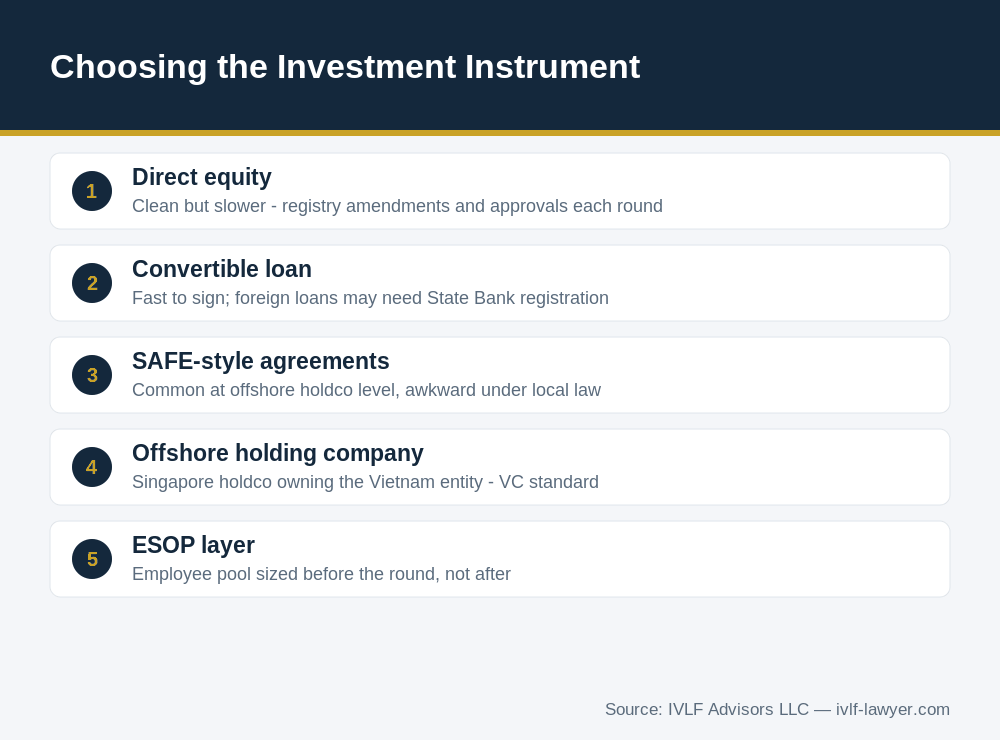
Startups and investors can structure capital raises through several mechanisms, including private placement, public offering, bond issuance, debt-to-equity conversion, and convertible loans – with the appropriate mechanism depending on the company’s form, stage, and the investor’s preferred instrument.
Transactional Documentation
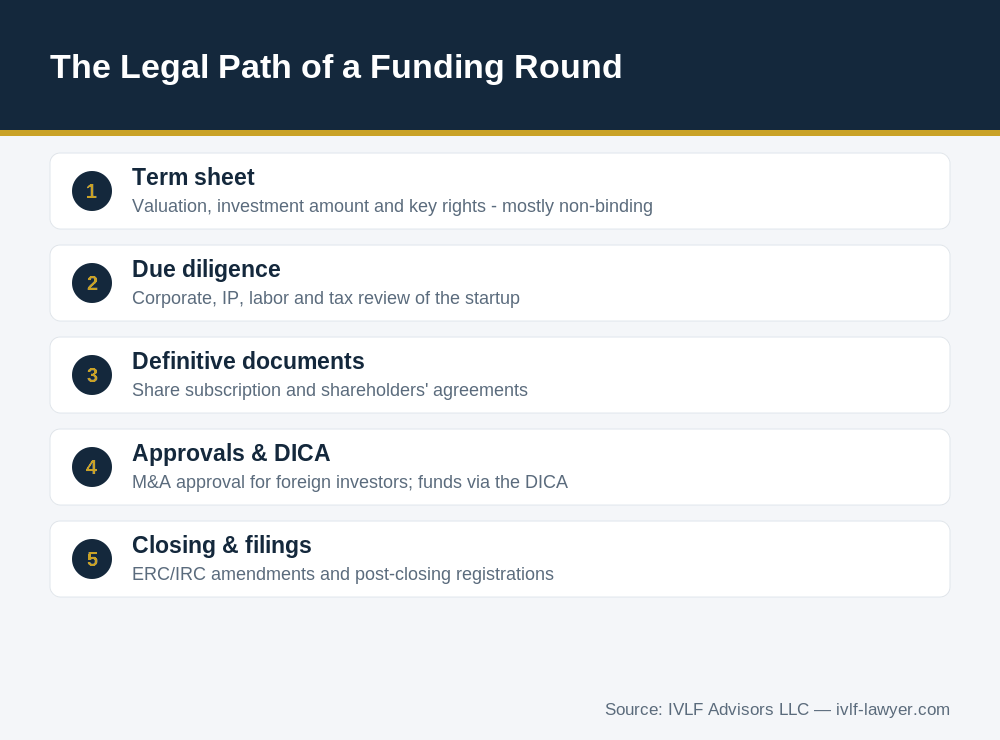
Legally, a fundraising round is typically structured as a form of M&A, and closing it well requires a set of carefully drafted transaction documents – commonly a Term Sheet, Memorandum of Understanding, Shares Purchase Agreement or Shares Subscription Agreement, and Shareholders Agreement. Each document should be reviewed against Vietnamese law and drafted to protect the legitimate rights and interests of every contractual party, not just boilerplate.
Due Diligence
Expect investor diligence to be broad but pragmatic: at seed stage it focuses on ownership, IP, and the cap table; by series A it extends to tax, labor, data protection, and sector licensing. The startup’s best tool is a standing data room updated quarterly – it turns every future round’s diligence from a scramble into a link.
While not mandatory, corporate due diligence is standard practice in most fundraising transactions. Legal, financial and tax advisors work together to surface key findings about the target company – corporate structure, foreign ownership implications, charter capital history – and assess how those findings should be addressed in the transaction documents before signing.
Foreign Investors: Approvals and the DICA
Most venture money in Vietnam is foreign, and that shapes the closing mechanics of fundraising for startups in Vietnam. A foreign investor acquiring equity typically needs M&A approval from the provincial Department of Planning and Investment before the registry amendment, and the subscription funds must arrive through the company’s direct investment capital account (DICA).
Neither fundraising for startups in Vietnam step is difficult, but both take calendar time – two to six weeks combined in routine cases – and both must appear in the transaction timeline. Rounds that treat Vietnamese procedure as an afterthought discover it at closing, when the money cannot lawfully move.
The Offshore Holding Structure
Institutional rounds frequently restructure the company before investing: a Singapore holding company is created, founders swap their Vietnamese shares for holdco shares, and the investment lands at the holdco level under Singapore-law documents. The Vietnamese entity becomes a wholly foreign-owned subsidiary.
The attraction is contractual freedom – preference shares, liquidation waterfalls, and SAFE-style instruments work cleanly offshore – plus a familiar forum for future rounds and exits. The cost is a genuine restructuring: the share swap itself is an M&A transaction with Vietnamese approvals, and ongoing transfer-pricing discipline between holdco and subsidiary matters. For founders planning serious institutional fundraising for startups in Vietnam, the structure conversation belongs at seed stage, not series B.
Preparing the Company Before the Round
Six months before serious fundraising for startups in Vietnam begins, founders should run a self-audit across five files. Corporate: charter capital fully contributed, ERC/IRC consistent with reality, board minutes complete. Equity: every share and option grant documented, no handshake allocations. IP: assignments signed by every founder, employee, and contractor who touched the product. Labor: contracts and social insurance current. Tax: filings up to date, related-party transactions documented.
This is the same fundraising for startups in Vietnam checklist investor counsel will run – running it first converts findings from negotiation leverage against the founders into a footnote.
Sizing the ESOP belongs here too. Investors will require a pool – typically 10–15% – created before their money prices the round. Founders who negotiate the pool after agreeing valuation discover the dilution lands entirely on them.
Negotiating the Term Sheet: What Matters Most
In fundraising for startups in Vietnam negotiations, four terms do most of the economic work: valuation and the ESOP pool (who bears dilution), liquidation preference (who gets paid first on exit), anti-dilution protection (what happens in a down round), and founder vesting with leaver provisions (what happens if a founder departs).
In fundraising for startups in Vietnam term sheets, founders often over-negotiate board seats and under-negotiate leaver clauses. A bad-leaver definition that strips a departing founder of vested equity for any resignation is a harsher term than an extra investor director will ever be – and far more common in first drafts than founders expect.
Everything else – information rights, pro-rata rights, drag and tag – is standard machinery. Spend negotiating capital where the economics live.
Common Legal Mistakes That Kill Rounds
Investor counsel running diligence on Vietnamese startups reports the same findings deal after deal:
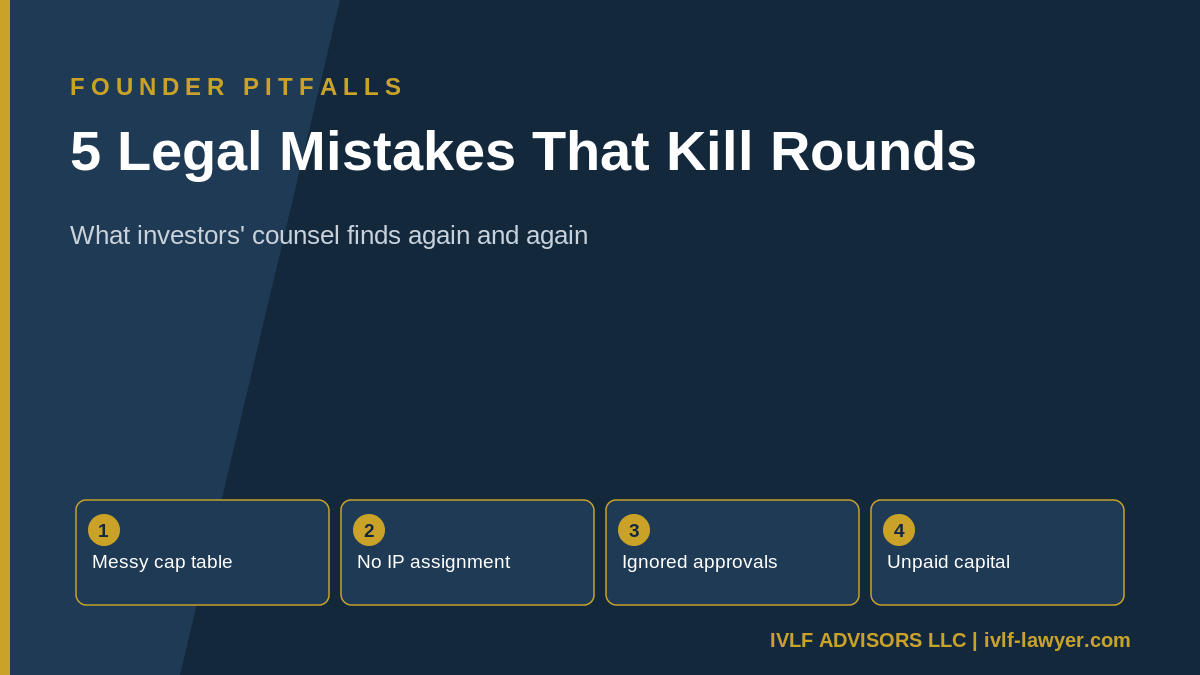
Each is fixable – before the round. A cap table reconstructed mid-negotiation, or IP assigned to the company while an investor waits, costs credibility and sometimes the deal itself. The discipline of fundraising for startups in Vietnam is mostly the discipline of keeping the company diligence-ready from day one.
After the Money Lands: Post-Closing Discipline
Closing is not the end of the legal work in fundraising for startups in Vietnam – it is a handover to a new operating rhythm. The ERC and, where applicable, IRC amendments must be filed on time; the shareholders’ agreement obligations – board composition, reserved matters, information rights – must be wired into how the company actually takes decisions; and investor reporting becomes a monthly habit.
Two post-closing items are chronically late in fundraising for startups in Vietnam rounds: updating the members’ register and share certificates, and registering any governance changes that require licensing updates. Both are five-minute tasks at closing and painful archaeology a year later, when the next round’s diligence asks for them.
The startups that raise fastest the second time are the ones whose first round left a clean file: every approval, every filing, every resolution in one place. In fundraising for startups in Vietnam, the best preparation for round N+1 is closing round N properly.
Key Legal Instruments
- Law on Enterprises 2020 – share classes, capital increases and shareholder arrangements; text on the Government’s legal documents portal.
- Law on Investment 2020 – M&A approval for foreign investors and conditional sectors.
- Circular 06/2019/TT-NHNN – DICA rules; guidance from the State Bank of Vietnam.
- Decree 38/2018/ND-CP (as amended) – investment in innovative startups and venture funds.
Frequently Asked Questions
How long does a funding round take in Vietnam? From signed term sheet to money in the account, six to twelve weeks is typical for direct investment – diligence and documentation drive the first half, approvals and DICA mechanics the second.
Can a Vietnamese company issue preference shares? Joint stock companies can issue several preference classes, though with less flexibility than offshore structures. Multi-member LLCs cannot – one reason startups convert to JSC form or move to a holdco before institutional rounds.
Do convertible notes work under Vietnamese law? Convertible loans are used, but a foreign lender’s loan of over one year requires State Bank registration, and conversion later triggers the same approvals as a direct share purchase. Many parties simply structure the note offshore.
Do government incentives exist for startup investment? Yes – Decree 38/2018 and the innovation-hub programs offer channels for venture funds and tax treatment for innovative startups, and several provinces run their own support schemes. In practice these shape fund structuring more than they change round mechanics for founders engaged in fundraising for startups in Vietnam.
Should the startup pay for the investor’s legal costs? Market practice varies: seed rounds usually see each side bear its own costs, while later rounds sometimes cap a contribution to investor counsel. Agree it in the term sheet either way – cost surprises at closing sour relationships cheaply.
What makes fundraising for startups in Vietnam different from Singapore? The instruments and negotiation dynamics are similar; the differences are procedural – approvals for foreign investors, DICA fund routing, and registry amendments – plus the LLC/JSC distinction that constrains preference shares onshore.
One structural note founders often miss: the legal work of fundraising for startups in Vietnam compounds. The charter drafted at incorporation determines how easily preference terms fit later; the first convertible note’s terms become precedent for the next; and every shortcut taken in round one resurfaces, with interest, in round two’s diligence. Treating each legal decision as infrastructure – not paperwork – is the cheapest advantage available in fundraising for startups in Vietnam.
Conclusion
Fundraising in Vietnam is achievable through a well-defined legal framework, but the mechanism, documentation, and due diligence process all need to be tailored to the specific deal. Getting this right from the term sheet stage avoids costly renegotiation later in the process.
Raising capital for your Vietnam-based startup?
IVLF Advisors LLC advises startups and investors on fundraising structure, transaction documentation, and due diligence for capital raises in Vietnam. Explore our practice areas or contact us to discuss your raise.
This article is provided for general information only and does not constitute legal advice for any specific case. Regulations may change – please consult a qualified professional before acting. Should further analysis be required, please contact one of our lawyers below.