
Offering equity in a foreign parent company is an increasingly common way to attract and retain talent at Vietnam-based operations. But an ESOP in Vietnam – an Employee Stock Ownership Plan issued by a foreign entity to its Vietnamese employees is not simply a matter of extending the existing plan – it must be registered with Vietnamese authorities and implemented through a compliant local process. Here are the key steps.
Step 1: Understand the Governing Framework
Awarding foreign equity or share options to Vietnamese employees – including any special rights attached to those options – must comply with Vietnam’s regulations on offshore equity compensation, alongside the appropriate compensation and benefits treatment under local labor rules.
Step 2: Confirm Eligibility
A foreign company can only award ESOPs to its Vietnam-based employees if it has a legitimate, registered commercial presence in Vietnam – typically a foreign-invested company, a branch or representative office, or an executive office under a business cooperation contract. The ESOP must then be registered with the State Bank of Vietnam through that commercial presence.
Step 3: Prepare an Implementation Plan
Treat the ESOP in Vietnam implementation plan as the operating manual the bank and the regulator will read: who administers awards locally, how money moves in each scenario – grant, vesting, sale, dividend – and who signs the quarterly reports. A plan written at this level of concreteness shortens both the SBV review and every future conversation with the account bank about an unusual transaction. Before applying for State Bank of Vietnam registration, the foreign entity must prepare an ESOP implementation plan that complies with both Vietnamese law and the entity’s home-jurisdiction law, and that has been approved by its own competent management authority.
Step 4: Register the ESOP
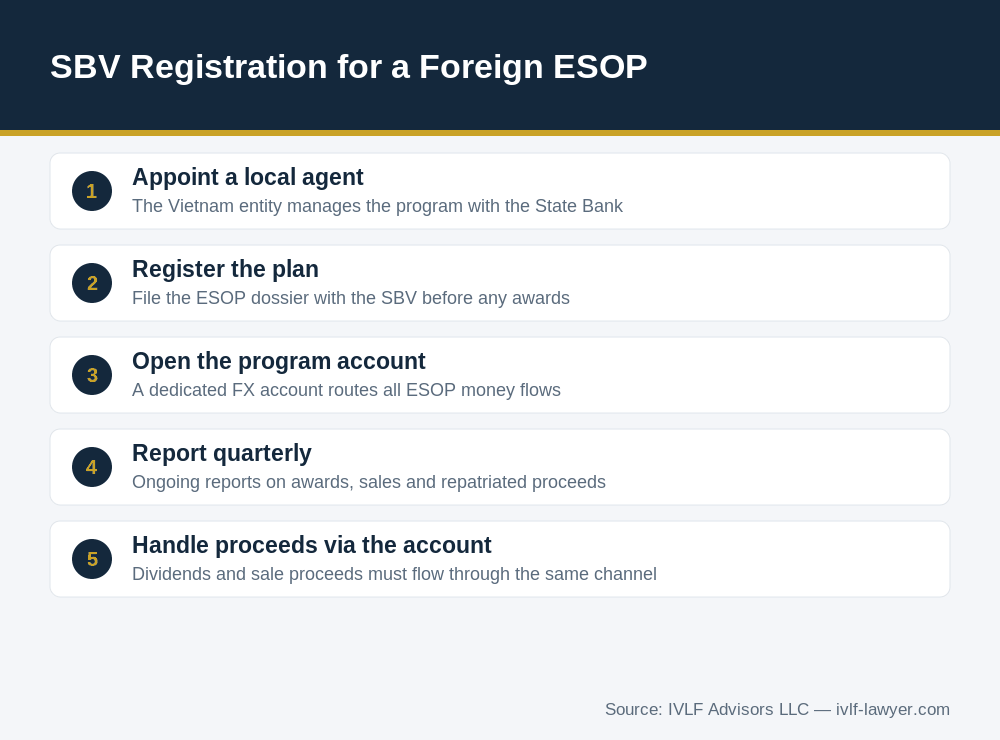 The Vietnam-based commercial presence must already hold the relevant underlying licenses (an Investment Registration Certificate, Enterprise Registration Certificate, M&A approval, or branch/representative office license, as applicable) before it can submit the ESOP registration application to the State Bank of Vietnam. The State Bank has 15 working days from receipt of a complete, valid application to grant written approval for the offshore ESOP.
Step 5: Open an ESOP Banking Account
Once approval is granted, the Vietnam-based entity opens a dedicated account with a licensed commercial bank in Vietnam through which all approved ESOP-related transactions must be conducted – keeping the equity compensation program within the approved regulatory channel.
How an ESOP in Vietnam Is Taxed
Tax drives much of the design. The Vietnamese treatment of an ESOP in Vietnam award follows the money, not the paper: 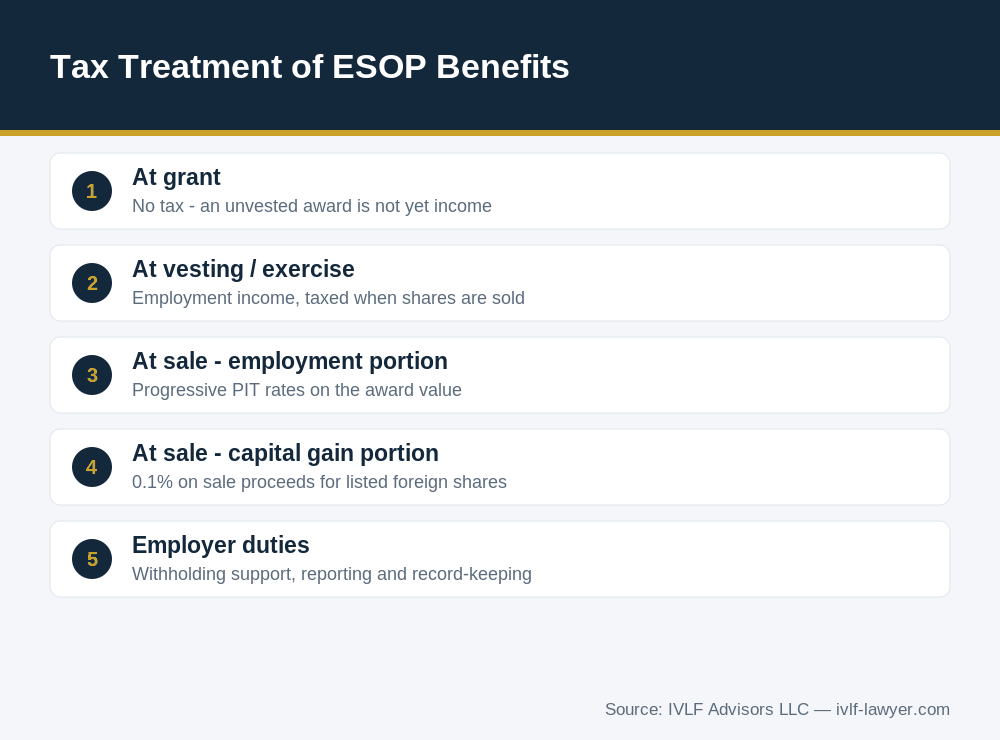 The employment-income portion is deferred: it is declared and taxed when the shares are sold, not at vesting – a cash-flow-friendly rule, but one that puts the reporting burden on the employee and the supporting records on the employer. The capital-gain portion for listed foreign shares is taxed at 0.1% of sale proceeds. Employers should prepare annual summaries for participating staff: award values, vesting dates, and sale confirmations. Employees rarely reconstruct this correctly on their own at finalisation time.
Common Compliance Mistakes
Global equity teams administering an ESOP in Vietnam from headquarters make a predictable set of errors: 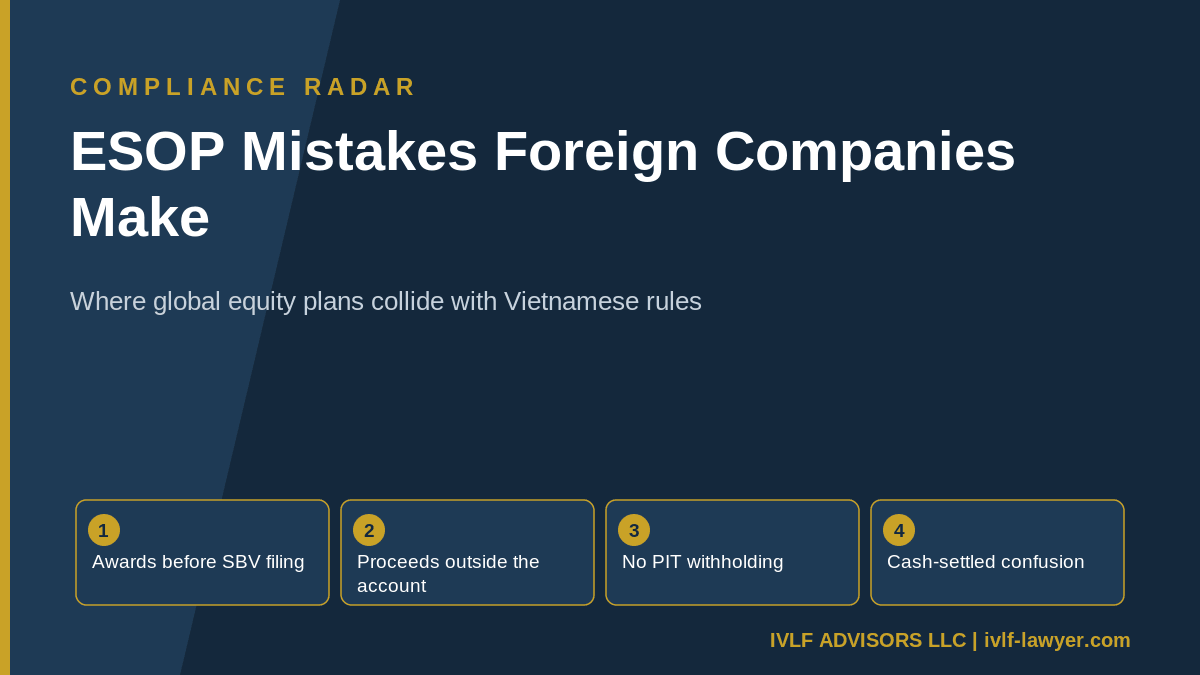 The most serious is moving money outside the registered program account – every ESOP-related flow, from purchase remittances to sale proceeds and dividends, must route through it. The most common is simply awarding shares before the State Bank registration exists, which converts an HR benefit into a foreign-exchange violation.
Cash-Settled Alternatives: Phantom Shares and RSU Cash Plans
Where the SBV process feels heavy for a small team, some groups sidestep securities transfer entirely: phantom share plans and cash-settled RSUs pay employees the value of shares without delivering shares. These plans avoid ESOP in Vietnam registration because no foreign securities are held – the payment is simply salary, taxed as employment income when paid. The trade-off is psychological and financial: employees hold a contractual bonus, not equity, and the company carries the cash liability. For teams below ten participants, the simplicity often wins; for larger or more senior populations, the real ESOP in Vietnam route pays for its paperwork in retention.
Designing the Plan Before the Paperwork
The legal steps assume a plan worth registering, and design decisions made at headquarters determine how smooth the ESOP in Vietnam rollout will be. Three parameters deserve local review before anything is filed. Vesting and leaver rules. Four-year vesting with a one-year cliff translates cleanly, but leaver provisions should anticipate Vietnamese labor law – termination disputes here are procedural, and equity that hinges on a contested dismissal invites complications. Award currency and valuation. Awards priced in USD against a VND payroll create expectation gaps; communicate values in both currencies and fix the FX convention in the plan documents. Participation scope. The registered program covers employees of the Vietnamese entity. Group structures with staff spread across an RO, a subsidiary, and contractor arrangements should reorganise employment first – the ESOP in Vietnam registration will only shelter genuine employees.
Timeline and Effort: What to Expect
A realistic ESOP in Vietnam schedule runs eight to twelve weeks: two to four weeks assembling the dossier – plan documents translated, board approvals, entity papers – then SBV review, then account opening at a licensed bank. Quarterly reporting follows a fixed calendar thereafter. The recurring ESOP in Vietnam workload is modest – a few hours per quarter once templates exist – but it is unforgiving of gaps: missed reports surface at the worst time, typically when an employee tries to repatriate sale proceeds and the bank asks for the program’s reporting history. Groups running plans across multiple countries should note that Vietnam’s regime is bank-centric rather than tax-centric: the choke point is the program account, and a good relationship with the account bank solves most operational questions an ESOP in Vietnam raises.
A Worked Example: Rolling Out a Global Plan Locally
A US software group with 60 engineers in Ho Chi Minh City wanted its global RSU plan to cover the Vietnamese team. The ESOP in Vietnam workstream ran as follows: the local subsidiary was designated implementing organisation; the global plan and award agreements were translated and filed with the SBV together with corporate approvals; a program account was opened at a foreign bank’s HCMC branch; and the first vesting event was scheduled only after registration confirmation arrived – nine weeks after kickoff. Two local ESOP in Vietnam adaptations proved worthwhile. Award communications were rewritten with net-of-tax examples in VND, which cut employee questions dramatically. And the company calendar-synced its quarterly SBV reports with payroll close, so the same data pull served both. Three years on, the plan covers 130 employees and processes sales twice a year through the program account without friction. The lesson generalises: an ESOP in Vietnam succeeds on operational routine, not legal heroics. Register before awarding, route every dollar through the account, report on schedule – and the plan behaves like the retention tool it was meant to be.
Key Legal Instruments
- Foreign Exchange Ordinance and implementing decrees – the basis for SBV control of outbound securities investment; documents on the Government’s legal documents portal.
- Circular 10/2016/TT-NHNN – the operative circular on ESOP programs of foreign companies with Vietnamese participants; guidance from the State Bank of Vietnam.
- Personal Income Tax law and guidance – timing and rates for employment income and securities transfers.
Frequently Asked Questions
Who registers the ESOP in Vietnam – the parent or the subsidiary? The Vietnamese entity acts as the implementing organisation: it files the registration, opens the program account, and submits the quarterly reports, even though the shares belong to the foreign parent’s plan. Can employees keep the foreign shares indefinitely? Yes – holding is not restricted. What is regulated is the money: any dividends or sale proceeds must be repatriated to Vietnam through the program account. Does an ESOP in Vietnam cover contractors? No. The regime covers employees with labor relations in Vietnam. Grants to contractors or advisors sit outside it and need case-by-case structuring. What happens if awards were made before registration? Regularisation is possible – register the program and disclose – but administrative penalties for foreign-exchange violations may apply, and banks will not process historic proceeds until the paperwork exists. Fix it before the first sale event, not after. Do these rules apply to shares of a Vietnamese parent company? No – a domestic ESOP in Vietnam (a Vietnamese JSC granting its own shares to staff) follows the Law on Enterprises and securities rules instead, without SBV foreign-exchange registration. This article’s regime is specific to foreign-company shares held by Vietnamese employees. Can the program account sit at any bank? It must be a licensed credit institution in Vietnam authorised for foreign-exchange activity. In practice, groups choose the subsidiary’s main operating bank for reporting convenience.
Conclusion
Awarding equity from a foreign parent to Vietnamese employees is achievable, but it runs through a specific registration and banking pathway rather than an informal grant. Getting the commercial presence, implementation plan, and State Bank registration right up front avoids compliance issues down the line and lets the ESOP do its job: attracting and retaining talent.
Planning an ESOP for your Vietnam-based team?
IVLF Advisors LLC advises foreign companies on structuring and registering offshore ESOPs for Vietnamese employees. Explore our practice areas or contact us to discuss your equity compensation plan.
Tax Treatment of Foreign ESOPs Awarded to Employees in Vietnam
When a foreign parent company awards ESOPs to employees in Vietnam, the tax event for Vietnamese personal income tax purposes typically arises at exercise (for options) or at vesting (for restricted stock units), not at grant. The taxable benefit is the difference between the fair market value of the shares on the taxable event and the exercise price paid, and it is taxed as employment income at progressive rates of up to 35%. Because the awarding entity is offshore, the Vietnamese subsidiary that employs the individual is usually still responsible for withholding and reporting this income through payroll, even though it did not pay the benefit directly – employers who overlook this obligation risk penalties during a tax inspection. Employers who are also reviewing broader equity retention tools alongside ESOPs, such as vesting schedules tied to an M&A transaction, may find our related discussion of due diligence in M&A transactions useful context for how equity incentives are typically treated during a deal.
Securities and Foreign Exchange Filings for Cross-Border ESOP Plans
Beyond personal income tax, a foreign ESOP plan awarded to employees in Vietnam intersects with two further compliance layers. First, under the State Bank of Vietnam’s foreign exchange rules, outbound payments by employees to exercise stock options (where cash is required) must generally be remitted through a securities investment capital account opened for that purpose, since informal outbound transfers are not permitted for capital-market transactions. Second, if the ESOP plan involves shares of a foreign listed company, the offering may need to be structured to avoid triggering Vietnam’s public offering rules, which is typically managed by limiting the offer to a private placement exemption available for employee stock plans. For the applicable outbound remittance procedure, see the State Bank of Vietnam foreign exchange management guidance, and for personal income tax treatment of share-based income, see the General Department of Taxation.
This article is provided for general information only and does not constitute legal advice for any specific case. Regulations may change – please consult a qualified professional before acting. Should further analysis be required, please contact one of our lawyers below.