Every enterprise capital increase Vietnam plan starts from the same reality: businesses need capital for more than routine operations financed through conventional bank loans – investment projects also require a defined amount of equity capital. For an investment project, total investment capital is generally made up of owner’s equity and mobilized capital. In every enterprise capital increase Vietnam assessment, depending on the scale and requirements of the project, owner’s equity typically needs to represent at least 15–20% of total committed investment capital, and demonstrating that ratio is a key part of proving financial capacity to the licensing authority during the investment approval process. The remaining 80–85% is generally mobilized capital, most often raised through bank financing at rates that depend on the company’s credit rating.
When Equity Capital Falls Short
Determining an investor’s financial capacity is not always straightforward, but once the equity figure is confirmed to meet the statutory 15–20% threshold, the investor has satisfied that financial capacity condition. If a company does not meet the required equity ratio, it has several options to increase its charter capital – and, correspondingly, its owner’s equity.
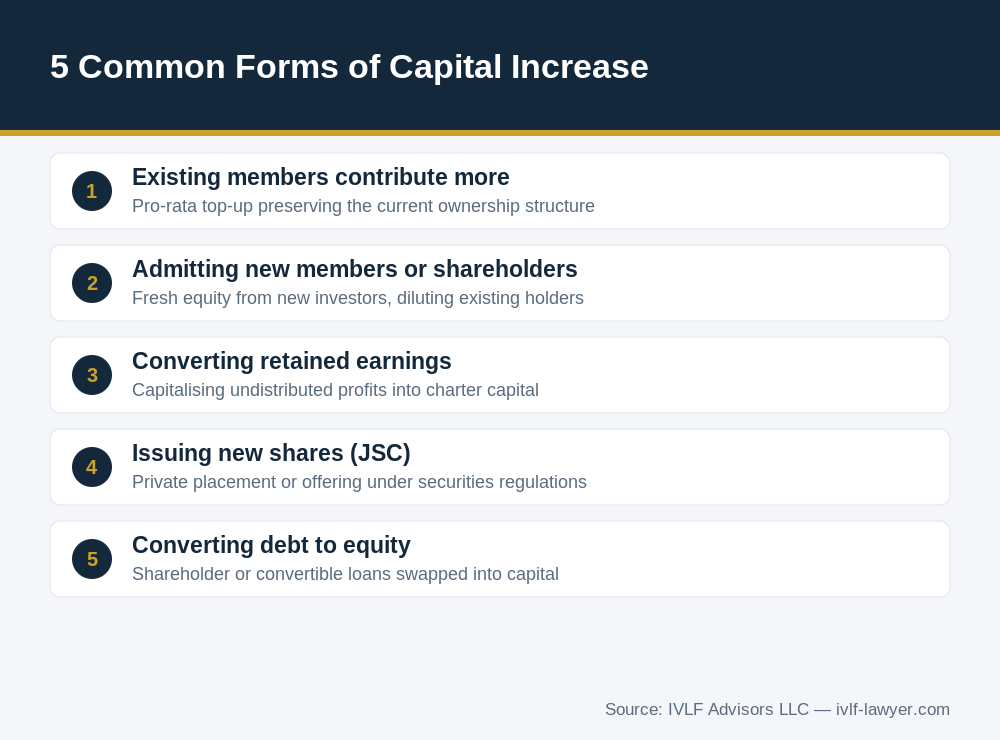
Common Forms of Capital Increase
- Private placement of shares
- Offering shares to existing shareholders
- Initial public offering (IPO)
- Paying dividends in shares
- Implementing an ESOP
- Converting loans or bonds into shares
- Mergers and acquisitions
- Combined structures drawing on more than one of the above
These are the most common ways a company can increase its charter capital, and charter capital increases move in step with owner’s equity – as charter capital rises, owner’s equity rises with it. Each of these methods, however, carries its own procedural requirements and regulatory approvals, and the right choice depends on the company’s structure, shareholder base, and timeline.
Choosing the Right Form of Enterprise Capital Increase Vietnam Rules Offer
The best form depends on three questions: who should own the company afterwards, how fast the money is needed, and what the tax and accounting consequences are. Existing-member top-ups preserve control and are procedurally the lightest, but they are limited by the members’ own capacity to fund. Admitting new investors brings fresh capital and often strategic value, at the price of dilution and a more complex negotiation – valuation, governance rights, and transfer restrictions all land on the table. Capitalising retained earnings converts profits the company already holds into charter capital; it strengthens the licensing profile without new cash. Debt-to-equity conversion is increasingly common in enterprise capital increase Vietnam practice, particularly for FDI companies that funded early operations through shareholder loans and now prefer a cleaner balance sheet. For joint stock companies, share issuance opens further variants – private placement, offerings to existing shareholders, or employee share schemes – each with its own securities-law overlay.
The Registration Procedure, Step by Step
Whatever the form, an enterprise capital increase Vietnam procedure follows a predictable sequence: 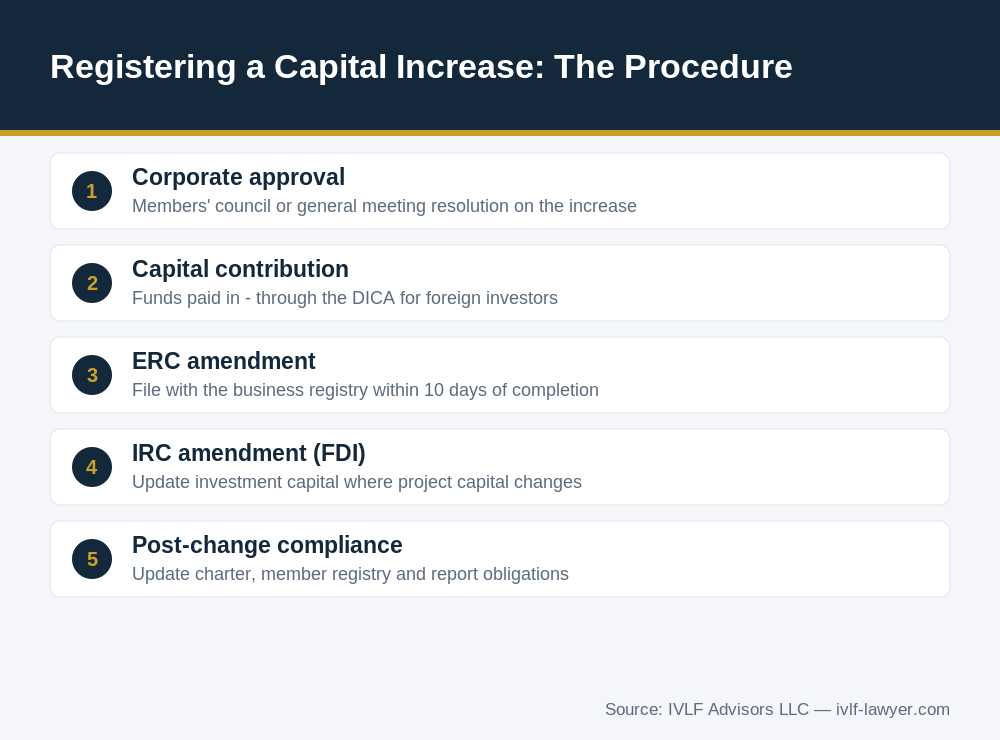 The statutory deadline that trips enterprise capital increase Vietnam filings most often: the ERC amendment must be filed within 10 days of the change. For foreign-invested companies, the funds themselves must arrive through the direct investment capital account (DICA), and where the increase changes the project’s registered investment capital, the IRC must be amended as well – a second procedure with its own dossier.
FDI-Specific Considerations
Foreign-invested enterprises face two extra checkpoints in any enterprise capital increase Vietnam transaction. First, sector conditions: if the increase brings a new foreign investor into a conditional sector, market-access conditions are re-examined. Second, banking mechanics: contributions must route through the DICA, and mismatches between the remitted amount, the resolution, and the amended ERC are the most common reason banks reject the transfer documentation. Timing matters too. The IRC amendment should generally precede or accompany the ERC amendment where investment capital changes; filing them out of order creates inconsistencies that surface during later FDI supervision reviews.
How Licensing Authorities Assess Financial Capacity
Because owner’s equity must typically cover 15–20% of total investment capital, an enterprise capital increase Vietnam decision is often driven by licensing strategy rather than operational need. Authorities reviewing an enterprise capital increase Vietnam outcome assess financial capacity through audited financials, bank balance confirmations, and the registered charter capital itself – and a company whose charter capital visibly matches its project commitments moves through appraisal with fewer questions. This is why timing the increase before filing a new IRC or project expansion dossier is standard practice. An enterprise capital increase Vietnam step completed after the project filing forces supplementary explanations; one completed before it simply strengthens the file. The same logic applies to bidding and large commercial tenders: counterparties read charter capital as a solvency signal. For groups running multiple Vietnamese entities, aligning each entity’s capital with its actual contract exposure – rather than leaving all equity parked in one holding company – is a small structural habit that prevents repeated capacity questions.
Common Mistakes to Avoid
- Contributing before the resolution – money arriving in the account before corporate approval creates classification problems with the bank.
- Missing the 10-day ERC filing window – a routine administrative fine that is entirely avoidable.
- Ignoring the IRC – increasing charter capital without amending project capital where required.
- Undocumented valuation for new investors – premium contributions should be papered to avoid later disputes over ownership percentages.
The Filing Dossier in Detail
Registrars reject incomplete filings rather than requesting corrections informally, so the dossier deserves care: 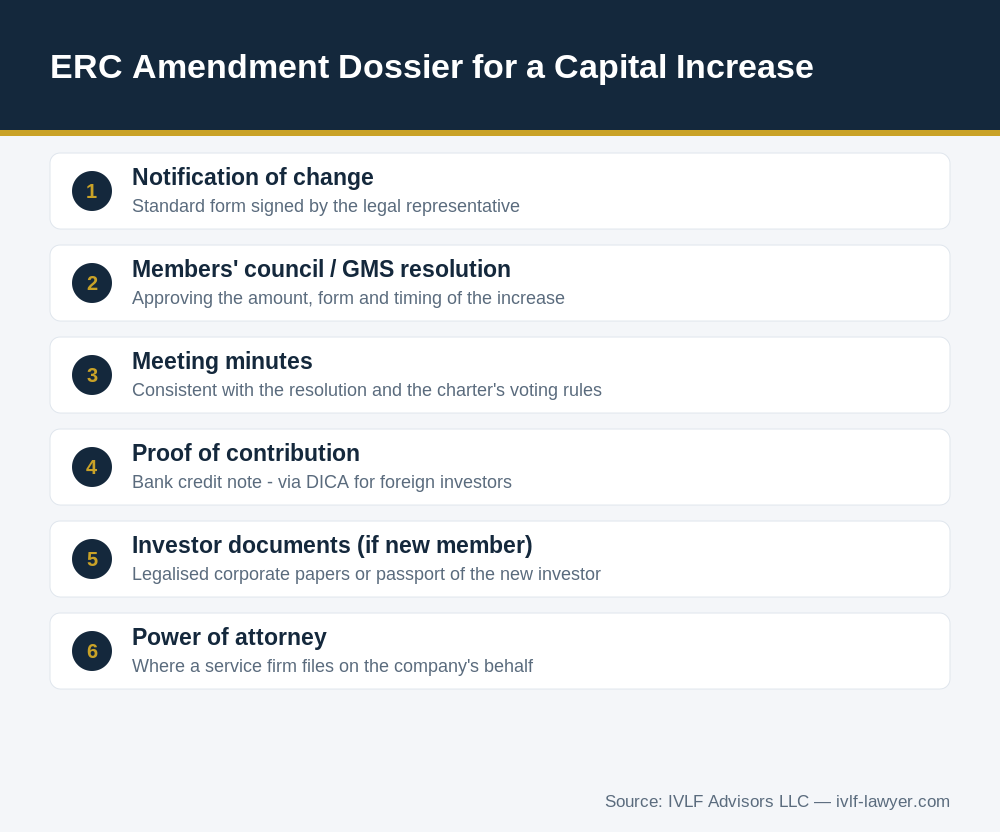 The item that most often causes rejection is inconsistency – a resolution approving one figure, a bank note showing another, and a notification form rounding a third. All three must match to the digit.
Worked Example: Bringing In a Strategic Investor
A two-member Vietnamese LLC providing logistics software wanted to admit a Singapore strategic investor with a 30% stake. The enterprise capital increase Vietnam sequence ran: valuation agreed and recorded in an investment agreement; members’ council resolution admitting the new member and approving the increase; market-access check confirming software services carry no foreign ownership cap; funds remitted into the newly opened DICA; ERC amendment filed within the 10-day window; and the charter and member registry updated the same week. Elapsed time from signed investment agreement to amended ERC: 24 days. The only friction point was the bank’s request to see the resolution before crediting the DICA – a sequencing detail worth planning for in every enterprise capital increase Vietnam project involving foreign money.
Capital Increase or Shareholder Loan?
Not every funding need justifies touching charter capital. A shareholder loan is faster than an enterprise capital increase Vietnam procedure – no registry filing – and repayable, but it creates debt-service obligations and, for foreign lenders, foreign-loan registration requirements with the State Bank once terms exceed one year. A capital increase is permanent and strengthens licensing capacity, but locks the funds in. Many FDI groups deliberately combine both: a base enterprise capital increase Vietnam step for licensing credibility, plus shareholder loans for working-capital flexibility.
Key Legal Instruments
- Law on Enterprises 2020 – forms of capital increase and corporate approvals; consolidated text on the Government’s legal documents portal.
- Decree 01/2021/ND-CP – enterprise registration procedures and the amendment dossier.
- Circular 06/2019/TT-NHNN – DICA rules for foreign investment flows, published by the State Bank of Vietnam.
- Law on Investment 2020 – IRC amendment where project capital changes.
Frequently Asked Questions
How long does an enterprise capital increase Vietnam procedure take? The ERC amendment itself is typically issued within three working days of a complete filing. The full timeline is driven by corporate approvals and, for FDI companies, DICA transfers and any IRC amendment – two to six weeks in most cases. Can charter capital be increased with assets instead of cash? Yes – in-kind contributions follow the valuation and transfer rules discussed in our in-kind capital contribution guide. Does a capital increase change tax obligations? The increase itself is not taxable, but license fee tiers depend on registered capital, so a large increase can move the company into a higher annual license fee bracket. Can the increase be done in stages? Yes – staged enterprise capital increase Vietnam plans are common for large projects, but each completed stage triggers its own ERC amendment filing. Is a capital increase possible while the company has unpaid initial capital? No. The original commitment must be settled – or formally reduced – before any enterprise capital increase Vietnam filing will be accepted. Does a foreign parent need a new approval to top up its Vietnamese subsidiary? Usually not for the ownership itself – an existing member contributing more does not change the ownership ratio. The DICA transfer, the resolution, and the ERC amendment remain necessary, and the IRC must be amended where the project’s registered capital changes with the top-up. What about decreasing capital later? Unlike an enterprise capital increase Vietnam filing, capital reductions are tightly controlled – they require settled obligations, a two-year operating condition in some cases, and their own registry procedure. Treat the increase as long-term.
Conclusion
Meeting Vietnam’s equity capital thresholds is a precondition for many investment approvals, and companies that fall short have multiple lawful pathways to close the gap. Choosing the right form of capital increase – and executing the procedure correctly – is essential to keeping an investment project on track.
Planning a capital increase for your Vietnam entity?
IVLF Advisors LLC advises companies on structuring and executing charter capital increases in Vietnam, from private placements to debt-to-equity conversions. Explore our practice areas or contact us to discuss your capital plans.
Capital Increase by Issuing New Shares vs Contribution: Choosing the Right Form
Enterprise capital increase in Vietnam can take several legal forms, and choosing the wrong one creates friction with existing shareholders or delays regulatory approval. A joint-stock company can increase capital by issuing new shares to existing shareholders pro-rata, offering shares to new investors (which requires either a private placement notification or a public offering registration depending on scale), or converting bonds/convertible instruments into equity. A limited liability company, by contrast, increases capital either by having existing members contribute additional capital in proportion to their holding or by admitting a new member, which requires the unanimous consent of the existing members’ council unless the charter provides otherwise. Foreign-invested companies must also confirm whether the capital increase changes the foreign ownership ratio in a way that triggers a fresh M&A notification to the Department of Planning and Investment. Companies planning a capital increase alongside a broader restructuring should also review our related guide on FDI company setup in Vietnam, since amendments to charter capital typically require updating both the IRC and ERC in a coordinated filing.
Amending the IRC and ERC After a Capital Increase
Once shareholders or members approve a capital increase, a foreign-invested company must amend both its Investment Registration Certificate and Enterprise Registration Certificate to reflect the new charter capital, and the amendment must be filed within 10 working days of the corporate resolution. The amended IRC confirms the new capital contribution schedule (typically 90 days from the resolution date for the incremental amount), and failure to file on time can result in administrative fines and complications when the company later applies for tax incentives or bank facilities that reference registered capital. Where the capital increase is funded by a foreign shareholder, the additional funds must be remitted through the company’s existing Direct Investment Capital Account to be recognized as valid capital contribution evidence. For the official procedure to amend an ERC after a capital change, see the National Business Registration Portal, and for IRC amendment requirements, see the Ministry of Planning and Investment.
This article is provided for general information only and does not constitute legal advice for any specific case. Regulations may change – please consult a qualified professional before acting. Should further analysis be required, please contact one of our lawyers below.