
Employment rights are often the first issue foreign executives need to clarify when they begin, change or end a role in Vietnam. This practical guide highlights the questions that should be addressed with the actual contract, company policies and working arrangements in view.
For international professionals building careers in Vietnam, having a trusted employment rights advisor is essential. IVLF Advisors LLC is proud to have been chosen by a long list of senior executives who have worked at renowned organisations including VinFast, Bamboo Airways, Vietjet, Hai Au Aviation, British University Vietnam (BUV), RMIT University and major language centres, advising them on their rights when employment contracts come to an end.
When a contract closes or a career move beckons, Vietnamese administrative procedures can consume enormous time and energy. With detailed knowledge of how large corporate employers operate, we provide end-to-end support so foreign experts can move on with complete peace of mind.
Our Employment Advisory Packages for International Experts
- Protecting benefits on termination: we resolve issues arising on termination of employment, ensuring clients receive their full severance allowance, salary, bonus and agreed benefits smoothly and quickly – and, where necessary, we coordinate third-party representation in disputes over severance or unlawful termination;
- Securing fair contract terms: we review employment contracts before signing, flag disadvantageous or unlawful clauses, and advise executives before they decide to terminate – or before their employer does;
- PIT refunds & one-off social insurance withdrawal: we prepare and process personal income tax refunds, social insurance book finalisation and one-off social insurance withdrawals. Our meticulous work has delivered real results – including helping senior personnel from VinFast and Bamboo Airways recover their social insurance books through direct engagement with those companies, and enabling foreign experts to receive their full one-off social insurance entitlement before leaving Vietnam;
- Seamless immigration status: renewal and conversion of work permits, temporary residence cards and visas, eliminating status gaps between jobs – plus practical solutions for settling bank accounts and other personal matters before departure.
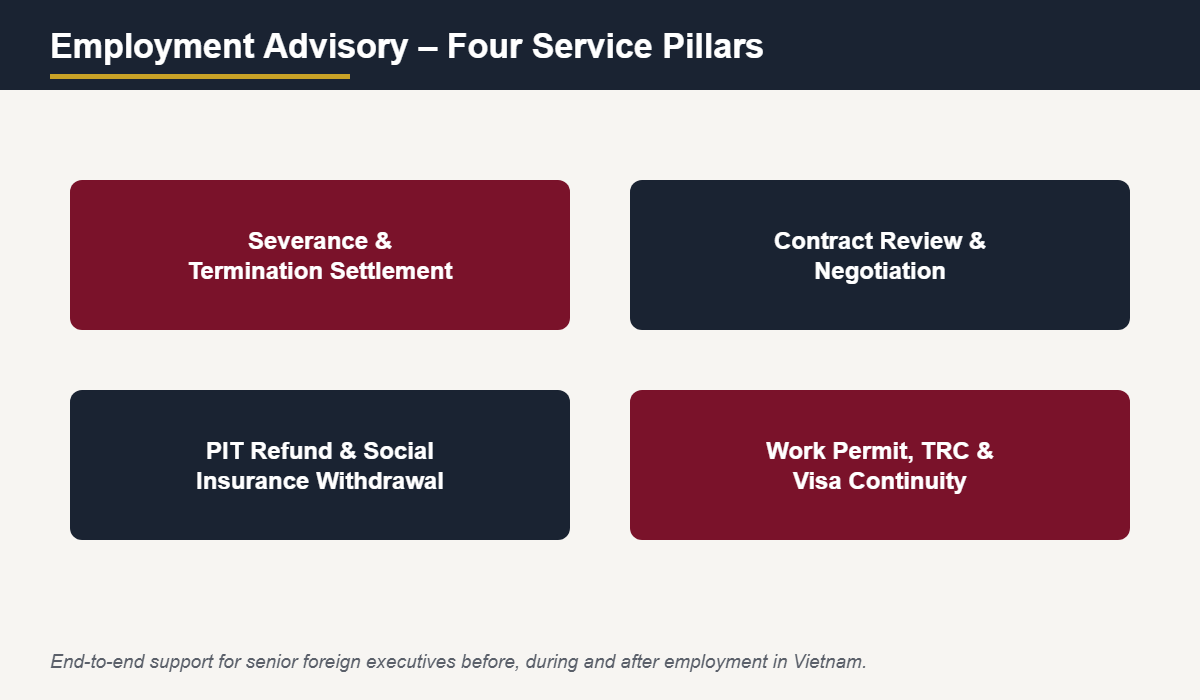
The four pillars of IVLF’s employment advisory service for international executives.
Trusted – and Referred – by International Professionals
Organised as an independent advisory firm, IVLF Advisors LLC always puts the client’s personal interests first. After each successful engagement we are regularly referred to our clients’ colleagues and friends – for similar employment matters and for related work such as establishing companies in Vietnam or resolving personal legal issues.
Key Legal References
- Labour Code 2019: termination grounds, severance allowance and unlawful-termination remedies;
- Law on Social Insurance (Law No. 41/2024/QH15 from 1 July 2025): social insurance book finalisation and one-off withdrawal by foreign employees;
- Law on Personal Income Tax: year-end finalisation and refunds for expatriates;
- Decree No. 219/2025/ND-CP: work permits, exemptions and the single-step procedure.
Related practice areas: Labour & Employment · Immigration & Work Permits · Tax
Facing a similar challenge?
IVLF Advisors LLC advises investors and enterprises on restructuring, M&A, employment and cross-border transactions in Vietnam. Contact us for a confidential assessment of your matter.
Employment rights: the practical starting point
For senior hires, employment rights should be reviewed as a complete working relationship rather than as a single contract clause. The relevant documents may include the labour contract, offer letter, internal labour regulations, compensation policies, appointment documents, work-permit materials and any confidentiality or incentive arrangements. Each document can serve a different purpose, and inconsistencies between them can create avoidable uncertainty.
A useful review starts by identifying the employing entity, the executive?s title, reporting line, location, working time and the intended duration of the role. It should then distinguish an employment relationship from board, consulting or shareholder roles that may exist alongside it. Clear role mapping helps the company administer employment rights consistently and helps the executive understand which policies apply in practice.

Seven questions to address before signing or renewing
- Who is the employer? Confirm the legal entity that signs the contract, pays remuneration and maintains personnel records. This point affects how employment rights and obligations are administered.
- What is the role and authority? The job title, scope of authority and approval limits should be described in documents that are consistent with the organisation?s governance structure.
- How is remuneration defined? Salary, allowances, incentives, reimbursements and any equity-related benefits should state the relevant conditions, timing and treatment on termination.
- Which benefits apply? The package may address leave, insurance, travel, housing, tax support and other benefits. Employment rights are easier to manage when eligibility and documentation are clear.
- Is a work permit or exemption needed? Immigration and labour requirements should be checked early, particularly where the executive?s position or employer will change.
- How is confidentiality protected? Confidential information, intellectual property, data access and return-of-property obligations should be practical and proportionate to the role.
- What happens at the end of the relationship? Notice, handover, accrued amounts, return of documents and communication responsibilities should be planned rather than left to the final day.
Employment rights during the working relationship
Day-to-day administration matters as much as the signed contract. Employment rights can be affected by changes to job scope, working location, salary structure, reporting arrangements or company policy. A well-maintained written record of material changes gives both sides a clearer reference point and reduces the risk that an informal practice is later misunderstood.
Senior executives often receive a mix of contractual remuneration and discretionary or policy-based benefits. The company should explain which components are guaranteed, which require separate approval and which depend on performance or continued employment. The executive should similarly keep copies of the current contract, amendments and policy acknowledgements. This is a simple but effective way to maintain visibility over employment rights.

Managing change, absence and performance issues
Before changing an executive?s position or compensation, the employer should review the contract and the relevant internal rules. The correct process depends on the facts: a temporary adjustment, a permanent amendment, a reassignment or a performance-management step may call for different documentation. Treating every change as a simple instruction can create unnecessary disputes about employment rights and responsibilities.
Where performance or conduct concerns arise, a structured process is generally safer than an informal exchange of messages. The employer can define the concern, collect relevant records, give the individual an opportunity to respond and document the next steps. The purpose is not to predetermine an outcome; it is to ensure that decisions are based on the appropriate documents and facts.
Ending an employment relationship carefully
Termination and end-of-contract arrangements require particular care because several matters may need to be handled at once: notice, final payments, accrued leave, tax, social insurance, handover, company property, access to information and communications with colleagues or clients. Employment rights should be considered alongside the company?s operational need for continuity and protection of confidential information.
A practical exit checklist can identify the responsible person, the document required, the timeline and any item requiring specialist advice. It is often helpful to prepare the checklist before a termination discussion takes place, especially where the executive has multiple roles or access to sensitive commercial information.

Where to obtain reliable information
Employment arrangements are fact-specific and may be affected by applicable legislation, internal regulations, immigration status and the parties? documents. For general official information, readers may consult the Government News portal and the International Labour Organization in Vietnam. These sources do not replace advice on a particular employment relationship.
This guide is general information only. The appropriate approach to employment rights for a foreign executive depends on the contract, the role, the employer and the facts at the relevant time. Early document review is usually more efficient than resolving uncertainty after a disagreement has emerged.
Employment rights and the written record
A complete file is the practical foundation for managing employment rights. The file should not be limited to the signed labour contract. Depending on the role, it may also include an appointment decision, job description, internal policies, salary approvals, incentive terms, tax or benefit instructions, immigration records and correspondence that confirms a material change. The purpose is not to collect paperwork for its own sake. It is to ensure that the parties can identify the current terms of the relationship from reliable records.
When a foreign executive joins a Vietnamese business, the employer should confirm which documents are intended to be contractual and which are guidance only. A policy can explain how a benefit is administered, while the contract may define the core entitlement. If the two documents use different language, the company should address that difference before it becomes a source of disagreement. This kind of review supports employment rights and makes later decisions easier to explain.
It is useful to maintain a controlled version of the working documents. The responsible HR, legal or management team can record the date of each amendment, the person who approved it and the reason for the change. Executives should be given the updated document where their terms are affected. A clear record is particularly valuable when the company operates through several entities or when the executive has regional responsibilities.
Compensation, benefits and incentives
Compensation arrangements for senior personnel may contain more than a monthly salary. They can include fixed allowances, performance incentives, discretionary bonuses, reimbursements, tax support, housing, travel, education or other benefits. The documents should state whether each item is guaranteed, conditional, discretionary or subject to a separate plan. This distinction is important because employment rights can be affected by the language used to describe a payment and by the company?s historic practice.
For incentive arrangements, the parties should identify the performance period, the relevant targets, the decision-maker, payment timing and the treatment of a departure before payment. If the plan is subject to annual approval, it should say so clearly. If a benefit is available only while the executive is employed, that condition should be visible rather than implied. Clear drafting reduces the risk of treating a commercial expectation as an automatic contractual entitlement.
Companies should also consider the administrative side of remuneration. Payroll records, approved expense claims, leave records and benefit-provider communications should be capable of supporting the final calculation if the relationship ends. Maintaining that information as the relationship progresses is usually more efficient than reconstructing it during an exit discussion.
Role changes, mobility and work authorization
Many disputes arise after an executive?s role changes without the documents being updated. A new reporting line, expanded authority, transfer to a different entity, altered work location or material change in compensation can have practical implications for employment rights. Before implementing a change, the company should assess whether the existing contract and approval documents still describe the actual arrangement.
Foreign executives may also need immigration or work-authorization arrangements that align with the employer, position and planned place of work. The right process depends on the facts and applicable rules at the relevant time. A change in title or employing entity should not be treated only as an internal HR matter if it may also affect a work permit, exemption, visa or related filing. Early coordination between HR, legal and the executive can prevent a routine business change from creating a compliance problem.
Mobility arrangements benefit from a practical checklist. The checklist can cover the proposed effective date, new role, signatories, required consents, payroll treatment, insurance, handover of authority and communications to staff or clients. This approach respects employment rights while giving the business a clear implementation path.
Performance management and workplace concerns
Performance and conduct issues should be handled through a process that is appropriate to the facts, rather than through informal messages or conclusions made in advance. The employer can define the concern, gather relevant records, identify the applicable policy or contractual term and give the executive a meaningful opportunity to respond. This does not require a rigid formula in every situation, but it does require a fair and well-documented approach.
Where improvement is expected, a written plan can state the objectives, support available, review period and next meeting date. The plan should focus on observable responsibilities rather than vague impressions. It can also identify whether the issue concerns a management role, technical output, compliance, interpersonal conduct or a resource constraint outside the executive?s control. A structured process helps preserve employment rights and helps management make a decision based on documented information.
Serious concerns may require a faster response, particularly where there are allegations involving confidentiality, conflicts of interest, data access or company property. Even in these cases, the company should protect evidence, limit unnecessary circulation of sensitive information and obtain appropriate advice before taking an irreversible step. The correct response depends on the evidence and on the relevant documents.
Confidential information, data and post-employment obligations
Senior executives often receive access to strategic plans, customer information, financial data, internal systems and commercially sensitive documents. The contract and related policies should explain how that information is to be used, stored and returned. The company should make the obligations practical: for example, by maintaining an asset register, access list and return checklist. Vague clauses are harder to administer than clear operational steps.
Any post-employment restriction should be reviewed carefully in light of the applicable law, the role and the legitimate business interest it is intended to protect. The company should avoid assuming that a broadly worded clause will solve every risk. A proportionate combination of confidentiality, intellectual-property, non-solicitation, access-control and handover measures may be more useful than a restriction that cannot be implemented consistently.
These issues also connect to employment rights. The executive should understand which information remains confidential, which property must be returned and which obligations continue after the working relationship ends. A written exit confirmation can reduce uncertainty for both sides.
Planning an orderly exit
An orderly exit is usually the result of preparation, not a last-minute exchange of documents. The parties may need to address notice, final salary, incentives, accrued leave, tax, insurance, work-authorization status, company property, passwords, board or management positions and communications with customers or colleagues. Each item should have an owner and a timeline.
Before a discussion takes place, the employer can prepare a factual summary of the role, the relevant contract terms and the proposed operational arrangements. The executive can review the same documents and seek advice where needed. This preparation helps the parties focus on the actual employment rights and obligations rather than on assumptions or incomplete records.
Handover should be tailored to the role. A senior executive may need to transfer project information, reporting responsibilities, regulatory contacts, authority documents, corporate records or key commercial relationships. The handover plan should protect business continuity without asking the executive to perform obligations that are not clearly defined or reasonably scheduled.
A practical review framework
For a periodic health check, the company can ask five questions: are the current terms documented; do the actual duties match the written role; are compensation and benefits being administered as described; are immigration and compliance records current; and is there a workable process for a change or exit? A short review against those questions can reveal gaps before they become contentious.
Foreign executives can use the same framework from their own perspective. They can keep current copies of their documents, clarify any change that affects pay or responsibility, record agreed handover arrangements and raise questions promptly when the written terms no longer reflect the role. This constructive approach supports employment rights and the company?s need for predictable administration.
The right outcome will always depend on the specific documents and facts. This material is general information, not legal advice for a particular employment relationship. Where a material change, dispute or termination is being considered, professional advice should be obtained before commitments are made or rights are waived.
Keeping employment rights visible in practice
Regular, documented conversations about employment rights can prevent routine management decisions from becoming disputes. The employer can explain the relevant policy, confirm the practical next step and keep a concise record of what was agreed.
For foreign executives, reviewing employment rights when the role, compensation or reporting structure changes is often more useful than waiting for a problem to arise. This also gives the business an opportunity to correct an outdated document before it is relied upon.
Clear communication does not remove the need for a fact-specific review, but it helps both sides identify the employment rights and responsibilities that matter at each stage of the relationship.
Employment rights: short review questions
- Employment rights and pay: do the written terms match the current package?
- Employment rights and role: does the documented authority reflect the actual position?
- Employment rights and change: has each material amendment been recorded clearly?
- Employment rights and exit: is there a realistic checklist for notice, payment and handover?
- Employment rights and records: can the relevant documents be located and reviewed promptly?
This article is provided for general information only and does not constitute legal advice for any specific case. Regulations may change – please consult a qualified professional before acting. Should further analysis be required, please contact one of our lawyers below.