A capitalization table – or cap table – tracks who owns what in a company: shares, equity classes, and dilution scenarios. For cross-border M&A transactions involving a Vietnamese target, an accurate cap table is not just good practice; it is often the starting point for determining which regulatory approvals the deal will need. Here are the key elements to get right.
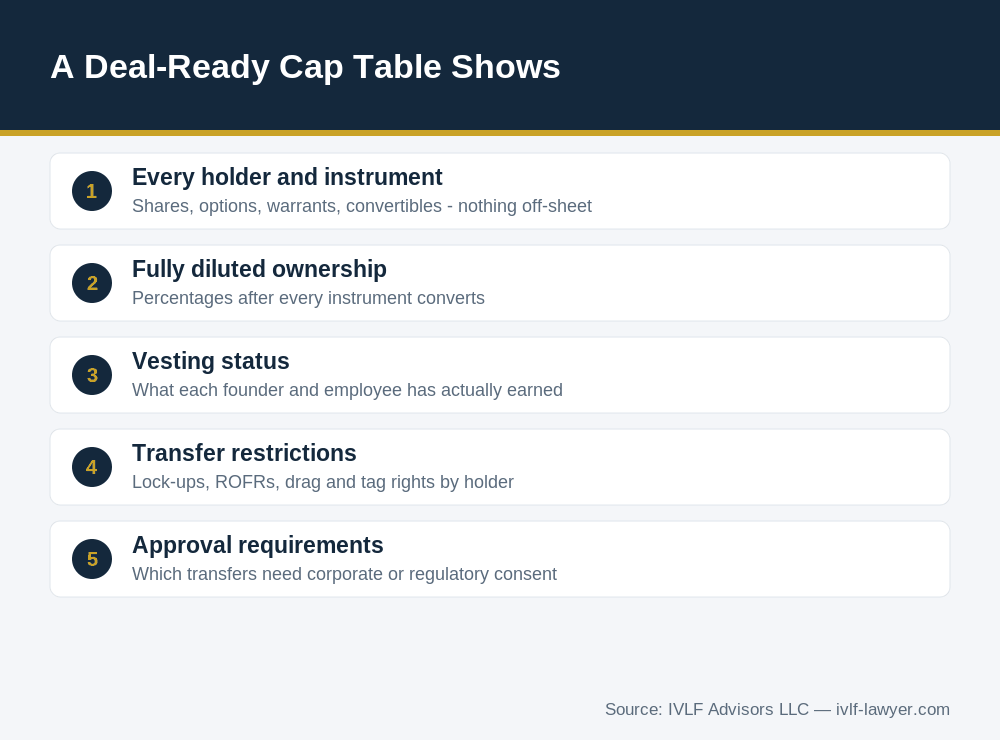
1. Identify Shareholders and Their Shares
Start with the company’s charter or shareholder agreement to identify every shareholder and the number and type of shares they hold – common shares, preferred shares, and options should be tracked separately, since each carries different rights and different treatment in a transaction.
2. Calculate Ownership Percentages – and Check Approval Triggers
Once shareholdings are documented, ownership percentages should be calculated so they total 100%. This figure matters beyond bookkeeping: depending on the resulting ownership structure and the sectors involved, the parties will need to determine whether the transaction triggers a requirement to obtain M&A investment approval or to file for merger clearance under Vietnam’s competition rules before closing.
3. Model Dilution Scenarios
Dilution occurs whenever new shares are issued – a new funding round or an option pool top-up, for example – reducing existing shareholders’ percentage ownership. Building out multiple dilution scenarios in the cap table, and calculating the resulting ownership for each shareholder under each scenario, helps all parties negotiate from the same set of facts.
4. Account for Convertible Securities
Convertible instruments – convertible bonds, convertible preferred shares, and similar instruments – can convert into common shares at a later date. These need to be included in the cap table on both an as-issued and an as-converted basis, so the potential ownership impact of conversion is visible before it happens.
5. Reflect the Impact of the Transaction Itself
The M&A transaction will itself change the cap table – new investor shares, founder rollover, earn-out mechanics, or escrow arrangements all need to be layered onto the pre-transaction structure to produce an accurate post-closing picture.
Anchoring the Cap Table in Vietnamese Records
In cross-border deals, the spreadsheet is only as good as the official records behind it. A Vietnamese target’s cap table must reconcile with five sources:
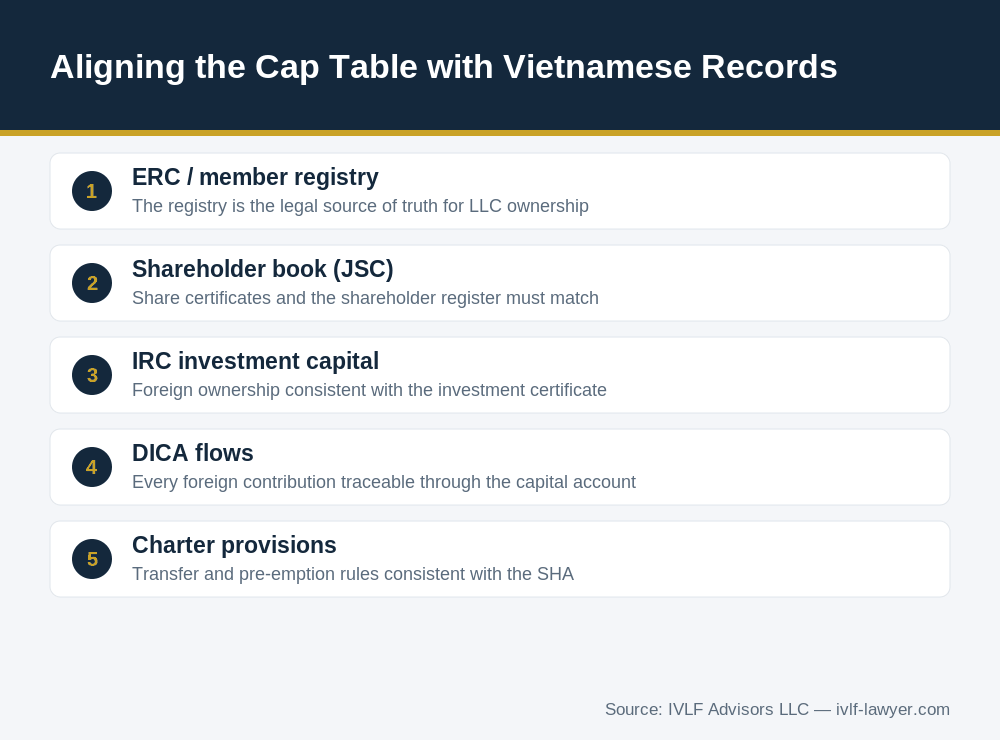
For an LLC, the member registry and ERC control; for a JSC, the shareholder register and share certificates. Where the buyer is foreign, the IRC’s registered investment capital and the DICA transaction history must also line up – a cap table entry that cannot be traced to a DICA remittance is a finding, not a footnote.
The reconciliation exercise routinely surfaces surprises: transfers signed but never registered, capital recorded as contributed that never arrived, or option promises made in offer letters that no corporate document supports.
Cap Table Errors That Stall Vietnamese Deals
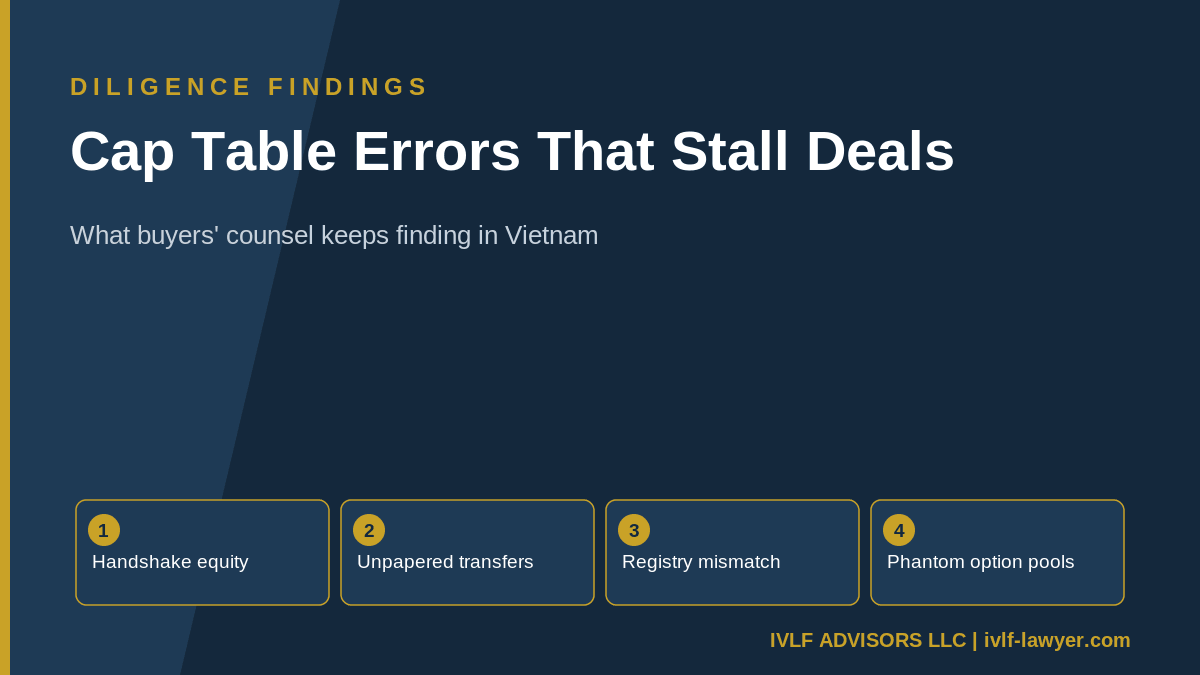
Each error has a standard cure – regularise the transfer, paper the equity promise, correct the registry – but every cure takes weeks and consumes negotiating goodwill. Sellers who reconcile their cap table before the process starts avoid donating that leverage to the buyer.
Why the Cap Table Drives Deal Structure
Beyond ownership arithmetic, the cap table determines transaction mechanics in Vietnam. It reveals which holders must sign – every member of an LLC selling out, or drag-along thresholds in a JSC. It exposes approval triggers: foreign ownership crossing conditional-sector caps, or pre-emption rights that force an internal offer round before any outside sale.
And it prices the waterfall. Preference stacks, convertible instruments, and ESOP overhang all change who receives what at a given enterprise value – modelling this early prevents the awkward late discovery that management’s expected payout and the founders’ differ by millions.
Worked Example: The Waterfall in Practice
Consider a Vietnamese fintech JSC selling for USD 20 million. The cap table shows: founders 55%, a series A investor 25% holding preference shares with a 1x non-participating preference of USD 4 million, an ESOP pool 12% (three-quarters vested), and an angel 8%.
The waterfall runs: the series A holder first chooses between its USD 4 million preference or converting to 25% (USD 5 million) – it converts. Unvested ESOP shares lapse at closing under the plan rules, redistributing value pro-rata. The final allocation differs meaningfully from the headline percentages – and every party’s expectation should have been set by a cap table model months before signing.
Run the same numbers at USD 12 million and the series A holder takes the preference instead – the founders’ share drops disproportionately. This sensitivity is why buyers ask for the cap table model early: price negotiations are really waterfall negotiations.
The Cap Table Inside the Transaction Documents
The final cap table appears twice in a Vietnamese SPA: as a representation – the sellers warrant it is complete and accurate at signing and closing – and as the closing deliverable schedule that drives payment allocation among sellers.
Buyers should insist the warranted cap table be expressed on a fully diluted basis and reconciled to the registry documents delivered at closing. Sellers should ensure the payment schedule matches the waterfall model everyone negotiated – mismatches between the SPA schedule and the model are a recurring source of post-closing disputes among sellers themselves.
Where earn-outs or escrows exist, the cap table also determines each seller’s share of later payments and of any warranty claims – another reason the document must be precise to the last share.
Cap Table Questions Unique to Vietnamese LLCs
Because most foreign-invested companies in Vietnam are LLCs, three LLC-specific wrinkles deserve attention. Contributions, not shares: percentages track contributed charter capital, so partially paid commitments distort the true picture until settled or reduced. Pre-emption by law: members enjoy statutory first-refusal rights on transfers, which every sale process must respect or waive in writing. And conversion mechanics: instruments that would be options or preferred shares in a JSC must be synthesised contractually in an LLC – which is why serious venture structures either convert to JSC form or move the cap table offshore to a holding company.
None of this makes LLC ownership unknowable; it makes documentation the whole game. The registry, the charter, the capital contribution records, and the DICA statements together are the cap table – the spreadsheet merely summarises them.
Key Legal Instruments
- Law on Enterprises 2020 – registries, share classes and transfer formalities; text on the Government’s legal documents portal.
- Law on Investment 2020 – foreign ownership caps and M&A approval thresholds.
- Circular 06/2019/TT-NHNN – DICA rules that make ownership traceable; see the State Bank of Vietnam.
Frequently Asked Questions
Who should maintain the cap table? One named owner – usually the CFO or general counsel – with every change supported by a corporate document. Shared, unversioned spreadsheets are how the errors above are born.
Does an LLC really have a cap table? Functionally yes: the members, their contributed capital, and their percentages. The discipline is identical even though the instrument is a capital contribution rather than shares.
What software do Vietnamese companies use? Early-stage companies manage in spreadsheets; venture-backed ones increasingly use platforms like Carta at the holdco level, keeping a reconciled Vietnamese registry view alongside.
Keeping the Cap Table Deal-Ready Between Rounds
The cheapest time to fix a cap table is when nothing is happening. A quarterly hygiene routine takes an hour: reconcile the spreadsheet against the member registry or shareholder book, confirm every equity change in the quarter has its corporate document filed, update vesting for joiners and leavers, and version the file with a date.
Two habits prevent most Vietnamese-specific problems. First, never let a transfer economics precede its registration – money moving before the registry changes creates exactly the unpapered-transfer findings buyers flag. Second, keep DICA statements attached to the capital history, so every foreign contribution is traceable in one folder.
Companies that maintain this discipline walk into diligence with nothing to reconstruct – and in a competitive process, being the target that closes six weeks faster is worth real money.
Frequently Asked Questions (Continued)
How do ESOP shares appear before they are exercised? As overhang: granted-but-unexercised awards shown in the fully diluted column. Buyers price against fully diluted numbers precisely to capture this.
What about nominee arrangements? Shares held through local nominees for foreign beneficial owners are a serious red flag in Vietnam – they sit outside the registry’s protection and can be unwound by neither party cleanly. Diligence treats them as ownership risk, not structure.
A closing thought on ownership psychology: the cap table is where founder relationships either stay honest or quietly fracture. Percentages written down, vesting enforced evenly, and promises papered promptly cost nothing when everyone is friends – and prevent the disputes that arrive precisely when the company becomes worth fighting over. The best Vietnamese deals we see are the ones where the cap table never became interesting.
Conclusion
A well-built cap table gives both sides of a cross-border M&A transaction a shared, accurate view of ownership – and an early read on which Vietnamese regulatory approvals the deal will require. Getting this right early avoids surprises during due diligence and closing.
Structuring a cross-border M&A deal in Vietnam?
IVLF Advisors LLC advises investors and target companies on cap table structuring, dilution modeling, and the regulatory approvals required for cross-border M&A in Vietnam. Explore our practice areas or contact us to discuss your transaction.
This article is provided for general information only and does not constitute legal advice for any specific case. Regulations may change – please consult a qualified professional before acting. Should further analysis be required, please contact one of our lawyers below.