Practice Area
Capital Markets Advisory
Internal capital from retained earnings is rarely sufficient to meet the rapid expansion ambitions of businesses. Leveraging Capital Markets through the issuance of shares, bonds, or listing on the stock exchange (IPO) is a strategic move – but capital markets are also governed by the strictest legal corridors. IVLF Advisors provides a comprehensive ecosystem of capital markets advisory services. Our capital markets team guides issuers from first bond to international listing.
Capital markets: the financial launchpad for corporate ambitions
Capital markets are where medium and long-term financial instruments (over 1 year) are traded. For businesses, this is not just a place to find money, but a lever to restructure the organization, elevate governance standards, and solidify brand position in the market.
At scale, the companionship of a sharp legal advisory firm like IVLF is indispensable to steer the corporate ship through the complex regulations of the State Securities Commission (SSC) and relevant management agencies.
Core capital markets advisory services
Equity Capital Markets (ECM) advisory
- Private placement of shares: advising on conditions and procedures for offering shares to strategic investors, VC funds, or PE funds
- Public offering of shares: structuring the issuance, preparing the licensing application dossier for the SSC
- Drafting transaction documents: Term Sheets, NDAs, Share Purchase Agreements (SPAs), and Shareholders’ Agreements (SHAs)
- Ensuring control: designing issuance structures with voting preference shares or dividend preference shares, helping owners raise capital while maintaining executive control
Debt Capital Markets (DCM) advisory
- Evaluating issuance conditions: reviewing financial capacity, credit rating, and capital adequacy against Decree 153 and Decree 65 on private placement of corporate bonds
- Developing issuance plans: determining volume, term, interest rate, and covenant clauses to protect bondholders’ rights
- Perfecting legal procedures: drafting the Information Disclosure Document, Bondholders’ Representative Agreement, and Collateral Management Agreement; working with depository agents, underwriters, and state agencies
IPO & listing advisory
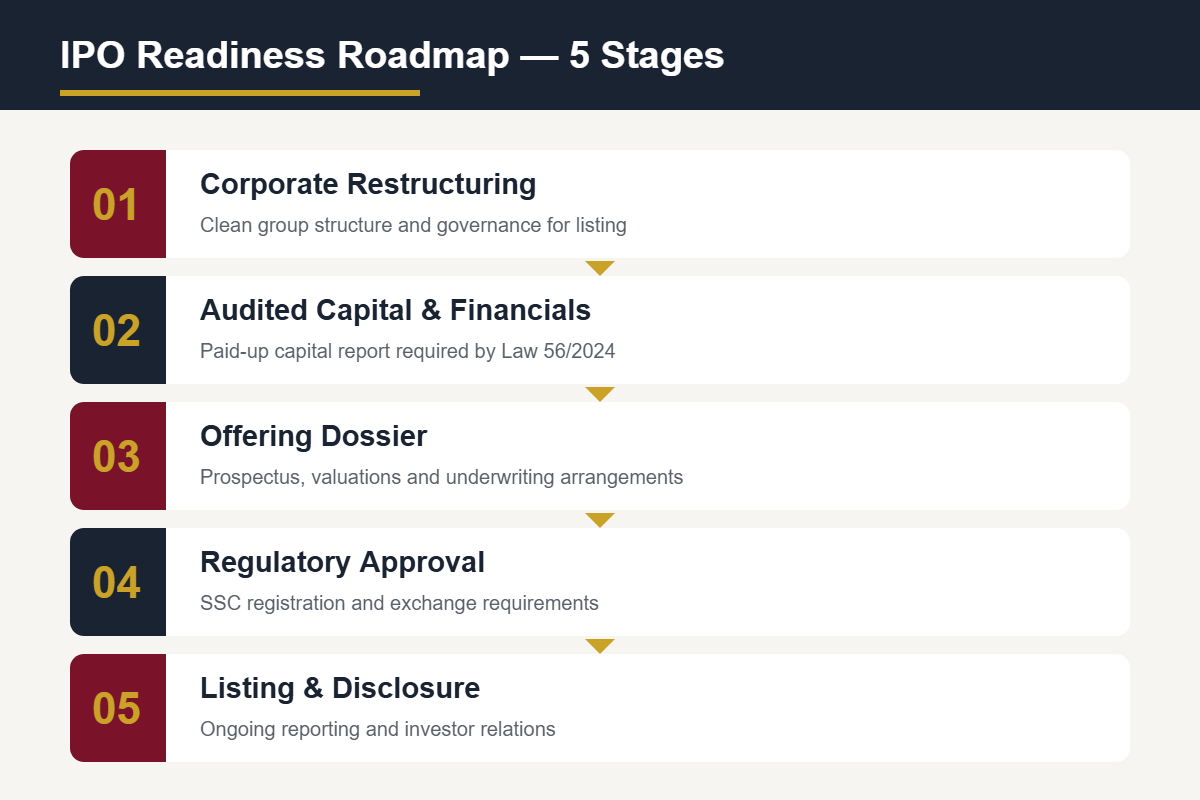
- Pre-IPO legal due diligence: comprehensive review, clean-up, and sanitization of all legal, financial, labor, contract, and asset records
- Corporate restructuring: rearranging the parent-subsidiary model, resolving cross-ownership issues, and building governance regulations up to public company standards
- Drafting the Prospectus: coordinating with auditors and securities companies for a transparent, honest and attractive document
- Legal representation: submitting the IPO application dossier and clarifying legal issues with the SSC and Stock Exchanges until shares are officially listed
“A successful IPO transaction is not determined on the day the gong is struck on the trading floor, but by the disciplined preparation, financial transparency, and strictness of the legal corridor during the 2–3 years prior.”
International Capital Markets
As Vietnamese businesses increasingly access international capital markets, the Vietnamese legal aspects of overseas listings, cross-border offerings and dual-track structures have become significantly more sophisticated. IVLF advises issuers, founders, shareholders, investment banks and international counsel on the Vietnamese law dimension of these transactions, working alongside underwriters and depositary banks to ensure the Vietnamese-law analysis is fully integrated into the wider deal structure and timetable.
Overseas bond, share and instrument issuances
- Offshore issuances of bonds, convertible bonds and other debt instruments by Vietnamese issuers and their offshore holding vehicles.
- Offshore share issuances and private placements to international investors, including pre-IPO and growth-equity rounds.
- Structuring of other financial instruments used in cross-border capital raising, including warrants, hybrid securities and structured notes.
- Foreign exchange, capital account and outbound remittance analysis for proceeds and repatriation flows.
International IPOs, dual listings and overseas admissions
- Vietnamese-law advice on international IPOs and admissions to overseas exchanges, run alongside international listing counsel.
- Dual-listing and dual-track structures, including parallel domestic and offshore offerings.
- Pre-listing corporate reorganisations, offshore holding company structuring and foreign ownership analysis under Vietnamese law.
Depositary receipt programmes (DR / ADR)
- United States – sponsored and unsponsored American Depositary Receipt (ADR) programmes, including NYSE and Nasdaq admissions.
- Hong Kong – depositary receipt and dual-listing structures in connection with the Hong Kong Stock Exchange (HKEX).
- Dubai – depositary receipt and listing structures in connection with Nasdaq Dubai and the DIFC.
- Other jurisdictions – advice on depositary receipt and offshore listing structures in additional markets as client mandates require.
Scope of our involvement
- Pre-listing restructurings and offshore holding structures
- Vietnam legal due diligence for underwriters, depositary banks and investors
- Foreign ownership analysis and outbound investment approvals
- Foreign exchange and regulatory approvals
- Vietnamese-law legal opinions for offering documents
- Post-listing compliance and ongoing disclosure support
As cross-border listings continue to evolve, clients increasingly require advisers who understand both international market practice and Vietnam’s legal and regulatory framework. Our role is to bridge those two perspectives and support efficient execution across multiple jurisdictions.
Legal compliance and financial transparency
The capital market operates on trust. Any concealment of information or legal loophole can cause a fundraising deal to collapse, even leading to criminal risks. A critical stage when appraising an IPO or bond dossier is reviewing compliance with tax obligations and asset legality – cross-checking finalization minutes and confirmations of no outstanding tax debts from local tax authorities. One unresolved social insurance debt, pending labor dispute, or advertising violation can cause the SSC to suspend the offering dossier immediately.
The IVLF legal team establishes a strict cross-check process, identifying potential issues early and proposing solutions before the dossier is submitted to authorities.
Process and why Joint Stock Companies choose IVLF
Pre-Feasibility Assessment
Sign an NDA and conduct a quick assessment of legal status and capital structure.
Strategic Planning
Select the appropriate fundraising instrument and establish a detailed implementation roadmap.
Legal Due Diligence
Comprehensive review, risk warning report, and cleaning up of company records.
Licensing & Post-Transaction
Submit dossiers, provide clarifications to authorities, and support periodic reporting obligations.
- Profound understanding of Securities and Enterprise Law, and of the SSC’s appraisal process
- Commercial-sense mindset that structures transactions to meet legal requirements while optimizing owners’ commercial interests
- Strong network with securities companies, international auditing firms (Big4), and depository banks
Capital markets guides from our team
- IPO in Vietnam: process, conditions and timeline
- Corporate bond issuance: private vs public routes
- Private placement of shares: rules and lock-ups
- Listing conditions: HOSE, HNX and UPCoM compared
- Depository receipts for international capital
- Offshore listing: US, Hong Kong or Singapore
- US listing paths: IPO, SPAC and ADR
- Capital markets consulting: the 4 issuer mandates
- International financial centre in Vietnam: 7 facts
Explore the complete Vietnam International Financial Centre resource hub
Capital markets regulatory updates (2025–2026)
- Law No. 56/2024/QH15 amending the Securities Law (effective 1 January 2025): IPO dossiers must now include an independently audited report on paid-up charter capital; sponsor and disclosure obligations are tightened
- Foreign investors are automatically classified as professional securities investors, removing the PSI verification step and easing participation in private placements
- Private corporate bonds: from 1 January 2026, individual professional investors may only trade privately placed bonds that carry a credit rating and are secured by collateral or a bank payment guarantee
- Decree No. 245/2025/ND-CP updates offering, listing and public-company procedures under the amended law
Frequently asked questions
How long does a business need to prepare for a successful IPO?
Typically 1 to 3 years – the period needed to transition governance, restructure finances, achieve continuous profitable operations, and perfect audited financial statements.
If the company has a large bank loan, can it still issue bonds?
Yes, provided it meets the financial safety ratios and offering conditions prescribed by law, and the dossier is transparent about the purpose of capital use and current leverage.
What is the biggest risk when issuing shares to PE/VC funds?
Losing control due to strict clauses in the Shareholders’ Agreement – veto rights, anti-dilution clauses, and tag-along rights. IVLF helps negotiate balanced terms.
How long does an IPO take in Vietnam?
Typically 12–24 months from restructuring to listing, depending on corporate cleanliness and audited track record.
Do private bonds need a credit rating?
From 1 January 2026, privately placed bonds sold to individual professional investors must carry a credit rating and be secured by collateral or a bank guarantee.
Related Practice Areas

Describe your matter and receive a preliminary legal assessment and fee estimate within 24 hours.
EXPLORE MORE