
Updated 30 July 2026
From 1 July 2026, Vietnam merger control thresholds rose by approximately 100% under Resolution 66.18/2026/NQ-CP. The Vietnam-market turnover or purchase-value test moved from VND 3,000 billion to VND 6,000 billion. A substantial band of mid-market transactions therefore falls outside the filing regime, and two to three months come out of the deal timetable.
If you assessed a live transaction against the old Vietnam merger control thresholds, reassess it. The change took effect without a transition period.
This note covers:
- The new Vietnam merger control thresholds, test by test
- How the group-level calculation works — and where foreign acquirers get it wrong
- Review timing, gun jumping and the recalibrated penalty regime
- What to change in your transaction documents
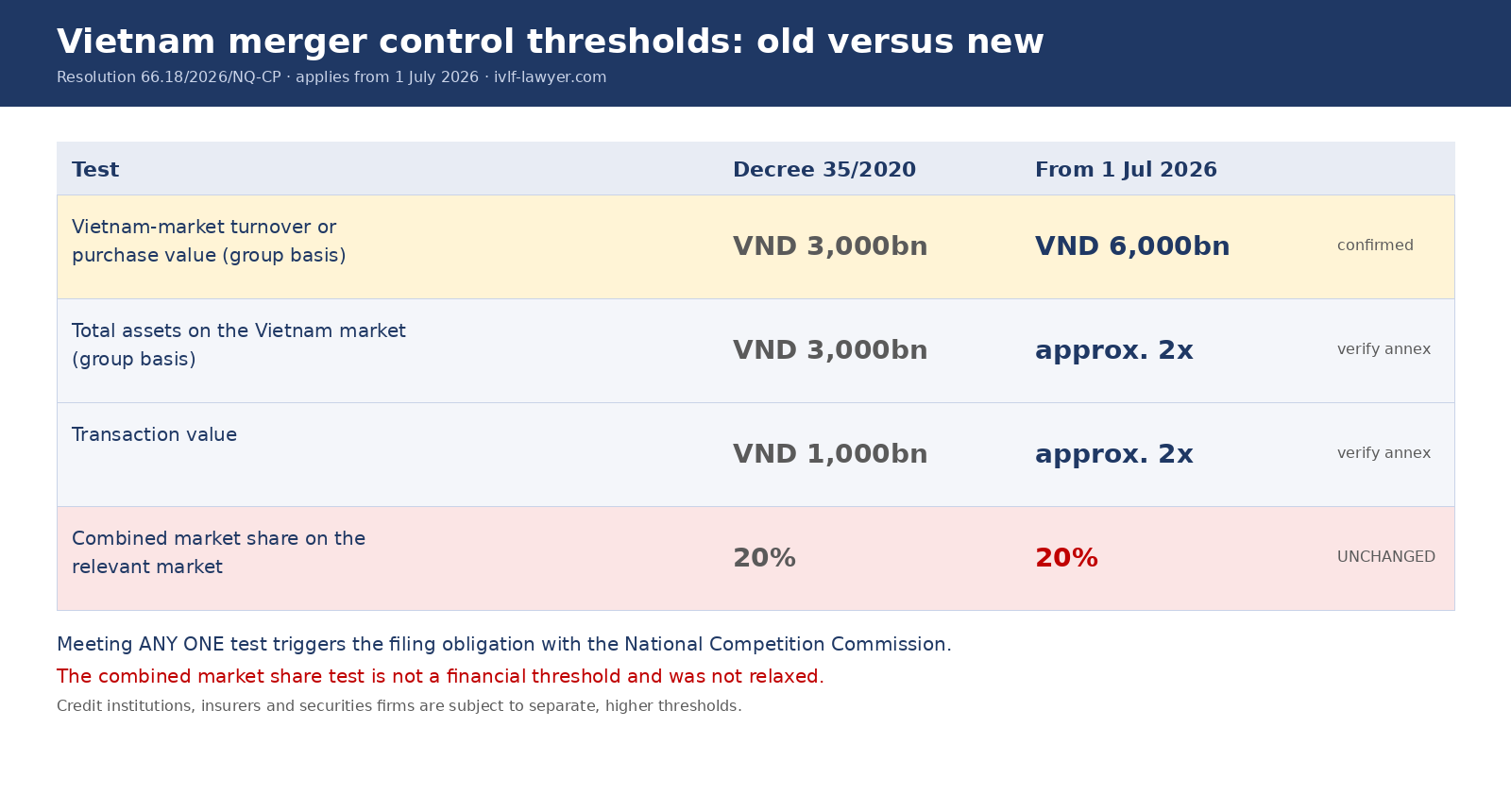
The new Vietnam merger control thresholds
Resolution 66.18/2026/NQ-CP of 18 May 2026 sits within a broader administrative simplification package. In competition law it does two things: it raises the quantitative Vietnam merger control thresholds, and it shifts the regulator’s posture from pre-clearance screening toward post-completion supervision.
| Test | Decree 35/2020 | From 1 July 2026 |
|---|---|---|
| Vietnam-market turnover or purchase value of an enterprise or affiliated group, in the preceding financial year | VND 3,000 billion | VND 6,000 billion |
| Total assets on the Vietnam market of an enterprise or affiliated group | VND 3,000 billion | Raised by approximately 100% |
| Transaction value of the economic concentration | VND 1,000 billion | Raised by approximately 100% |
| Combined market share on the relevant market | 20% | Not a financial test — unchanged and still assessed separately |
A word on how confident you should be in each figure. The VND 6,000 billion turnover test is confirmed. For the asset and transaction-value tests, the Resolution states the direction of travel — approximately double — and the precise figures should be read off the Resolution’s annex before you conclude on a specific deal. We check the instrument itself rather than relying on summary briefings, and you should too.
Any one test triggers the obligation
The architecture of Decree 35/2020/NĐ-CP is unchanged. Parties to an economic concentration must notify the National Competition Commission if they meet any one of the Vietnam merger control thresholds. They are alternatives, not cumulative conditions. This is the single most common misreading when a client self-assesses.
Three of the four tests are purely arithmetic. The fourth — combined market share — requires defining the relevant product and geographic market, which is an analytical exercise rather than a calculation.
Credit institutions, insurers and securities companies are subject to separate, higher Vietnam merger control thresholds. If your target sits in one of those three sectors, do not apply the general figures.
The group-level calculation, and where foreign acquirers get it wrong
Vietnam merger control thresholds are measured at the level of the affiliated group, not the individual entity signing the transfer. In practice this is where assessments fail.
Three recurring errors:
- Counting only the target. If the acquirer belongs to a group with substantial Vietnamese turnover, the Vietnam merger control thresholds can be met even where the target is very small. Target size is not determinative.
- Omitting offshore affiliates that sell into Vietnam. What matters is turnover on the Vietnam market, not where the entity is incorporated. A Singapore or Korean affiliate with Vietnamese revenue counts.
- Using the wrong financial year or unaudited figures. The test looks to the financial year immediately preceding the year of implementation.
Practical recommendation: build a group-level Vietnam revenue and asset schedule at term sheet stage, signed off by finance. The cost is trivial against the consequence of getting the Vietnam merger control thresholds analysis wrong.
The market share test was not relaxed
The increase in Vietnam merger control thresholds does not touch the 20% combined market share test. Two mid-sized businesses in the same narrow market can still be notifiable despite falling well below every financial test.
This is why “the thresholds doubled” is not the same as “we are exempt”. In concentrated sectors, relevant market analysis remains mandatory, and it is the part of the assessment that cannot be delegated to a spreadsheet.
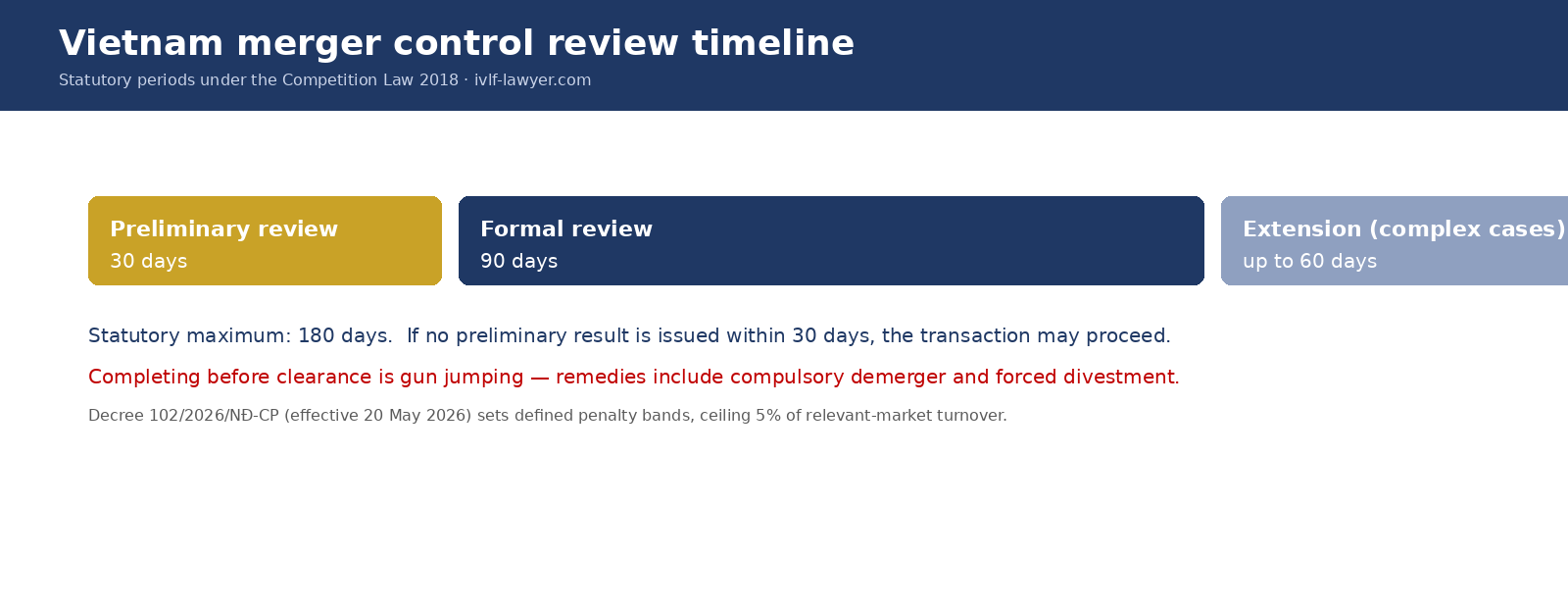
Review timing and what it does to your timetable
Where a filing is required, the statutory clock runs as follows:
- Preliminary review: 30 days from receipt of a complete and valid file. If the Commission issues no preliminary result within that period, the transaction may proceed.
- Formal review: 90 days from the preliminary notification, extendable by up to 60 days for complex matters.
- Statutory maximum: 180 days.
Resolution 66.18/2026/NQ-CP also simplifies the mechanics: filings may be made in person, by post, or online through the National Public Service Portal, using a streamlined form, with a standardised completeness check.
Where the new Vietnam merger control thresholds take your deal out of the regime entirely, the saving is two to three months. Reflect that in the long-stop date rather than carrying forward the old assumption.
What a Vietnamese merger filing actually contains
Counsel arriving from other jurisdictions often assume a Vietnamese filing resembles a short-form notification. It does not. Expect to assemble corporate documents for every notifying party and its affiliated group, audited financial statements for the preceding financial year, the transaction documents or a detailed summary, and a substantive report on the relevant market and the parties’ positions within it.
The relevant market report is the part that determines timing. A thin market definition invites questions, and questions restart the completeness clock rather than the review clock. Where the parties overlap, commission economic input early rather than treating it as a contingency.
Documents originating outside Vietnam require notarisation, consular legalisation and certified Vietnamese translation. For a group with several offshore entities this is routinely a three to four week workstream on its own, and it runs in parallel with, not after, the substantive analysis.
How Vietnam merger control compares regionally
Two structural features distinguish the Vietnamese regime from what many inbound acquirers are used to.
It is mandatory and suspensory. Unlike Singapore’s voluntary notification model, where parties self-assess and file only if they judge it prudent, meeting a Vietnamese threshold creates a legal obligation to notify and to wait. There is no equivalent of a considered decision not to file.
The financial tests do most of the work. In several regional regimes the substantive competitive assessment governs whether a filing is worthwhile. Under Vietnam merger control, the arithmetic tests capture transactions with no plausible competitive effect — which is precisely the problem the 2026 increase addresses. Intra-group reorganisations and minority growth investments were routinely caught.
The practical implication for a regional acquirer running a multi-jurisdictional filing analysis: do not assume that a deal falling outside Singapore or Malaysian notification will fall outside Vietnam merger control. The tests are not comparable, and the Vietnamese group-level turnover test is broader than most.
Gun jumping and the recalibrated penalty regime
Decree 102/2026/NĐ-CP, effective 20 May 2026, amends Decree 75/2019/NĐ-CP. It replaces the turnover-percentage calculation with defined penalty bands while retaining the ceiling of 5% of turnover on the relevant market.
In quantitative terms this is not necessarily an increase — the old percentage mechanism could produce very large numbers for high-turnover groups. The substantive change is a clearer, more administrable framework suited to post-completion enforcement.
The remedies matter more than the fine. Where a prohibited economic concentration has been implemented, the authority may compel demerger or division of the merged entity, compel divestment of some or all of the acquired capital or assets, and subject the post-merger business to State control over its pricing and other transaction terms.
That is a materially different risk profile from a monetary penalty you can provision for. It is the possibility of an integrated business being unwound.
Post-completion supervision creates an unwritten obligation
The relaxation of Vietnam merger control thresholds is paired with a move to post-completion supervision. This creates a practical obligation the text does not spell out as a discrete provision: parties should retain their competitive assessment materials to support a later review.
Minimum file to keep: the four-test calculation with source data; the relevant market and combined share analysis; and the conclusion on notifiability, with the name of whoever signed it off. Retain for at least five years.
Three worked scenarios
Scenario 1 — a fund acquires 30% of a manufacturer. Target turnover VND 1,200 billion, transaction value VND 400 billion, no affiliate of the fund operating in Vietnam. Under the old regime the transaction-value test needed careful checking; under the new Vietnam merger control thresholds the deal sits below every financial test. What remains is the combined market share analysis.
Scenario 2 — a foreign group acquires a small company. Target turnover VND 200 billion, but the acquirer’s affiliates generate VND 8,000 billion in Vietnam. The Vietnam merger control thresholds are still exceeded, because the test is applied at group level. This is the scenario foreign buyers most often misjudge.
Scenario 3 — intra-group reorganisation. A merger of two subsidiaries under common control. This is the category that benefits most clearly from the new levels: such transactions rarely alter competitive structure, yet frequently tripped the old asset test.
The Resolution is a temporary measure
This point is missing from most coverage. Resolution 66.18/2026/NQ-CP applies for a defined period pending formal amendment of Decree 35/2020/NĐ-CP. Sources indicate an end date of 28 February 2027.
The practical consequence for long-dated transactions: if you assess against the current Vietnam merger control thresholds but complete after the Resolution lapses and before an amending decree is issued, the obligation must be reassessed. For deals expected to complete from Q1 2027, include a contractual undertaking to re-test notifiability under the law in force at completion.
What to change in your transaction documents
- Conditions precedent. If the deal is no longer notifiable, remove the clearance condition rather than retaining it for comfort — retaining it creates a completion blocker you have no need of.
- Long-stop date. Shorten by two to three months.
- Seller warranties. Add a warranty as to the accuracy of the turnover and asset figures used to test the Vietnam merger control thresholds, with a corresponding indemnity.
- Interim covenants. Keep the consent list narrow. Gun jumping exposure is unchanged, and an overbroad list can be characterised as premature exercise of control.
How the three Vietnamese clearances interact is set out in our guide to M&A in Vietnam. Scope and fee basis for merger control work are on our corporate restructuring and M&A services page.
What to do next
- Re-run all four tests on every live transaction, using preceding-financial-year figures on a Vietnam-wide group basis.
- Do not stop at the financial tests. Assess combined market share — that test was not relaxed.
- Verify the asset and transaction-value figures against the Resolution annex before concluding.
- Prepare and retain the assessment file even where the conclusion is that no filing is required.
- For completions from 2027, add a re-test undertaking to the agreement.
Frequently asked questions on Vietnam merger control
What are the Vietnam merger control thresholds in 2026?
From 1 July 2026 the Vietnam-market turnover or purchase-value test is VND 6,000 billion, up from VND 3,000 billion, under Resolution 66.18/2026/NQ-CP. The asset and transaction-value tests were also raised by approximately 100%. The 20% combined market share test is not financial and was not changed.
Do all four tests have to be met?
No. Meeting any single test triggers the obligation to notify the National Competition Commission.
Whose turnover counts?
That of the affiliated group on the Vietnam market, not merely the entity party to the transaction. Offshore affiliates with Vietnamese revenue are included.
What happens if we complete before clearance?
That is gun jumping. Beyond a fine capped at 5% of relevant-market turnover, the authority may order demerger of the combined entity or divestment of the acquired capital or assets.
Are the new levels permanent?
No. Resolution 66.18/2026/NQ-CP applies for a defined period pending amendment of Decree 35/2020/NĐ-CP. Transactions completing from 2027 should be re-tested under the law then in force.
Sources
- Resolution 66.18/2026/NQ-CP — Government legal database
- Notification thresholds under Decree 35/2020/NĐ-CP — National Competition Commission
- Article 13, Decree 35/2020/NĐ-CP — full text
About the author
M&A Advisory Team — IVLF Advisors
IVLF Advisors’ specialists advise on mergers and acquisitions, competition filings and foreign investment in Vietnam, acting for strategic acquirers, private equity sponsors and Vietnamese corporates.
Need a notifiability assessment for a specific transaction?
Arrange a call about Vietnam merger control
This article is general information current as at 30 July 2026 and does not constitute advice on any specific matter. The law referred to is subject to change. Please take professional advice before acting.
This article is provided for general information only and does not constitute legal advice for any specific case. Regulations may change – please consult a qualified professional before acting. Should further analysis be required, please contact one of our lawyers below.