An IPO in Vietnam is a six-stage journey, and companies that map it before starting close it one to two years faster than those who improvise. This guide walks through the conditions, the process and the realistic timeline for an IPO in Vietnam under the current Securities Law framework, based on transactions our capital markets team has advised.
Who qualifies for an IPO in Vietnam
The core conditions come from the Securities Law 2019, as amended by Law 56/2024, and Decree 155/2020: charter capital of at least VND 30 billion, profitable operation in the two years before the offering with no accumulated losses, a feasible plan for using the proceeds approved by shareholders, and at least 15% of voting shares sold to a minimum of one hundred non-major shareholders. Founders and major shareholders must commit to holding at least 20% of charter capital for one year after the IPO in Vietnam completes.
The six stages of an IPO in Vietnam
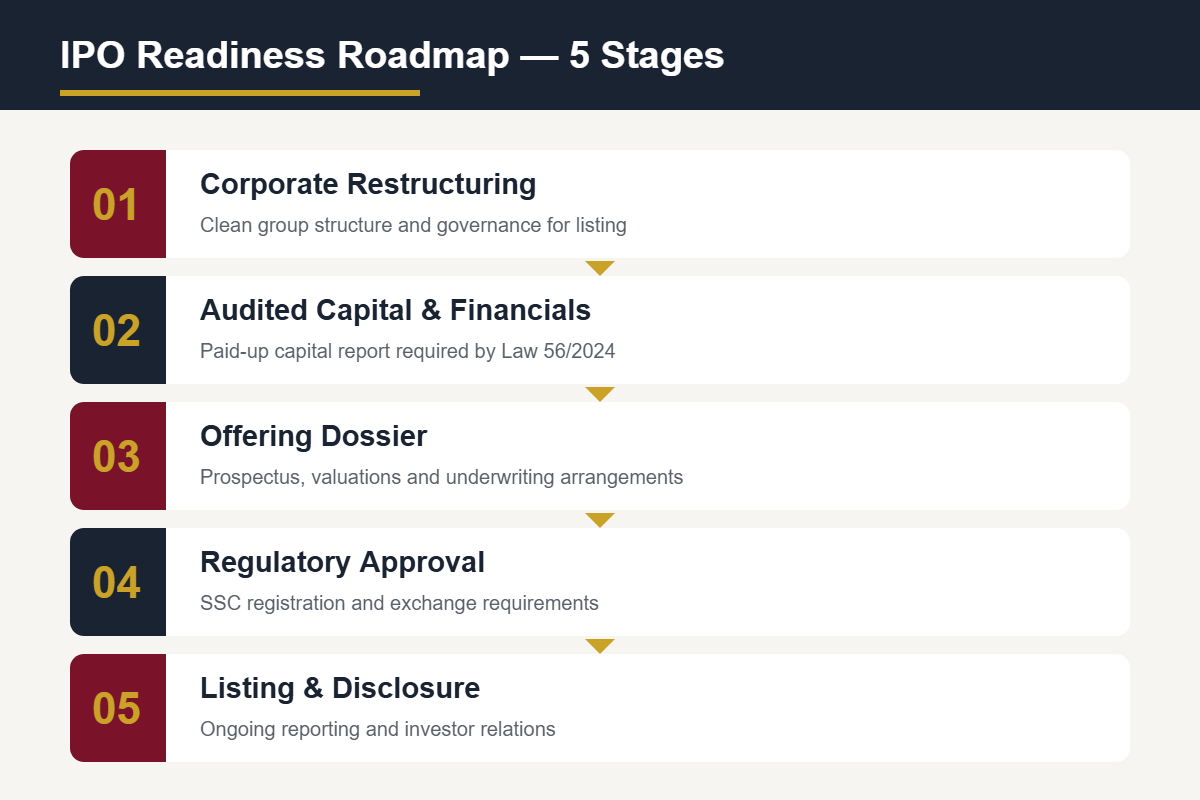
1. Corporate restructuring and clean-up
Convert to a joint stock company if needed, resolve related-party loans, settle disputes and align the charter with listed-company governance. Skeletons found here cost months later; this is where most of the value of early preparation sits.
2. Audited financials and intermediaries
Two years of audited statements by an approved audit firm, plus appointment of the securities company that will underwrite and advise the offering.
3. Offering dossier and prospectus
The registration statement and prospectus for the IPO in Vietnam go to the State Securities Commission, which reviews within 30 days of a complete file – in practice, expect question rounds that extend this.
4. SSC approval and announcement
Once approved, the offering must be announced and completed within 90 days, extendable to a maximum of 30 additional days.
5. Distribution and escrow
Proceeds sit in a blocked escrow account until the offering is confirmed complete and results are reported to the SSC.
6. Listing or UPCoM registration
Shares must be registered for trading; issuers meeting exchange thresholds proceed to HOSE or HNX under the listing conditions, while others start on UPCoM.
Timeline and cost expectations
A well-prepared IPO in Vietnam runs 12 to 18 months from decision to trading; complex restructurings add six months or more. Budget for audit, underwriting, legal and listing fees – and for management time, which is the cost most boards underestimate.
What good preparation looks like in practice
Issuers who complete an IPO in Vietnam on schedule share three habits. They appoint counsel and auditors before restructuring, so every clean-up step is done once and documented for the dossier. They run the prospectus as a project with owners and deadlines rather than a drafting exercise, because the SSC reads consistency across sections and inconsistencies trigger question rounds. And they prepare investor materials in parallel with the legal file, so the offering window opens the moment approval lands rather than months after.
The pattern repeats in reverse for delayed offerings: a skeleton found late, an audit qualification discovered in year two, a use-of-proceeds plan shareholders never properly approved. Every month saved in an IPO in Vietnam is bought during preparation, not during review.
One more practical note: the offering is not the finish line. Listed-company obligations – periodic disclosure, related-party approvals, insider lists – begin immediately, and exchanges sanction early stumbles visibly. Building the compliance function during the IPO in Vietnam process, rather than after trading starts, is the cheapest insurance an issuer can buy.
Choosing advisers for an IPO in Vietnam
The underwriting securities company drives the market side; legal counsel owns the dossier, the restructuring and the prospectus liability; the auditor controls the timetable more than anyone admits. Interview all three against one question: how many offerings of your size have they closed in the last three years, and what went wrong in each. An IPO in Vietnam is a coordination exercise, and advisers who have not worked together add silent weeks to every round of comments. Fix the working rhythm – weekly all-adviser calls, one shared issues list, a single version of the truth for numbers – in the engagement letters, before the first drafting session.
IPO in Vietnam: frequently asked questions
Can foreign investors buy in the offering?
Yes, within the foreign ownership limit applicable to the issuer’s sectors. Issuers near their cap should model demand carefully – our analysis of the GSM offshore structure shows what happens when the FOL binds.
Is an offshore listing an alternative?
For some issuers, yes – via structures such as depository receipts or offshore holding companies, each with its own approval path.
Where should preparation start?
With a readiness assessment against the conditions above. Our capital markets advisory team runs this as a fixed-fee diagnostic; official regulations are published by the Ministry of Finance.
This article is provided for general information only and does not constitute legal advice for any specific case. Regulations may change – please consult a qualified professional before acting. Should further analysis be required, please contact one of our lawyers below.