Beyond minimum charter capital, entity type, business lines and licensing conditions, the assets used to fund a company’s capital also draw close attention – and in-kind contributions, such as contributing a high-value vehicle to a company, have become a popular topic. Using a case study of a founding shareholder contributing a luxury SUV to a golf business company, here is how in-kind capital contribution Vietnam rules actually work in practice.
Step 1: The Underlying Project Must Already Be Licensed
Before any capital contribution question arises, the golf course investment project itself must hold an Investment Policy Approval or an Investment Registration Certificate (the specific requirement depends on whether the investor is domestic or foreign, and other project-specific factors), and must satisfy the golf course investment and business conditions set out in Decree 52/2020/NĐ-CP on the investment and business of golf courses.
Step 2: The 90-Day Rule for In-Kind Capital Contribution Vietnam Deadlines
Once the company is licensed, founding shareholders or members are required to contribute their committed capital in full within 90 days from the date the Enterprise Registration Certificate is issued.
Step 3: Valuing and Transferring an In-Kind Asset
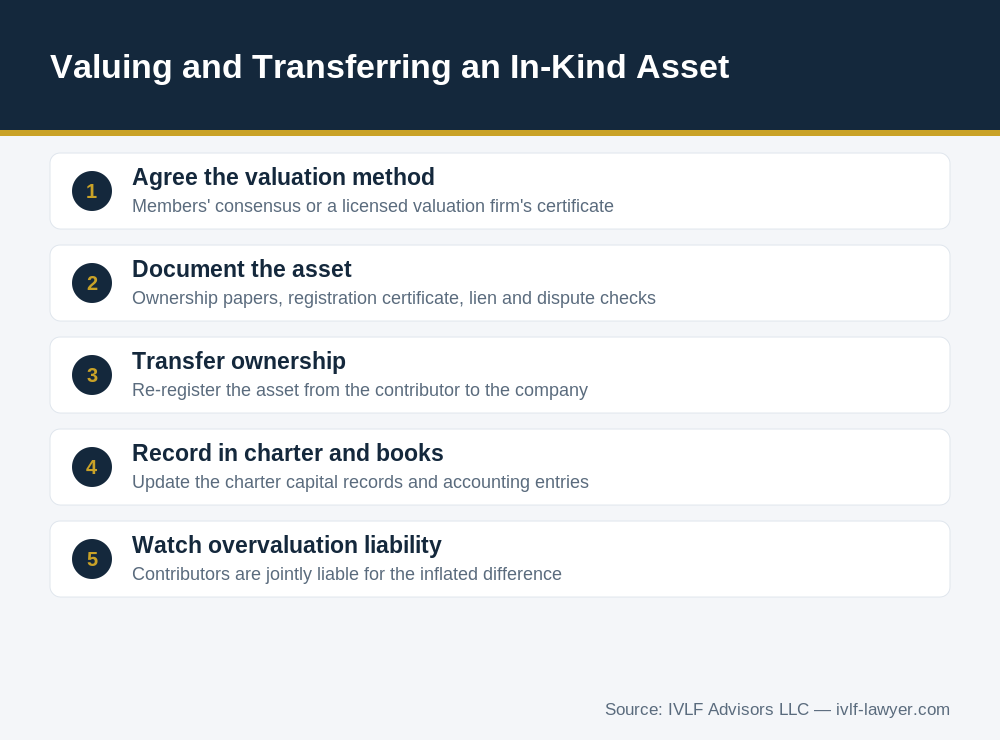
If a shareholder chooses to contribute capital in kind – a vehicle, for example – rather than in cash, that asset must first be professionally valued, and legal ownership must then be formally transferred from the individual to the company. For a vehicle, this transfer is registered with the competent vehicle registration authority in the locality where the company is headquartered, and only once this transfer is completed does the asset legally belong to the company as part of its charter capital.
Step 4: Ongoing Compliance After an In-Kind Capital Contribution Vietnam Transaction
Beyond the capital contribution itself, the investor must also comply with golf course business conditions and obtain all licenses, approvals and other requirements needed to carry out the project on the schedule set out in its Investment Approval. Failing to keep pace with that schedule risks having the project revoked for non-compliance with the Investment Approval or related regulations.
Which Assets Qualify for In-Kind Capital Contribution Vietnam Rules Allow
Under Article 34 of the Law on Enterprises 2020, contributed assets may be Vietnamese dong, freely convertible foreign currency, gold, land use rights, intellectual property rights, technology, technical know-how, or other assets valuable in dong. Vehicles, machinery, and equipment fall comfortably within this last category.
The unifying requirement across every in-kind capital contribution Vietnam case is lawful ownership: only the person or organisation holding legal title to the asset may contribute it. An asset under lease, lien, or dispute cannot be cleanly contributed until that status is resolved.
Valuation and the Overvaluation Trap
Valuation is where in-kind capital contribution Vietnam practice most often goes wrong. The law allows two routes: valuation by consensus among founding members, or by a licensed valuation organisation. Either way, the declared value becomes part of charter capital – and the law attaches real liability to inflation.
If an asset is valued higher than its actual worth at contribution, the contributors must jointly make up the difference, and they are jointly and severally liable for damage caused by the intentional overvaluation. In our golf business case study, the SUV’s valuation certificate from an independent firm was the single most important protective document for the founding shareholder.
Tax and Fee Treatment
An in-kind capital contribution Vietnam transaction enjoys notable tax treatment: contributing an asset as capital is not a sale, so it does not trigger VAT, and no invoice is required – a capital contribution record with valuation minutes replaces it. Vehicle re-registration does involve a registration fee procedure, and the receiving company records the asset at its contributed value for depreciation purposes.
For foreign contributors, one caution applies: where the contributor is a foreign investor, the asset’s import history matters. Equipment imported duty-free under an incentive regime cannot simply be redeployed as contributed capital to a different project without revisiting the duty exemption.
Common Mistakes to Avoid
Most disputes we see in in-kind capital contribution Vietnam matters trace back to five avoidable errors:
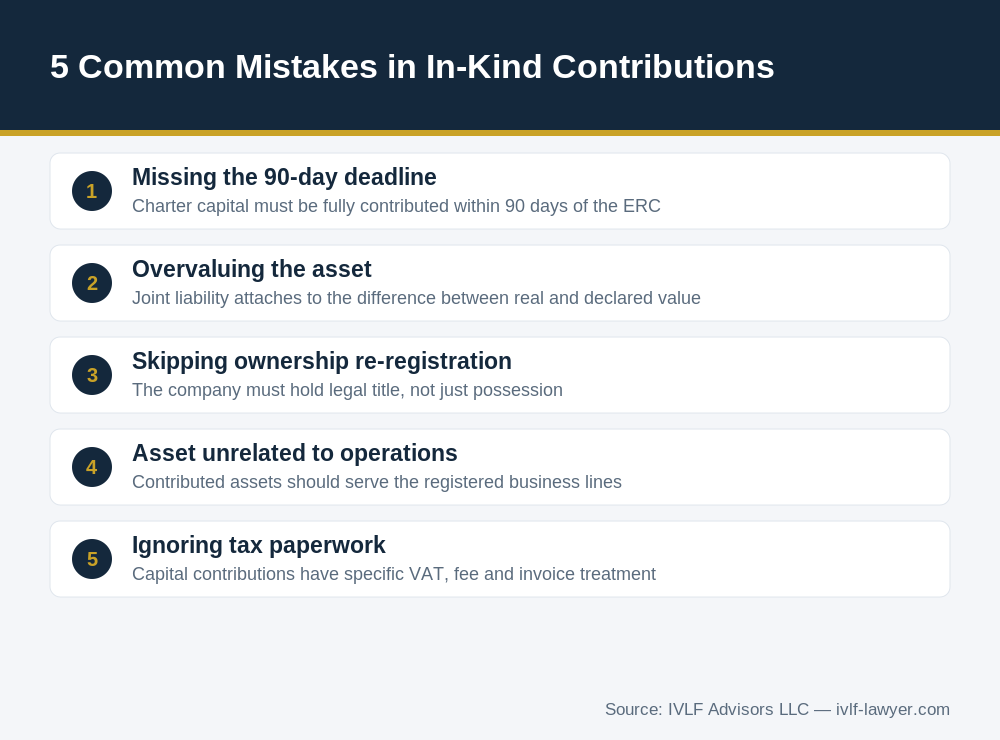
Each is inexpensive to prevent at contribution time and expensive to repair later – particularly missed ownership re-registration, which can leave the company depreciating an asset it does not legally own.
The Complete Document Pack
A clean in-kind capital contribution Vietnam file is built from six documents, assembled in this order:
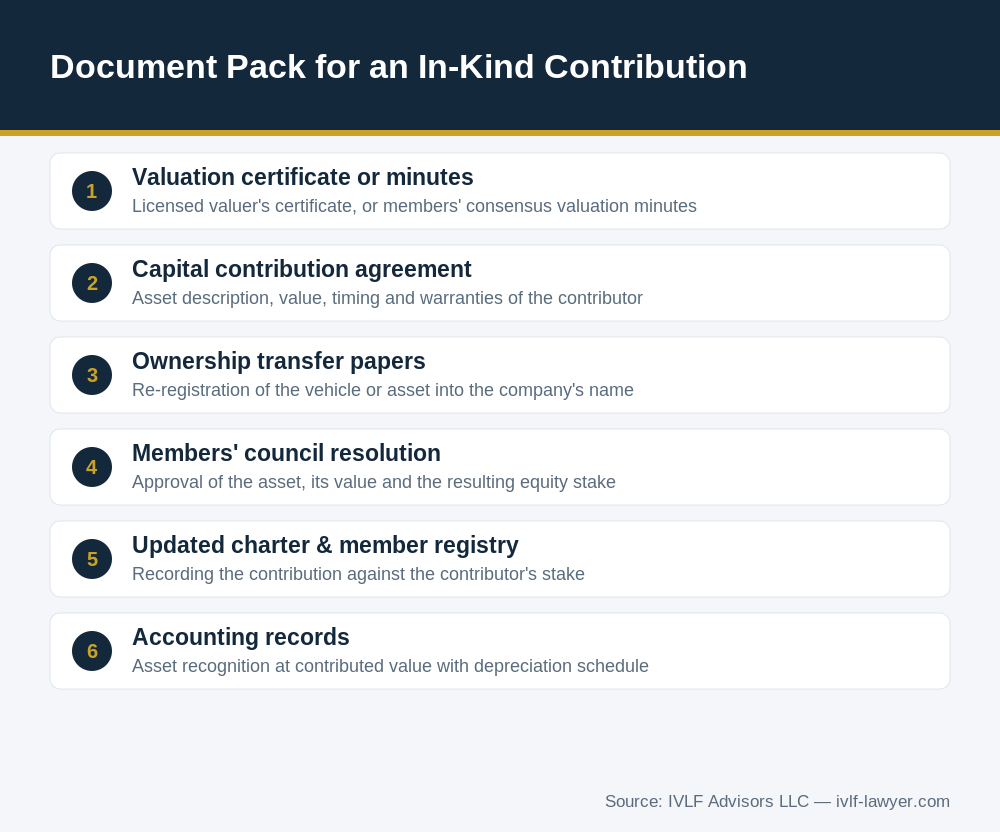
In the vehicle case study, the entire pack was completed within three weeks – the valuation certificate and the vehicle re-registration being the two steps with external dependencies. Companies that prepare the resolution and agreement templates in advance routinely halve that timeline.
Key Legal Instruments
Three instruments govern most questions in this area:
- Law on Enterprises 2020 (Articles 34–36) – contributed asset types, valuation methods, and overvaluation liability. The consolidated text is published on the Government’s legal documents portal.
- Law on Investment 2020 – licensing conditions for the underlying project receiving the capital.
- Circular 45/2013/TT-BTC (as amended) – fixed-asset recognition and depreciation of contributed assets, guidance available via the Ministry of Finance.
Reading them together answers the three questions every in-kind capital contribution Vietnam matter turns on: can this asset be contributed, at what value, and with what ongoing obligations?
Case Study Walkthrough: The SUV Contribution, Step by Step
To make the in-kind capital contribution Vietnam process concrete, here is how the golf business case unfolded in practice.
The founding shareholder held a luxury SUV worth approximately VND 8 billion and wanted it to form part of his equity in a newly licensed golf services company. The members’ council first confirmed the asset served the registered business lines – client transport and course operations – then commissioned an independent valuation firm rather than relying on internal consensus, precisely to neutralise any future overvaluation argument.
With the certificate issued, the parties signed a contribution agreement, passed the members’ resolution, and re-registered the vehicle in the company’s name at the provincial registration office. The accounting team recognised the SUV as a fixed asset at the certified value and began depreciation. Total elapsed time: 21 days, comfortably within the 90-day in-kind capital contribution Vietnam deadline.
Two details made this in-kind capital contribution Vietnam example clean: the vehicle was unencumbered, and the valuation was external. Files missing either feature are the ones that resurface in shareholder disputes years later.
Practical Tips for Foreign Investors
Foreign investors handling an in-kind capital contribution Vietnam matter face two extra layers. First, if the asset sits abroad, importing it as contributed capital involves customs procedures, and eligibility for import-duty exemption depends on the project’s incentive status – this should be confirmed in writing before shipment. Second, the value of in-kind assets counts toward the investment capital registered on the IRC, so the valuation certificate should be consistent with the figures reported to the investment registration authority. Inconsistencies between the corporate file and the investment file are a common trigger for questions during later FDI supervision reviews.
Where the contributor is a foreign company rather than an individual, board approvals under the home jurisdiction’s rules should also be papered – Vietnamese counterparties and banks increasingly ask for them.
When Cash Is the Better Route
In-kind contributions suit assets the company genuinely needs. But where the asset is illiquid, hard to value, or personal in character, contributing cash and having the company purchase the asset separately is often cleaner – it creates a market-tested price and avoids valuation liability entirely. Comparing the cash route against the in-kind capital contribution Vietnam route should be a standard step in every formation plan – and the in-kind capital contribution Vietnam option should win only when the company truly needs the asset.
Frequently Asked Questions
Can capital be contributed in-kind after the 90-day deadline? No. After 90 days from the ERC, unpaid charter capital must be reduced accordingly; late contribution requires a capital increase procedure instead.
Does the company or the contributor pay for valuation? The parties may agree either way, but in practice the company usually bears the valuation firm’s fee as a formation cost.
Is director approval enough for in-kind contributions? No – acceptance of in-kind assets and their valuation belongs to the members’ council or shareholders under the charter, and the decision should be minuted.
Can land use rights be contributed the same way? Yes, but the in-kind capital contribution Vietnam procedure for land use rights runs through the land registry, requires notarisation, and takes materially longer than movable assets.
Does the 90-day rule apply to capital increases too? The 90-day rule applies at incorporation. For later increases, the contribution deadline follows the resolution approving the increase and the amended charter.
What happens if the asset loses value after contribution? Nothing retroactively – under in-kind capital contribution Vietnam rules, the risk passes to the company at contribution. Liability only arises where the declared value exceeded the asset’s true worth at the time of contribution, not where market value later declines through ordinary use or market movement.
Conclusion
This case study illustrates a broader principle: in-kind capital contributions in Vietnam are fully lawful, but they require proper valuation and a formal ownership transfer to the company – not just a symbolic gesture – and they sit on top of, rather than replace, the underlying project’s own licensing obligations.
Structuring a capital contribution or golf/leisure project in Vietnam?
IVLF Advisors LLC advises investors on capital contribution structuring, in-kind asset transfers, and licensing for golf course and leisure investment projects in Vietnam. Explore our practice areas or contact us to discuss your project.
This article is provided for general information only and does not constitute legal advice for any specific case. Regulations may change – please consult a qualified professional before acting. Should further analysis be required, please contact one of our lawyers below.