
Practice Area
In-Depth Tax Advisory Services
In the modern business environment, tax is not only a financial obligation but also a factor that shapes a business’s operational efficiency. For complex transactions such as M&A (Mergers and Acquisitions) or corporate restructuring, a flawed tax strategy can cause the entire deal to lose its expected value. Understanding this pressure, IVLF Advisors provides a specialized ecosystem of tax advisory services — helping clients strictly comply with Vietnamese tax law while optimizing their financial obligations legally. Our tax advisory practice combines legal and accounting insight in one team.
Tax in commercial transactions and M&A: a “double-edged sword”
In major financial transactions, tax is often considered the most unpredictable variable. A perfect M&A plan from a business perspective that is not designed with an optimal tax roadmap can lead to unexpected tax obligations when handing over assets, transferring shares, or executing merger agreements.
In Vietnam, the constant changes in decrees and circulars regarding Corporate Income Tax (CIT), Value Added Tax (VAT), and Foreign Contractor Tax (FCT) require leaders to have strategic vision. Errors in determining non-deductible expenses, incorrect tax incentive declarations, or mismanagement of Transfer Pricing can lead to heavy administrative penalties, or even tax arrears amounting to billions of VND.
Comprehensive tax advisory solutions at IVLF
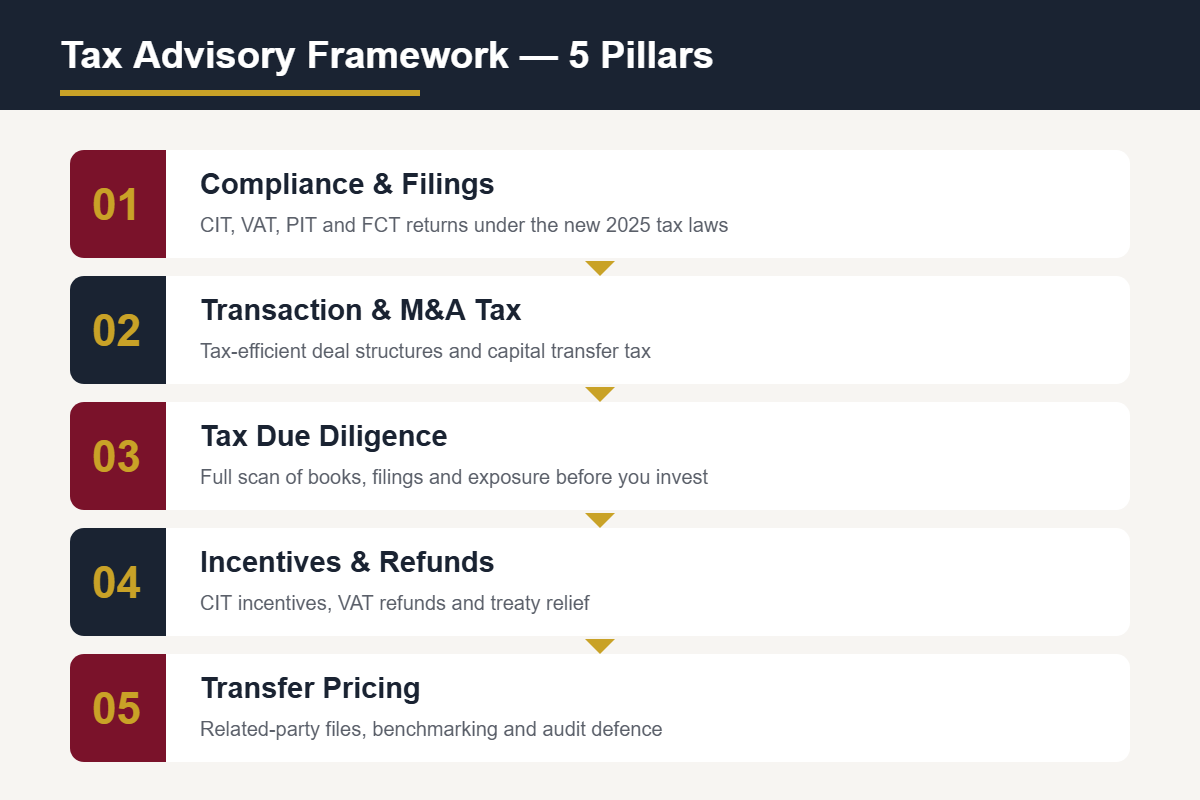
With deep understanding of the Vietnamese tax legal system, IVLF provides consulting service packages that are tailor-made for each specific business.
Strategic tax advisory in M&A and restructuring
M&A is the most tax-sensitive activity. We accompany clients to:
- Design transaction structures: select the method of merger, share acquisition, or asset acquisition to achieve the most optimal tax efficiency.
- Advise on tax incentives: maximize the use of investment tax incentives, industry-based, or economic zone-based incentives to reduce the tax burden for the business post-merger.
- Negotiate tax clauses: design clauses regarding indemnities related to potential tax liabilities in M&A contracts.
Tax due diligence services
Before deciding to invest in a project or business, conducting tax due diligence is a vital step:
- We conduct a comprehensive review of all accounting books, tax declarations, and past working minutes with tax authorities of the target business.
- Detect potential tax debts, contractor tax advisory risks, or points of non-compliance in determining revenue and expenses.
- Provide remediation solutions before the deal closes, helping clients avoid inheriting the seller’s tax liabilities.
Optimal legal tax obligation advisory
IVLF does not just help clients do it right; we help clients do it smarter:
- Advise on structuring operating costs, payroll costs, and R&D costs to maximize deductible expenses when determining CIT.
- Support tax refunds, exemptions, and reductions based on international commitments and Vietnamese law.
- Advise on transfer pricing risk management for businesses with related-party transactions with parent groups abroad.
“A smart tax governance system is not just about compliance, but about wisely leveraging legal loopholes to maximize shareholder profits.”
Why businesses need a tax advisory partner
Many businesses often make the mistake of filing tax returns based on general accounting experience without the counter-argument of a tax lawyer. In reality, when working with local tax authorities, working minutes often require extremely strict explanations regarding the validity of invoices and vouchers. The presence of an IVLF tax lawyer helps businesses:
- Prepare legal arguments: we build explanatory dossiers and debate with tax inspection and examination teams to defend the business’s viewpoint against unreasonable tax arrears conclusions.
- Peace of mind in operations: when tax issues are controlled by IVLF, the Board of Management can dedicate all their mental energy to growth targets instead of worrying about surprise inspections.
Professional tax advisory process at IVLF
To bring optimal efficiency, IVLF applies a closed four-step process:
Reception & Risk Assessment
Understand the business scale, characteristics, and conduct a general review of current tax reports.
Strategy Proposal
Develop a plan to optimize tax obligations or tax structures for M&A/restructuring deals.
Implementation
Directly draft dossiers, support filing, or participate in working and explaining to tax authorities on behalf of the business.
Monitoring & Updating
Monitor changes in tax law and update policies for businesses periodically.
Frequently asked questions
When does a business need to hire a tax consultant?
You should hire an expert as soon as you plan M&A deals, organizational restructuring, or when entering new fields with complex tax policies. Hiring a consultant from the start helps businesses avoid basic mistakes that are hard to fix later.
Does corporate restructuring increase tax obligations?
Corporate restructuring can trigger tax obligations if not performed according to the correct process — for example, transferring shares in a subsidiary can trigger corporate income tax on capital transfer. However, if executed according to a legal merger or consolidation plan, businesses may enjoy tax deferral or exemption policies. IVLF will calculate this for you.
How long does a tax audit take?
Typically, a tax audit lasts from 7 to 45 days depending on the business scale and the number of tax periods to be audited. IVLF will represent the business in working with the audit team to accelerate progress and ensure the most accurate, objective audit conclusion.
Vietnam tax law updates 2025–2026
Our advice is always aligned with the latest legislation. Key recent changes include:
- New Corporate Income Tax Law No. 67/2025/QH15 (effective 1 October 2025, applying from tax year 2025): preferential 15%–17% CIT rates for qualifying SMEs, revised rules on deductible expenses and loss offsetting, and taxation of foreign e-commerce and digital platform businesses, now recognised as creating a permanent establishment in Vietnam.
- New VAT Law No. 48/2024/QH15 (effective 1 July 2025): revised taxable price rules, input credit conditions and refund procedures.
- Global Minimum Tax (OECD Pillar Two): Resolution No. 107/2023/QH15 and Decree No. 236/2025/ND-CP apply the QDMTT and IIR to multinational groups with consolidated revenue of EUR 750 million or more, with CbCR safe harbours for transitional years.
- Business licence fee abolished from 1 January 2026 under Resolution No. 198/2025/QH15 — no more annual declarations or payments.
- Restructured tax administration: following the 2025 consolidation into 34 provinces and two-tier local government, tax authorities have been reorganised — filings, audits and rulings now follow the new provincial structure.
More frequently asked questions
Do foreign-invested companies pay different taxes in Vietnam?
No — the same CIT, VAT and PIT framework applies, but FIEs face extra attention on transfer pricing, foreign contractor tax and capital transfer tax. Qualifying SMEs enjoy 15%–17% CIT rates under the new 2025 CIT Law.
When is tax due diligence worth doing?
Before any share or capital acquisition. Hidden tax debts transfer with the target company — a due diligence scan is far cheaper than inheriting a reassessment.
Can you work with our accountants?
Yes. We complement in-house or outsourced accountants by handling structuring, rulings, audits and disputes — the areas where legal analysis drives the outcome.
Related Practice Areas

Let IVLF become the strategic partner protecting the safety and maximizing the profits of your business.
EXPLORE MORE
Related to This Practice
Tax guides from our team
- Corporate income tax compliance in Vietnam
- Transfer pricing documentation: Local File, Master File, CbCR
- Lawful transfer pricing structures in Vietnam
- Corporate income tax law 2025: key changes
- Tax consulting in Vietnam: the 4 services compared
- IFC tax incentives: planning questions
- Zone tax incentives and how to protect them