


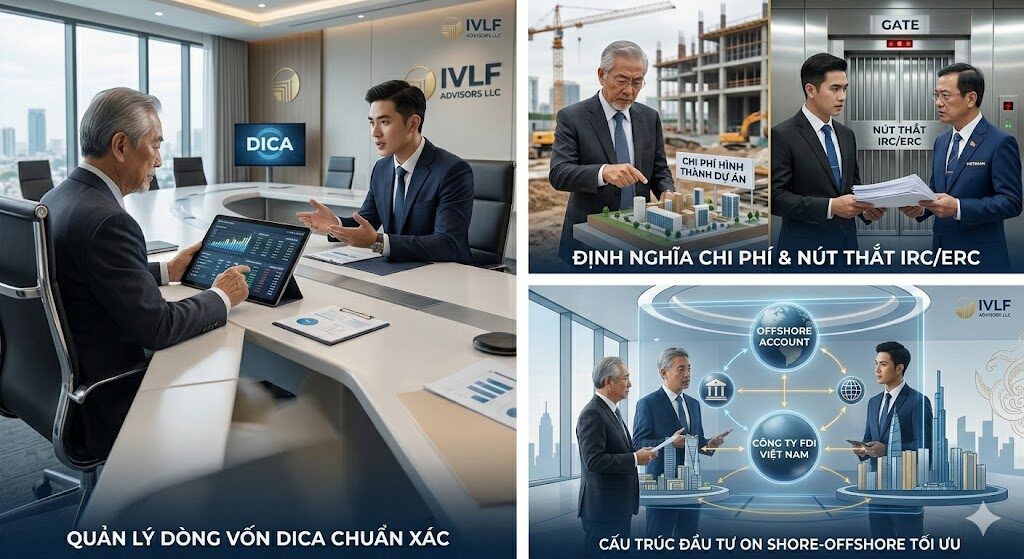
In the structure of Foreign Direct Investment (FDI) inflows into Vietnam, the pre-incorporation phase is invariably the most sensitive and complex period. Currently, the State Bank of Vietnam (SBV) is seeking public comments on the Draft Circular intended to replace Circular No. 06/2019/TT-NHNN, an initiative that has garnered significant attention from legal and financial experts.
Despite expectations to streamline administrative procedures, the new Draft leaves a substantial technical “gray area” surrounding the definition and operational mechanism of project formation costs. This very bottleneck could potentially freeze the pre-investment cash flows of international corporations.
Below is an in-depth analysis and perspective from IVLF Advisors LLC on the critical challenges associated with these specific costs.

1. What is the Legal Nature of “Project Formation Costs”?
Although the term project formation costs (or pre-investment expenses) appears frequently in the SBV’s foreign exchange management regulations and tax finalization guidelines, there is currently no synchronized, consistent legal definition within higher-level legislation, such as the Law on Investment or the Law on Enterprises.
This lack of clarity creates a massive gap between statutory regulations and accounting realities:
-
Confusion Among Commercial Banks: When a foreign-invested enterprise (FIE) or an investor transfers funds into Vietnam, credit institutions lack a clear statutory basis to approve whether a specific disbursement legitimately qualifies under the category of project formation costs.
-
Corporate Income Tax (CIT) Risks: If an expense is not precisely defined, tax authorities may refuse to recognize it as a deductible expense for the legal entity post-incorporation, or reject the conversion of such expenses into charter capital (equity conversion).
IVLF Advisors LLC recommends: The new Draft Circular should establish a specific definition or a comprehensive “white-list” of approved expense categories recognized as project formation costs to serve as a framework for uniform enforcement.

2. Inflow and Outflow Bottlenecks on DICA for Project Formation Costs
Under Vietnamese law, it is the Foreign-Invested Enterprise (FIE) in Vietnam that opens and operates the Direct Investment Capital Account (DICA), not the foreign investor (except in cases executed under a Business Cooperation Contract – BCC). The DICA serves as the exclusive channel for managing all inbound and outbound capital flows.
However, during the transitional phase—where the FIE has been incorporated (possessing an ERC and a DICA) but the new project is still undergoing the application process for an Investment Registration Certificate (IRC)—the mechanism governing inflows and outflows for project formation costs faces a severe deadlock:
-
Inflow Restraints: The Draft needs to clarify whether the DICA will restrict or prohibit the receipt of pre-investment capital contributions from both foreign and Vietnamese investors (in joint-venture projects) intended to cover initial project formation costs. If inbound mechanisms are tightened, FIEs will lose synthesized financial resources from local partners.
-
Outflow Bottleneck: The Draft has yet to create a seamless corridor allowing FIEs to convert foreign currency from the DICA into Vietnamese Dong (VND) checking accounts to settle essential project formation costs prior to the issuance of the IRC.
3. Staff Salaries, Taxes, and Office Rentals: Do They Qualify as Project Formation Costs?
This is a practical technical question that IVLF Advisors LLC regularly receives from international CFOs and investors. To launch a project in Vietnam, an FIE inevitably incurs three major expenses: salaries for the initial core personnel, office/site rental fees, and related tax/fee obligations.
-
If recognized as project formation costs: The FIE is fully entitled to utilize foreign currency transferred by investors into the DICA, execute foreign exchange sell orders into a VND checking account, and legally disburse the funds under banking supervision.
-
If rejected: The disbursement channel via the DICA will be obstructed. Commercial banks will refuse to process the documentation due to non-compliance with capital usage purposes prior to obtaining the IRC. Consequently, enterprises will be forced to seek informal cash flow alternatives, triggering immense risks regarding auditing and legal compliance.
4. Handling Pre-ERC Security Deposits via Offshore Accounts
Another practical challenge tightly bound to project formation costs involves security deposits for office or land leases. To submit applications for an IRC and ERC, investors must prove their lawful right to use a location through a lease contract or an agreement in principle. To secure these documents, foreign investors are required to pay a deposit to the lessor in Vietnam.
However, at this juncture, the FIE has not yet been established, meaning the DICA does not yet exist (banks only permit the opening of a DICA after the ERC is granted).
Under the current Circular 06/2019/TT-NHNN, foreign investors are permitted to remit funds directly from their offshore accounts to the Vietnamese lessor’s checking account to cover this specific type of project formation costs.
A major concern raised by IVLF Advisors LLC is whether the new Draft Circular will continue to uphold and inherit this offshore remittance mechanism. If the Draft restricts or abolishes it without an alternative solution (such as a temporary USD checking account for foreign investors), the entire process of securing locations for new FDI projects will be paralyzed from the very first step.
5. Key Recommendations from IVLF Advisors LLC
Although project formation costs are incurred within a relatively short timeframe, they form the bedrock that determines the ultimate success and compliance of an FDI project in Vietnam.
IVLF Advisors LLC expects the final official Circular of the State Bank of Vietnam to resolve this bottleneck by:
-
Providing a clear, synchronized definition of the structural items that constitute project formation costs.
-
Allowing and offering explicit guidance on the process of converting foreign currency from the DICA to VND checking accounts to fund pre-IRC operational expenses.
-
Inheriting the mechanism that permits the direct payment of project formation costs (security deposits) from the foreign investor’s offshore account prior to the incorporation of the legal entity.
Optimizing and bringing transparency to this cash flow will be a significant advantage, helping Vietnam maintain its position as a safe, attractive, and streamlined investment destination for global capital. It will serve as a powerful signal affirming Vietnam’s commitment to fostering a favorable business environment that aligns closely with international standards.

6. ABOUT IVLF ADVISORS LLC
IVLF Advisors LLC is a specialized boutique advisory firm based in Hanoi, focusing on: Project Investment, Foreign Investment, International Investment, Project Finance, M&A, Capital Markets, and Financial Restructuring. With a team of experts possessing a profound understanding of foreign exchange management practices and cross-border transactions, we are dedicated to delivering the most optimal and secure capital structuring solutions for our Clients.
-
Website: www.ivlf-advisors.com
-
Email: nghia@ivlf-advisors.com
Disclaimer: This article is prepared by the expert team of IVLF Advisors LLC for informational and academic analysis purposes only. It does not constitute formal legal advice for any specific case. Readers are advised to consult with legal professionals before entering into any related transactions.