
Legal advisory for labor matters is one of the most frequent needs for foreign employers in Vietnam, from drafting compliant employment contracts to defending against labor disputes.
Our legal advisory for labor and HR practice covers the full employment lifecycle, and clients rely on this legal advisory for labor service whenever internal regulations or restructuring plans need a compliance review.
Labor & HR Legal Advisory
In the modern business environment, human resource management is not only an economic challenge but also a complex legal one. For a business to develop sustainably, it requires a solid legal foundation to manage human resources, from recruitment and contract signing to procedures related to foreign labor. Our labor and HR legal advisory practice keeps employers compliant and disputes rare.

Why is labor management the backbone of a business?
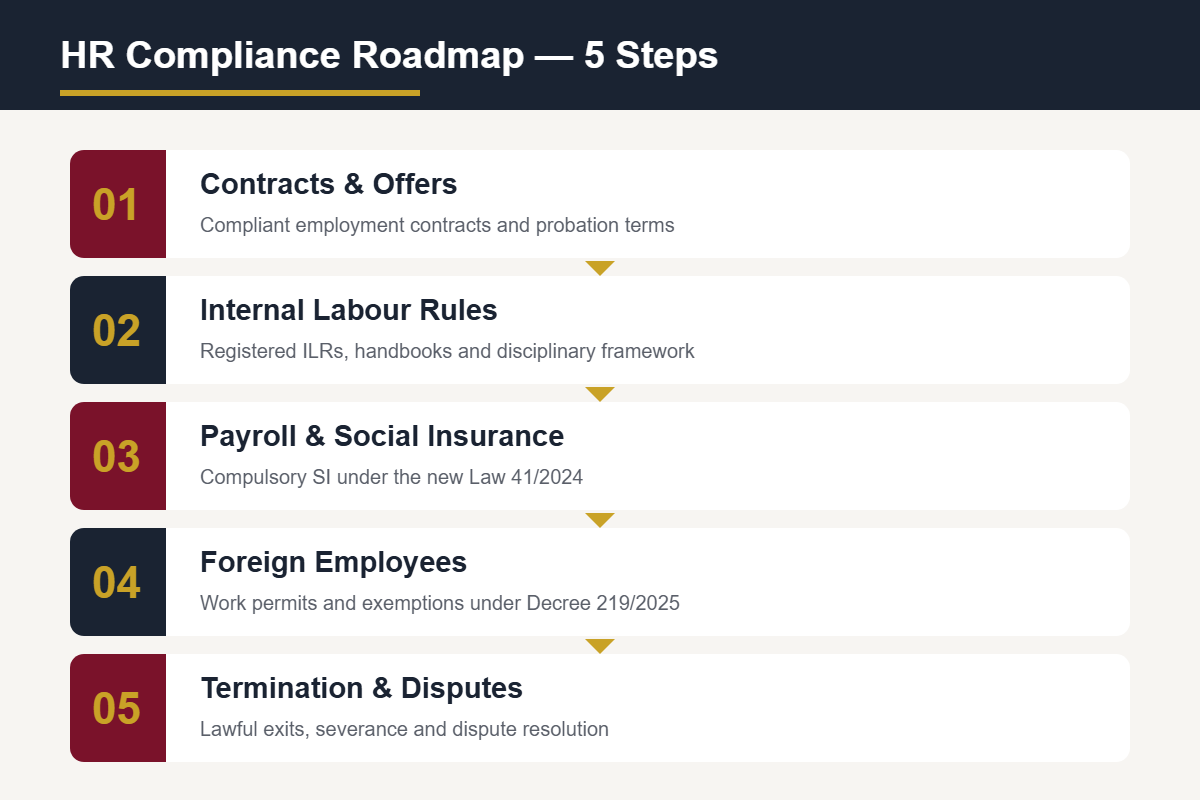
Comprehensive labor and HR legal advisory solutions
Contracts and internal policies
- Labor contracts: robust templates that protect the interests of the business while ensuring full compliance, with emphasis on Non-Disclosure Agreements (NDA) and Non-Compete Agreements (NCA)
- Internal policy system: building, reviewing, and registering Internal Labor Regulations, Collective Labor Agreements, and internal regulations on salaries, bonuses, and allowances
Immigration services for foreigners (Visa, Work Permit, TRC)
- Work Permit: advising on the demand explanation for foreign labor, completing dossiers, and representing the business in new issuance and renewals
- Temporary Residence Card (TRC): long-term TRCs for experts and their dependents
- Vietnam Visa: entry dispatch, business visas, and investment visas with optimized waiting time
Labor dispute resolution and disciplinary handling
- Legally compliant procedures for disciplinary dismissal, ensuring businesses are not countersued due to procedural errors
- Representation before competent authorities or Courts in complex labor dispute cases
What ongoing legal advisory support includes
Most employers retain IVLF for monthly legal advisory support rather than one-off questions. The package covers employment contract templates in bilingual form, internal labor regulations registered with the authorities, disciplinary procedures that will survive challenge, and a hotline for the daily questions HR teams actually face – probation, overtime caps, allowances, reorganisations and terminations. For companies employing foreigners, the legal advisory team manages work permits, visa compliance and the exemption categories under Decree 219/2025, keeping every expatriate file audit-ready. When restructurings or collective disputes arise, the same lawyers who built your framework handle the negotiation, which shortens response times and keeps positions consistent. This continuity is the core value of a standing legal advisory relationship: your documents, practice and defence all come from one place.The IVLF advantage
- Proactive prevention: reviewing and cleaning legal risks within governance systems in advance
- Solving difficult dossiers: Work Permit and TRC dossiers involving missing degrees, mismatched experience, or complex explanation procedures
- Practical understanding of the working methods of local labor management agencies

Common employer questions we resolve
Can we extend probation twice? How do we lawfully restructure a department without triggering severance disputes? Which allowances must be included in the salary base for social insurance? When does a foreign employee qualify for a work permit exemption, and what happens if the permit lapses mid-contract? These are the questions our legal advisory hotline answers every week, in writing, with the legal basis cited so HR can file the answer and rely on it later. We also run annual labor compliance audits. The legal advisory team reviews contracts, payroll practice, social insurance declarations, overtime records and disciplinary files against current regulations, then delivers a red-amber-green report with fixes ranked by exposure. Employers use the audit before fundraising rounds, before M&A due diligence, and simply to sleep better. Most issues we find cost little to fix when caught early – and a great deal when discovered by an inspector or an opposing lawyer instead.Transparent and speedy processing procedure
Reception & Assessment
Lawyers receive the dossier and advise on the most feasible plan.Drafting & Finalization
Support drafting, translation, and consular legalization of necessary documents.In-depth Execution
Representing the client before the Department of Labor, Invalids and Social Affairs, and the Immigration Department.Handover & Support
Continuous progress updates and handover of results on schedule.Legal advisory updates: labour law 2025–2026 for employers
- Foreign employees – Decree No. 219/2025/ND-CP (effective August 2025) replaces Decrees 152/2020 and 70/2023: labour-demand approval and the work permit are merged into a single procedure of about 10 working days; experts need a bachelor’s degree plus 2 years’ experience (1 year in priority sectors); 15 exemption categories apply
- Social insurance – Law No. 41/2024/QH15 (effective 1 July 2025): expanded compulsory coverage, new rules on one-off withdrawals and a reduced minimum contribution period of 15 years for pension eligibility
- Trade unions: the amended Law on Trade Unions 2024 (effective 1 July 2025) allows foreign workers to join trade unions and confirms the 2% employer union levy
- Restructured administration: work permits and labour registrations are now handled at provincial level under the two-tier local government model (34 provinces)
Frequently asked questions
Is an internal labour regulation (ILR) mandatory?
Employers with 10 or more employees must issue and register an ILR. Without it, disciplinary action and dismissal are legally fragile.How long does a work permit take in 2026?
About 10 working days under the single-step procedure of Decree 219/2025, provided documents are complete.Can we dismiss an employee for poor performance?
Only with documented evaluation criteria in registered internal rules and a correct procedure. We design the framework and manage the process to minimise dispute risk.
Related to This Practice
Foreign employers often ask us to review their labor documentation before an inspection. This legal advisory for labor review typically covers internal labor regulations, collective agreements and termination procedures, giving management a clear compliance picture before regulators raise questions.
When disputes arise, our legal advisory for labor team represents employers before labor conciliation councils and courts, drawing on the same playbook used in our legal advisory for labor compliance reviews so litigation strategy and day-to-day HR policy stay aligned.